题目内容
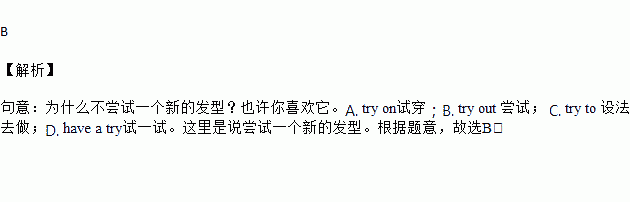
Why not ________ a new hairstyle?Maybe you like it.
A. try on B. try out C. try to D. have a try
—Would you please help me ________,Wang Lei? I can't work out the problem.
—OK.Let me try.
A. out B. up C. with D. after
When the child saw his uncle,he ran up ____ hello to him.
A. say B. said C. says D. to say
—What is she doing? —She is ________ Jim.
A. calling up B. call C. callings D. call up
—Where is your brother? —He ________ in the school library.
A. sits B. sat C. will D. is sitting
—I didn't hear you come in just now.
— That's good.We tried ________ any noise,for you were sleeping.
A. not make B. not to make C. to make D. making
VI.根据汉语意思完成句子。
1.他们叫你帮忙做什么?
What did they ask you to___________________?
2.本在每学期开始时都会制定一些计划。
Ben ___________________ at the beginning of every term.
3.她曾是个护士。
She ________________ a nurse.
4.圣诞节离现在只有一周的时间了。
Christmas Day is only a week _____________.
5.让我们号召一些朋友参加比赛吧!
Let's ____________ some friends to take part in the game!
My mother always tells me ________ out alone at night.
A. go B. not go C. not to go D. don't go
I was 9 years old when I found out my father was ill. It was 1994.but I can remember my mother's words as if it were yesterday. "Kerrel, I don't want you to take food from your father, because he has AIDS. Be very careful when you are around him."
AIDS wasn't something we talked about in my country when I was growing up. From then on, I knew that this would be a family secret. My parents were not together any more and my dad lived alone. For a while, he could take care of himself. But when I was 12, his condition worsened. My father's other children lived far away, so it fell to me to look after him.
We couldn't afford all the necessary medicine for him because Dad was unable to work. I had no money for school supplies and often couldn't even buy food for dinner. I would sit in class feeling completely lost, the teacher's words muffled as I tried to figure out how I was going to manage__
I did not share my burden with anyone. I had seen people react to AIDS. Kids laughed at classmates who had parents with the disease. And even adults could be cruel. When my father was moved to the hospital, the nurses would leave his food on the bedside even though he was too weak to feed himself.
I had known that he was going to die, but after so many years of keeping his condition a secret, I was completely unprepared when he reached his final days. Sad and hopeless, I called a woman at the nonprofit National AIDS Support. That day, she kept me on the phone for hours. I was so lucky to find someone who cared. She saved my life .
I was 15 when my father died. He took his secret away with him, having never spoken about AIDS to anyone. Even me, he didn't want to call attention to AIDS.
1.What does Kerrel tell us about her father?
A. He had stayed in the hospital since he fell ill B. He depended on the nurses in his final days.
C. He worked hard to pay for his medication. D. He told no one about his disease.
2.What can we learn from the underlined sentence?
A. Kerrel couldn't understand her teacher. B. Kerrel had special difficulty in hearing.
C. Kerrel was too troubled to focus on the lesson. D. Kerrel was too tired to hear her teacher's words.
3.Why did Kerrel keep her father's disease a secret?
A. She was afraid of being looked down upon. B. She thought it was shameful to have AIDS.
C. She found no one willing to listen to her. D. She wanted to obey her mother.
4.Why did Kerrel write the passage?
A. To tell people about the sufferings of her father. B. To show how little people knew about AIDS.
C. To draw people's attention to AIDS. D. To remember her father.