题目内容
口语运用。(共5分,每小题1分)
选择句子,补全对话,其中有两项是多余的。
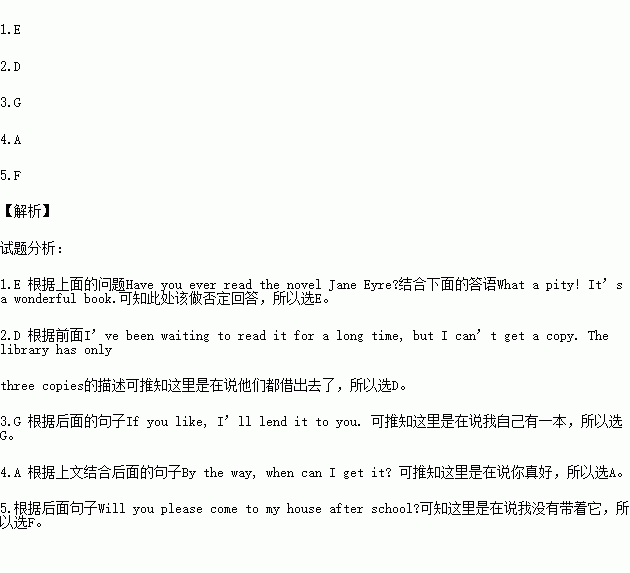
A: Have you ever read the novel Jane Eyre?
B: 1.
A: What a pity! It’s a wonderful book.
B: Well, I’ve been waiting to read it for a long time, but I can’t get a copy. The library has only three copies. 2.
A: Well, 3. If you like, I’ll lend it to you.
B: Thank you. 4. By the way, when can I get it?
A: 5. Will you please come to my house after school?
B: OK. I’ll go as soon as school is over.
A.That’s very kind of you. B.I forgot where I had put it. C.You really should read it. D.But they are all out. E.I’m afraid I haven’t. F.I haven’t had it with me. G.I have a copy of my own. |

写作(计20分)
中学生普遍面临着很多烦恼,请用英语描述下面表格中列出的问题,并提出自己的建议。
烦恼1 | 整天有做不完的作业,经常熬夜学习,无暇顾及个人爱好; |
烦恼2 | 父母太忙,没有时间陪自己; |
烦恼3 | 几乎没有亲密的朋友可以交流,经常感到孤独; |
烦恼4 | 对自己的体重不满意,不知如何改变; |
建议 | … … |
要求:1、条理清楚,语句通顺;
2、80词左右。开头已给出,不计入总词数。
Now, many middle school students face some problems.
任务型阅读 阅读下面的短文,根据短文内容完成表格中所缺信息,在答题卷上相应的横线上填写答案,每空限填一词。(本大题共5分,每小题0.5分)
It seems school children all over the world don’t like their school food. So what do students of your age eat for lunch at school?
Japan
High schools have dining rooms, which serve everything from noodles to rice, but not hamburgers and chips. Other children bring food from home such as cold rice balls, meat of fish and vegetables. Students take home a menu for the coming month with notes on nutrition value(营养价值). The class with the fewest leftovers(剩饭) at the end of the month receives a prize.
United States
A menu from a US school is made up of a hamburger with potatoes or chicken, fruit and cookies. School lunches must also provide at least one-third of the daily vitamin(维生素) A, vitamin C, iron(铁), calcium(钙) and calories(卡路里).
Australia
Hot dogs are traditional dishes in Australia school shops. But as the country pays more attention to children’s health, healthier foods have started to find their way onto school menus.
Many schools have used a traffic light system(系统). The sale of red-labelled foods, including chocolate and soft drinks, is served only twice a week. Healthier green-labelled foods such as sandwiches, corn and watermelon, however, are provided every day.
South Africa
Most of South Africa’s schools do not provide meals at all. Classes end at 1:30 p.m. and students get their own lunches. Many students bring food from home, usually sandwiches.
Fast food sells the best among students. But as more people began to realize the fact that being too fat may cause different illness, some schools in towns have led the way towards better nutrition. Now students at these schools are provided with lunches of porridge(粥) with vegetables, such as potatoes, carrots and tomatoes
Schools serve different foods in different 1. . | |
Japan | In high schools, children can buy everything such as noodles and rice. But they can’t buy hamburgers and 2. from dining rooms. Some children 3. food from their homes. The class will get a prize if they have the 4. leftovers in a 5. . |
The USA | Children can get one-third of daily nutrition from their 6. at school. |
7. | School shops 8. students with traditional dishes. The sale of green-labelled foods is served every day, 9. red-labelled foods are sold twice a week. |
South Africa | Students like eating fast food so that they are overweight. Students in some schools in towns can eat vegetables to 10. fit. |