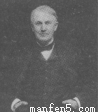
Thomas Edison lit up the world with his invention of the electric light. Without him, the world might still be in the dark at night. However, the electric light was not his only invention. He also invented 1,200 other important things. Nearly every two weeks, he created something new.

Thomas Edison was born in 1847. He attended school for only three months. His mother taught him at home, but he was mostly self-educated. He started trying but his new ideas at a very young age and he loved that very much.

When he was 12 years old, he got his first job. He became a newsboy on a train. He did experiments on the train in his spare time. Unluckily, his first working experience didn’t end well. He was fired (解雇) when he accidentally (偶然地) set fire to the floor of the train. Then Edison worked as a telegraph operator (电报员) for five years, but he continued to spend much of his time creating things until the vote recorder (投票计数器), his first invention, came in 1868.

Thomas Edison was nearly deaf in one ear and it was also hard for him to hear in the other, but he never minded. Because of this, he could have more time for work. He always worked 16 out of every 24 hours. Sometimes his wife had to remind him to eat and sleep.

Thomas Edison died at the age of 84. He left many inventions that greatly improved the quality of life all over the world.

1.How old was Edison when he had his first invention?

A. 12. B. 17.

C. 19. D. 21.

2.How do you feel about Thomas Edison?

A. He was serious.

B. He was humorous.

C. He was lucky.

D. He was hard-working.

3.Which of the following is NOT true?

A. Edison showed great interest in creating something new at an early age.

B. Edison once worked as a great worker in a newspaper company.

C. There was something wrong with Edison’s ears.

D. Edison often forgot to eat and sleep when he was working.

4.Which is the best title for the passage?

A. Edison’s life.

B. Edison’s inventions.

C. Edison’s education.

D. Edison’s mother.

In 2004,18-year-old Nadal helped Spain win the Davis Cup by defeating (击败) Andy Roddick, who was the second-best American player in the world at the time. This made Nadal the youngest player to win a match for a victorious country in the Davis Cup.

Professional(职业的) tennis is played on courts made of three different materials:clay, glass and hard court. The different surfaces have a significant effect on the game, so much so that for many years few players mastered tennis on all three surfaces. Nadal was called“The king of Clay”because he was so dominant(占优势的) on clay courts. But now he is one of several players to win grand slam titles on all three surfaces.

In 2016, Nadal founded a tennis academy in his hometown,Manacor, Spain. His goal was to combine tennis instruction and education so that young athletes would not need to neglect their education. He intends to live in the area long-term and remain involved with it.

Perhaps Rafael Nadal's incredible career will continue,and he will also make great efforts in passing on his skills and techniques to new prospective athletes.

1.Where is Rafael Nadal from?

A. England B. American C. Spain D. France

2.Which of the following is correct according to the passage?

A. Nadal became the youngest player to win a match the Davis Cup in 2013.

B. A few players mastered tennis on all three surfaces.

C. Nadal was best at playing on clay court.

D. He is the only one to win grand slam titles on all three surfaces.

3.What can we guess from this passage?

A. Rafael Nadal has never founded tennis academies in his hometown.

B. Rafael Nadal decided to live abroad

C. Rafael Nadal is not going to play tennis.

D. Rafael Nadal will work hard to teach young athletes tennis skills.

In the 6th century BC, there was a war between the Romans and the Etruscans(伊特拉斯坎人) who lived north of Rome. The Etruscans raised a great army and marched toward Rome. At that time, Rome was just a small town, and the Romans did not have enough fighting men to protect their people.

One morning, thousands of Etruscan horsemen and footmen were seen marching straight toward the wooden bridge over the Tiber River. Rome was in immediate danger!

Among the guards at the bridge was a brave man named Horatius. He ordered the soldiers to cut down the bridge. At the same time, he took two soldiers with him to the far side of it. There, the three brave men kept the enemy from taking the bridge.

The soldiers tried to destroy the bridge as quickly as they could, and soon it was ready to fall. Some of them ran across to call the three men back.

Horatius yelled at the two others to cross first. At that moment the bridge fell with a great crash. Horatius fought the Etruscans by himself, and a dart(标枪) entered his left eye. In great pain, he turned and jumped into the river.

Horatius sank into the deep water but soon came out of the water, halfway across the river. He was greeted with shouts of joy, for he had saved the town. He gained a new name, Horatius Cocles, meaning the "one-eyed Horatius" and is remembered as one of Rome’s greatest heroes.

1.From the first paragraph we learn that Rome ________.

A. did not have many brave soldiers

B. was not large and strong then

C. was under the control of the Etruscans

D. had sent most of its army away.

2.To save the city of Rome, Horatius planned________.

A. To burn the road to Rome.

B. To drive the enemy into the river.

C. To cut down the bridge.

D. To kill the enemy horsemen first.

3.After the two soldiers came back,________.

A. The bridge fell into the water.

B. Horatius was killed by a horseman.

C. The Etruscans won the battle.

D. Horatius defeated the Etruscans by himself.

4.Horatius was renamed "Horatius Cocles" because ________.

A. he was the wisest man in Rome

B. he had saved the town of Rome

C. he had shown great courage against the enemy

D. his left eye had been hurt in the battle

5.Which of the following words could NOT necessarily be used to describe Horatius?

A. Fearless. B. Honest. C. Selfless. D. Bright.

违法和不良信息举报电话:027-86699610 举报邮箱:58377363@163.com

精英家教网