题目内容
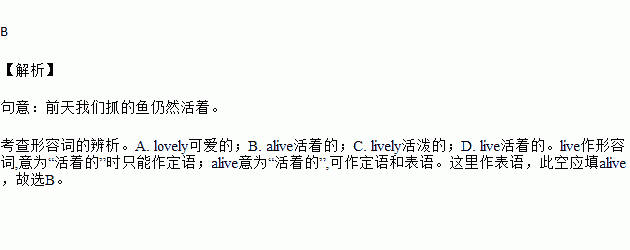
The fish we caught the day before yesterday is still .
A.lovely B.alive C.lively D.live
Electrical appliances make it _______ for us to do the housework.
A.easy B.difficult C.easily D.difficulty
I sometimes help my mother with the housework ______ Saturdays.
A.at B.on C.in D.for
语法填空
阅读下面短文,按照句子结构的语法性和上下文连贯的要求,在空白处填入一个适当的词或使用括号中词语的正确形式填空。
Nancy went to China on vacation with 1.(she)parents.They visited a lot of famous 2.(city),such as Beijing,Guangzhou and Shanghai.She stayed in Beijing for 3. week.She 4.(visit)the Palace Museum,the Great Wall,Tian'anmen Square and the Summer Palace.They also 5.(go)to the zoos and the parks.It was cloudy 6. not rainy,so 7. was not too hot.They 8.(have)a great time in China.Nancy learnt a lot 9. Chinese history.She said,“It is 10.(interest)to visit China.I love China very much.”
The _____ in Britain is very different from our Chinese food. For example, they eat a lot of potatoes. They like to eat _____ every day. They eat bread _____ breakfast and usually for other meals. They eat their bread with butter, cheese or jam, which we don’t eat much in _____. Cheese and butter are made from (由……制成) _____ .They drink a lot of milk, too. They drink the milk cold or _____, and they put it in their tea. They put sugar in their _____ as well. They are the world’s biggest tea ______. They don’t eat much rice. For their main meal they like meat or fish with _____ and vegetables. They serve all these together. After the main meal they always have ______ sweet. They call this dessert (甜点).
1.A.apples B.tea C.food D.fruit
2.A.it B.them C.him D.they
3.A.to B.with C.on D.for
4.A.Britain B.China C.Chinese D.England
5.A.milk B.cow C.meat D.bread
6.A.hot B.many C.much D.some
7.A.milk B.tea C.coffee D.meat
8.A.makers B.buyers C.drinkers D.sellers
9.A.tomatoes B.bananas C.pears D.potatoes
10.A.something B.anything C.everything D.nothing
What do you think say?
A.I should B.should I C.I should to D.should I to
Answer the questions(根据短文内容回答下列问题)
Most of us have never thought about building an educational toy by ourselves. If we need a learning toy or something, we simply go to the nearest store and buy it. However, things are not as easy in third world countries. With families even having no food to put on the table, buying toys, especially the educational ones, is the last thing on the parents’ minds.
So how can one get these kids interested in science? This was a question that worried the Indian engineer. Arvind Gupta so much that he decided to give up a good job and spend his life making toys from trash, things that people no longer want or need! Mr Gupta began teaching in the 1970s. While still an engineering student at the Indian College of Technology, he volunteered to teach the children who could not afford to go to school. Upon graduation, he found a good job at India’s Tata Motors and spent the next five years designing cars.
But he soon realized that this was not something he wanted to do for the rest of his life. So he took a year’s training course and took part in the Hoshangabad Science Teaching Program whose aim was to make science fun and exciting for poor children using available materials.
Mr Gupta found the whole project so satisfying that he decided to leave his high paying job and focus his attention on designing educational toys that were not only cheap and easy to build, but also full of scientific principles(原理), so that children could get interested in this interesting subject.
When the Internet started becoming a more widespread learning tool, Mr Gupta created a toys from Trash website and also recorded over 250 YouTube videos.
Today, over 50,000 children and teachers visit the website daily to download the videos for the toy creations based on cool science. Some young children have become so inspired(鼓舞) that they have even won international science competitions with the help of his creations.
1.What are these educational toys made from?
___________________________________________________________
2.Did Arvind Gupta start building educational toys as soon as he graduated from the college?
_______________________________________________________________
3.Who did Mr Gupta build these educational toys for?
_________________________________________________________
4.How are the educational toys designed by Mr. Gupta?
__________________________________________________________________________
5.What did Mr Gupta do to introduce his educational toys?
_______________________________________________________________________
6.How can these educational toys help the children in third world countries?
_________________________________________________________________
Is a human brain a __________ powerful calculator __________ a computer?
A.much; as B.more; a C.much; than D.more; than
—What's your QQ number? —_________is 345667596.
A.He B.I C.It D.She

 名师点拨卷系列答案名师点拨卷系列答案