ÌâÄ¿ÄÚÈÝ

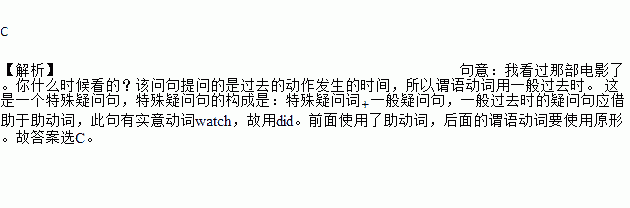
¡ªI have watched the game£® ¡ªWhen ____ you _______ it£¿

A. have£»watched B. do£»watch C. did£»watch D. will£»watch

C ¡¾½âÎö¡¿¾äÒ⣺ÎÒ¿´¹ýÄDz¿µçÓ°ÁË¡£Äãʲôʱºò¿´µÄ£¿¸ÃÎʾäÌáÎʵÄÊǹýÈ¥µÄ¶¯×÷·¢ÉúµÄʱ¼ä£¬ËùÒÔνÓﶯ´ÊÓÃÒ»°ã¹ýȥʱ¡£ ÕâÊÇÒ»¸öÌØÊâÒÉÎÊ¾ä£¬ÌØÊâÒÉÎʾäµÄ¹¹³ÉÊÇ£ºÌØÊâÒÉÎÊ´Ê+Ò»°ãÒÉÎʾ䣬һ°ã¹ýȥʱµÄÒÉÎʾäÓ¦½èÖúÓÚÖú¶¯´Ê£¬´Ë¾äÓÐʵÒ⶯´Êwatch£¬¹ÊÓÃdid¡£Ç°ÃæÊ¹ÓÃÁËÖú¶¯´Ê£¬ºóÃæµÄνÓﶯ´ÊҪʹÓÃÔ­ÐΡ£¹Ê´ð°¸Ñ¡C¡£
Á·Ï°²áϵÁдð°¸
Ïà¹ØÌâÄ¿

One day, there was a blind man called John sitting on the bench with a hat by his feet and a sign that read: ¡°I am blind. Please help me.¡±

A creative publicist£¨¹ã¸æÔ±£© named Tom was walking by the blind man and stopped to see that the man only had a few coins in his hat. He put a few of his own coins in the hat. Without asking for permission, he took the sign, turned it around and wrote a new message. Then he put the sign by the feet of the blind man, and left.

Later that afternoon the publicist returned to the blind man and noticed that his hat was almost full of bills and coins. The blind man recognised£¨Ê¶±ð£© his footsteps and asked if it was he who had changed his sign. He also wanted to know what the man wrote on it.

The publicist said, ¡°I just wrote the message a little differently.¡± He smiled and went on his way.

The new sign read: ¡°Spring has come, but I can¡¯t see anything.¡±

1.What¡¯s the blind man¡¯s name?

A. Tom. B. John. C. Tony. D. Sorry, I don¡¯t know.

2.Who wrote a new message?

A. The blind man. B. The teacher. C. The publicist. D. The farmer.

3.How did the blind man recognise the publicist?

A. By his sign. B. By his footsteps. C. By his voice. D. By his coins.

4.When did the story happen?

A. In spring. B. In summer. C. In autumn. D. In winter.

5.What can we learn from the passage?

A. Publicists are always friendly and helpful.

B. We can get more money by chang-ing a sign.

C. The blind man was very stupid, so he had little money.

D. The power£¨Á¦Á¿£© of language is great.

1.B 2.C 3.B 4.A 5.D ¡¾½âÎö¡¿ÎÄÕ½éÉÜÁËÒ»¸ö¹ã¸æÔ±ÓÃÒ»¾ä»°°ïÖúÁËÒ»¸öäÈ˵ĹÊÊ¡£ 1.¸ù¾Ýthere was a blind man called John sitting on the bench with a hat by his feet¹ÊÑ¡B 2.¸ù¾ÝThe publicist said, ¡°I just wrote the me...

Concorde, the world¡¯s fastest passenger plane, will soon be over 33 years old. It first _____ on March 2nd in 1969 in France. The _____ was developed by both France and Britain. From 1956 these two countries had a _____of a supersonic(³¬Éù²¨)passenger plane. In 1962 they started to _____ on the project together. The plane cost _____ 1.5 billion pounds to develop. It was given over 5,000 hours for testing.

Concorde flies at twice the speed of _____. This means that it _____ only 3 hours 25 minutes to fly between London and New York, compared with 7-8 hours in other passenger jets. Because _____ the five-hour time difference between the USA and Britain, it is _____ to travel west on Concorde and arrive in New York before you leave London! You can catch the 10:30 a.m. ______ from Heathrow, London and start work in New York an hour ______!

Concorde is much used by business people and film stars. ______ Concorde is built at a cost of 55 million pounds. Twenty have been built so ______. Air France and British Airway ______ the most. ______ they all have seven planes.

Do you usually take planes to go out for a trip or on business? Maybe you just take this kind of plane. If you just take it, you can experience the speed of it. It will be an exciting experience.

1.A. invented B. produced C. flew D. bought

2.A. plane B. train C. bus D. car

3.A. talk B. dream C. meeting D. fight

4.A. work B. do C. carry D. finish

5.A. by B. with C. in D. about

6.A. voice B. sound C. noise D. speech

7.A. spends B. takes C. costs D. pays

8.A. for B. at C. in D. of

9.A. possible B. necessary C. real D. easy

10.A. doctor B. stranger C. flight D. airline

11.A. later B. nearly C. early D. fast

12.A. None B. Each C. Either D. Any

13.A. far B. long C. easy D. quick

14.A. build B. make C. sell D. own

15.A. So B. Or C. And D. But

1.C 2.A 3.B 4.A 5.D 6.B 7.B 8.D 9.A 10.C 11.A 12.B 13.A 14.D 15.C ¡¾½âÎö¡¿±¾ÎÄÊÇһƪ˵Ã÷ÎÄ¡£ÎÄÕÂÖ÷Òª½éÉÜÁËÊÀ½çÉÏ×î¿ìµÄ¿Í»ú¡ª¡ªÐ­ºÍʽ·É»úµÄ·¢Õ¹Ê·¡£33ÄêµÄÀúÊ·¡¢Ó¢·¨ÁªÊÖ´òÔì¡¢ºÄ×ÊÊ®¶à¸öÒÚ¡¢·ÉÐÐËÙ¶ÈΪÒôËÙµÄÁ½±¶¡­¡­ÎÞÒ»²»ÁîÈËÃÇ̾Ϊ¹ÛÖ¹¡£ 1...

China is a country which has a long history. It has lots of traditional handicrafts£¨ÊÖ¹¤ÒÕÆ·£©. 1.It varies from animals and plants to the scenes of our everyday lives. Guangling paper-cutting is one of the country's most famous craftsmanships. Thanks to the efforts of Zhang Duotang, a descendant£¨ºó´ú£©of its founder, paper-cutting has now developed into a industry.

The Guangling paper-cutting has been listed in the list of nationally protected intangible cultural heritage(·ÇÎïÖÊÎÄ»¯ÒŲú). 2. It is regarded as a "Unique Chinese Folk Art" and was added to the list of World Intangible Cultural Heritage by UNESCO in 2009.

There are 38 procedures about making paper cuts. It's a pure handicraft that cannot be replaced by modern machines. But as more and more young people are leaving Guangling to find work, it's an art that is slowly dying. However, Zhang has decided to do something about it. 3.

In 2007, Zhang began to build the Guangling paper-cutting cultural industry park, investing£¨Í¶×Ê£© over 45 million yuan into the project.

4. Besides, he set up a paper-cutting industry chain in the process.

5. He also thinks that it is a duty for him to pass on the skill. He and his team research how to make better paper-cutting from morning to night. It is their efforts that make the world know about Chinese paper-cutting. We believe that Chinese paper-cutting art will be well handed down.

A.It¡¯s very popular with young people.

B.Zhang regards paper-cutting as his life.

C.Chinese paper-cutting is one of the oldest handicrafts£¨ÊÖ¹¤ÒÕÆ·£©in China.

D.It¡¯s famous for its bright colors, vivid£¨èòèòÈçÉúµÄ£© models and skillful engraving£¨µñ¿Ì£©.

E.He built China's first Guangling paper-cutting art museum and a training school.

F.He organized his family members, brothers and sisters, trying to explore new ways to revive£¨Ê¹¸´ÐË£© this traditional skill.

1.C 2.D 3.F 4.E 5.B ¡¾½âÎö¡¿±¾ÎÄÖ÷Òª½éÉܵÄÊǼôÖ½ÊÇÖйúÒ»ÖÖ¹ÅÀϵÄÊÖ¹¤ÒÕÆ·¡£¼ôÖ½´Ó¶¯ÎïºÍÖ²Îïµ½ÎÒÃÇÈÕ³£Éú»îµÄ³¡¾°¶¼ÓС£¹ãÁé¼ôÖ½ÊÇÖйú×îÖøÃûµÄÊÖ¹¤ÒÕÖ®Ò»¡£ÎªÁ˽«¹ãÁé¼ôÖ½¸üºÃµØÁ÷´«ÏÂÀ´£¬Æä´´Ê¼È˵ĺó´ú½«Æä½øÐÐÁ˲úÒµ»¯·¢Õ¹£¬²¢È¡µÃºÜºÃµÄЧ¹û¡£ 1.C ¸ù¾ÝÉϾ䡰It has lots of traditional handicrafts£¨ÊÖ¹¤ÒÕ...

Î¥·¨ºÍ²»Á¼ÐÅÏ¢¾Ù±¨µç»°£º027-86699610 ¾Ù±¨ÓÊÏ䣺58377363@163.com

¾«Ó¢¼Ò½ÌÍø