题目内容
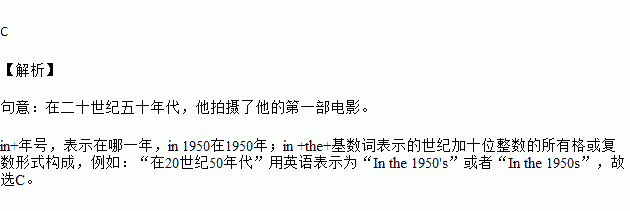
______, he made his first film.
A.In the 1950 B.In 1950s’ C.In the 1950s D.In the 1950s’
Do you mind sharing your test scores with others?
On May 16, Guo Ruiting , 14 from Shenzhen Foreign Language School, had a big debate (辩论) with her classmates on this topic.
Guo believed that making the scores public would make students study harder. At first, she explained many theories (理论) that she had collected on the Internet. But they were too difficult to understand. So she was easily beaten by her opponent (对方) Du Xiaoshe.
“Publishing the results of our tests is bad for us,” said Du. He came to this conclusion (结论) after he failed his history exam one month ago. He thought it was just an accident. But he felt so hurt when his parents got a list of his marks. It also showed the marks of other students in his class.
His experience seemed to have won over many students. But Guo’s team didn’t give up.
“Don’t you forget the time when we all worked harder after knowing the average mark of Class 2?” asked Guo. “We’d have never been so good if we didn’t know how far we were behind. So it’s good to know others’ marks,” said Guo.
These words encouraged Du. He partly agreed with Guo’s team. He thought it was good to show the average mark of each class but not individual (个人的) marks. This is the perfect way to respect their privacy (隐私) and make them work hard as well.
1.The students debated .
A.whether students’ marks should be made public
B.whether teachers should tell parents about students’ marks
C.how students’ marks should be made public
D.whether students’ marks could make them study harder
2.Guo Ruiting must have before the debate.
A.been beaten back B.collected some information on the Internet
C.got much support D.failed in exams
3.Du Xiaoshe’s accident was that .
A.he lost the debate B.the teacher made his mark public
C.he failed in an exam D.his parents got to know his poor mark
4.The passage is related to the ________.
A.art B.school life C.home education D.science
话题写作
假如你是学校英文周刊的特约小记者,刚刚采访了丹尼(Danny)一家对电视节目的喜好。请你根据下面的提示,写一篇调查报告。
提示:
1. What programs does your father love?
2. What programs can’t your mother stand?
3. What programs don’t you mind? ...
要求:
1. 语句通顺、符合逻辑,可适当发挥;
2. 80词左右。开头已给出,不计入总词数。
What do Danny’s family think of different TV shows? Let’s have a look. ______________________
________________________________________________________________________________________________________________________________________________________________________________________________________________________________________________________________________________________________________________________________________________________________________________________________________________________________________________________________________________________________________________________________________________________________________________________________________________________________________
—I think Bonnie Bears(熊出没)isn’t as as Pleasant Goat(喜羊羊).
—I agree with you. Bonnie Bears is than Pleasant Goat.
A. famous,more famous B. famous,less famous
C. more famous,less famous D. less famous,more famous
I saw two _______ ________ an apple when I came by.
A.mice, eating B.mouses,eating
C.mice, eat D.mouses,eat
We must do everything we can ________ our earth cleaner and safer.
A.made B.to making C.make D.to make
If an American friend invites you to his or her home for dinner, keep in mind these important rules.
First of all, arrive on time but not early. Americans expect promptness. It’s OK to be ten or fifteen minutes late but not forty-five minutes late.
Second, it is polite to bring a small gift. Flowers or candies are always good. If you take a special gift that is made in your own country, your friend will certainly enjoy accepting that.
Wearing beautiful clothes and a smile are good but not enough. Table manners are also very important. Don’t talk when you are eating food. Also, chew food with your mouth closed. When you want to get food that is a little far from you, do not stretch your hands to reach for it. Ask others to pass the food to you.
Don’t leave at once after dinner, but don’t stay at your friend’s house for too long, either. When your friend seems to be getting tired, tell him or her that you need to leave. The next day, call or write to say how much you enjoyed the evening.
1.When you go to an American friend’s home for dinner, it is OK to arrive ________.
A.fifteen minutes early B.ten minutes late C.forty-five minutes late
2.Which of the following is acceptable in American culture?
A.Talking with others when you are eating food.
B.Bringing candies when you visit their homes.
C.Leaving their houses at once after dinner.
3.What does the underlined word “stretch” in Paragraph 4 mean in Chinese?
A.挥动 B.清洗 C.伸出
4.How many table manners are mentioned in the passage?
A.Two. B.Three. C.Four.
5.Where would you most probably read this passage?
A.In a diary. B.On a menu. C.In a magazine.
阅读理解七选五 根据短文内容,从短文后的选项中选出能填入空白处的最佳选项。有两项多余。
Sydney is the coast of Australia.1. It’s famous for its Opera House and the Sydney Harbor Bridge. The weather is warm. The temperature is about 12 degrees in winter. And it is about 35 degrees in summer. It has beautiful beaches and many parks.
2. You can see many visitors in the park from different countries. It’s quite a popular park. The only way to see this is by going “bush”(荒野小路). Then you could find some nice gravel roads(砾石路).3. Of course you will need to travel with food and water. To see a small part of the mountains, you need some days, because there are many roads to get to the Blue Mountains.
Sydney has many beautiful beaches.4. They are Bondi and Manly. Bondi has a nice street with many shops and restaurants. Parking is not hard in the place. Manly is a great beach to go to. If you want to go there, you can take a coat. It’s a cheap and great way to see the Sydney harbor.5.
If you are going to visit Sydney, I hope you will enjoy it.
A. The roads can take you to the Blue Mountains.
B. The ticket there is quite expensive.
C. Two of them are quite famous.
D. It will take you about 30 minutes.
E. In the west of Sydney, there is a big park called the Blue Mountains.
F. Do you know what the capital of Australia is?
G. It is a lively city.
—Jackie Chan is a famous actor.
—Yes, he is popular _______ many young people.
A.for B.as C.with D.to