题目内容

【题目】A timetable for Children's Palace

Tuesday

13:00-15:00(5 weeks)

Photo

Mr. Brown From France.

Learn to take good photos.

Please bring your own camera.

Wednesday

16:30-19:00(12 weeks)

Computer Science

Mr. Smith From New York.

Learn how to use computers.

Thursday

19:30-21:30(4 weeks)

Modern Medicine

Ms. Wu From Beijing.

Would you like to know some medical development?

Saturday

14:00-17:00(16 weeks)

Chess

Ms. Green from London.

Do you want to improve your skills of playing chess?

Sunday

8:30-10:30(8 weeks)

Show of personal inventions

You can see many inventions by students. You may also bring your own inventions.

--

1The teacher who teaches Modern Medicine is from .

A.FranceB.AmericaC.China

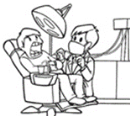
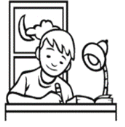
2If you are free between 16: 00 and 20: 30, you can learn .

A.B.C.

3You can go to the Children's Palace on , if you are interested in inventions.

A.TuesdayB.WednesdayC.Sunday

4Tony doesn't like classes that are long(时间长的), so he might NOT take lesson.

A.Show of Personal InventionsB.ChessC.Modern Medicine

【答案】

1C

2C

3C

4B

【解析】

文章大意:这是一张少年宫的时间表,介绍了周二、周三、周四、周六和周日少年宫的活动安排。

1细节理解题。根据题干中“Modern Medicine”可定位至表格3,根据表中信息“Ms. Wu From Beijing.”可知教现代医学的老师来自北京,属于中国。故选C

2细节理解题。根据题干中时间“between 16: 00 and 20: 30”可知之后表格2的活动符合要求,可以学习如何使用电脑;结合图片内容可知C项是学习使用电脑的。故选C

3细节理解题。根据题干中“inventions”可定位到表格5,周日有个人发明展。故选C

4细节理解题。根据题干可知Tony不喜欢太长时间的课程,对比时间可知国际象棋课需要进行16周,每周三小时,是所有课程中时间最长的,Tony应该不会选择这门课。故选B

文章属于图表类阅读,这类阅读一般多出细节理解题。图表本身简单明了,只需带着题目要求去图表中找对应信息即可,是考试中的送分题。第1小题关键词“Modern Medicine”,定位到表格3,答案一目了然。

练习册系列答案
相关题目

【题目】

It was one of the hottest days of the dry season. We had not seen in almost a month. The crops were dying. If we didn’t see some rain soon, we would lose everything.

I was in the kitchen that day when I saw my son, Billy, walking toward the . Trying to be as still as possible, he was obviously walking with great . Minutes after he disappeared into the woods, he came running out again, toward the house. Moments later, however, he was once again walking in that way toward the woods. I couldn’t take it any longer and I him.

He was cupping both hands in front of him as he walked, being very not to spill (溢出) the water he carried.

As I came closer, I saw the most surprising sight. Several large deer stood in front of him. Billy walked right up to them. But the deer did not hurt him nor move as Billy knelt down. And then I saw a baby deer lying on the ground, obviously thirsty, lift its head to lap up the water in my boy’s hands. When the water was gone, Billy jumped up to run back to the house. I followed him back to a spigot (水龙头). Billy opened it and let the drip slowly up his “cup”.

When he stood up and began to turn back, I was there in front of him. His little eyes were filled with tears. “I’m not ,” was all he said. The week before, he had made the same trouble with our horses, which caused him a lecture from his father about the importance of not wasting water.

This time, I him, with a small pot of water from the kitchen. I let him take care of the baby deer alone for it was his job. As the tears that rolled down my face began to hit the ground, they were suddenly joined by other drops… more drops… and more. I looked up at the sky. All I can say is that the rain that came that day saved our farm, just like the actions of one little boy saved another.

【1】 A. wind B. snow C. rain D. cloud

【2】 A. woods B. school C. house D. rivers

【3】 A. surprise B. effort C. doubt D. notice

【4】 A. natural B. obvious C. popular D. unusual xk.Com]

【5】A. stopped B. followed C. accepted D. controlled

【6】 A. careful B. noisy C. comfortable D. polite

【7】 A. ever B. yet C. even D. never

【8】A. set B. fill C. put D. place

【9】 A. interrupting B. joking C. complaining D. wasting

【10】A. received B. believed C. joined D. pushed

【题目】If I were to ask you to close your eyes and I gave you a piece of apple to eat, would you be able to tell me what it is just by tasting it? Of course, you could. Your tongue (舌头) helps you know what different foods taste like. Do you know that foods would taste different if you did not have a nose?

What You Need

a friend to help

small pieces of any food like carrot, orange, banana—whatever you have

small pieces of apples, raw (uncooked) potato and (if you are brave) onion (洋葱)

What You Do

There are actually three different experiments. You and your friend should take turns trying them on each other.

Experiment 1:

Have your friend close her eyes and open her mouth. Give her a piece of the food and ask her to taste it. Then, ask her what she thinks it is. She will probably guess correctly.

Experiment 2:

While your friend has her eyes closed, give her a piece of raw potato. At the same time, hold a piece of apple right under her nose. Ask her to eat the potato and tell you what she thinks it is. She will say it is a piece of apple! You can even do it the other way around, and she will think she is eating a potato, or, perhaps, she won’t be able to name what she is eating.

Experiment 3: (for the brave)

Take a piece of raw onion. You don’t have to close your eyes this time. Press your nose closed with your other hand so that no smells can get into your nose. Now eat a small piece of the onion. Surprise! As long as you hold your nose, you will not be able to taste the onion.

The Science Secret

You already know the science secret. Your nose and your tongue work together to make food taste the way it does. Your tongue, however, can taste only certain flavors like salty, bitter, sour, and sweet. All of the other “tastes” are actually “smells”, and you need your nose to taste them.

Oh, you might use this science secret the next time you are forced to eat something you don’t like the taste of. If you hold your nose while you eat it, you won’t “taste” it at all.

1According to this article, what could a person know about food?

A. People hold their noses to eat onions.

B. If you close your eyes, food will taste better.

C. People need a sense of smell to taste some food.

D. If you can smell potatoes, you will taste apples.

2What is the most probable reason Experiment 3 is called “for the brave”?

A. You have to eat a raw onion. B. You keep your eyes open.

C. You have to hold your nose. D. You do the experiment alone.

3What can we learn from the passage?

A. Knowledge comes from personal experience.

B. Team work helps us to find out science secrets.

C. We should have courage while doing experiments.

D. We can’t draw a conclusion simply from the feeling.

4What’s the passage mainly about?

A. Why different foods can smell the same.

B. How smell influences the way food tastes.

C. Why some things smell better than others.

D. How smell changes the way we see things.

违法和不良信息举报电话:027-86699610 举报邮箱:58377363@163.com

精英家教网