ÌâÄ¿ÄÚÈÝ

ÊéÃæ±í´ï£¨¹²1Ì⣻Âú·Ö20·Ö£©

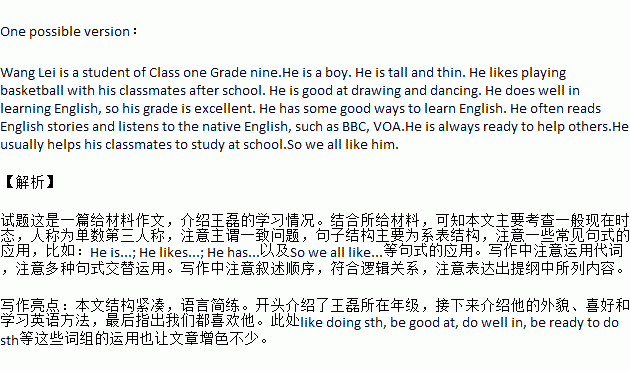
¼ÙÈçÄãÊÇУ±¨±à¼­£¬Ñ§Ð£¾ö¶¨ÔÚУ±¨ÉÏÐû´«Ò»ÅúÓÅÐãѧÉú¡£ÇëÄãÓÃÓ¢ÎÄÏòȫУͬѧ½éÉÜÓÅÐãѧÉúÖ®Ò»ÍõÀÚ£¬ÄÚÈÝÈçÏ£º

1¡¢ ÍõÀÚ£¬ÄУ¬¾ÅÄê¼¶Ò»°àѧÉú£»

2¡¢ ÍõÀÚµÄÍâò¡¢ÐËȤ°®ºÃºÍÌØ³¤£»

3¡¢ ÍõÀÚµÄÓ¢Óï³É¼¨ÓÅÒ죬½éÉÜËûѧϰӢÓïµÄ2-3ÖÖ·½·¨£»

4¡¢ ÍõÀÚÀÖÓÚÖúÈË£¬ÔÚѧϰÉϰïÖúͬ·½¡£

ÒªÇó£º1¡¢±í´ïÇå³þ£¬Óï·¨ÕýÈ·£¬ÉÏÏÂÎÄÁ¬¹á£»

2¡¢±ØÐë°üÀ¨ËùÓÐÏà¹ØÐÅÏ¢£¬²¢×÷Êʵ±·¢»Ó£»

3¡¢´ÊÊý£º80´Ê×óÓÒ£»

4¡¢²»µÃʹÓÃÕæÊµÐÕÃûºÍУÃûµÈ¡£

Á·Ï°²áϵÁдð°¸
Ïà¹ØÌâÄ¿

When you make a mistake, big or small, treasure it as it's the most valuable thing in the world.

Most of us feel bad when we make mistakes, beat ourselves up about it, feel like failures, and get mad at ourselves.

And that's only natural: Most of us have been taught from a young age that mistakes are bad, and we should try to avoid mistakes. We've been punished when we make mistakes ¡ª at home, school and work. Maybe not always, but probably enough times to make feeling bad about mistakes an unconscious reaction(ÎÞÒâʶµÄ·´Ó¦).

Yet without mistakes, we could not learn or grow. If you think about it that way, mistakes should be treasured and celebrated for being one of the most amazing things in the world: They make learning possible; they make growth and improvement possible.

By test and error ¡ª trying things, making mistakes, and learning from those mistakes ¡ª we have found out how to make electric lights, to paint the ceiling of the Sistine Chapel, and to fly.

Mistakes make walking possible for the smallest toddler, make speech possible, and make works of genius(Ìì²Å) possible.

Think about how we learn: We don't just get information about something and know it at once or know how to do it. You don't just read about painting, or writing, or computer programming, or baking, or playing the piano, and know how to do them right away. Instead, you get information about something, from reading or from another person or from watching usually ... then you set a model in your mind ... then you test it out by trying it in the real world ... then you make mistakes ... then you correct the model based on the results of your real world experiment ... and repeat, making mistakes, learning from those mistakes, until you've pretty much learned how to do something.

That's how we learn as babies and toddlers, and how we learn as adults. Mistakes are how we learn to do something new ¡ª because if you succeed in something, it's probably something you already knew how to do. You haven't really grown much from that success ¡ª at most it's the last step on your journey, not the whole journey. Most of the journey is made up of mistakes, if it's a good journey.

So if you value learning, if you value growing and improving, then you should value mistakes. They are amazing things that make a world full of wonders possible.

1.According to the passage, how should we treat mistakes?

A. We should try to avoid making mistakes.

B. We should owe(°Ñ¡­¹é¹¦ÓÚ) great inventions mainly to mistakes.

C. We should treat mistakes as good chances to learn.

D. We should make feeling bad about mistakes an unconscious reaction.

2.The underlined word ¡°toddler¡± in Paragraph 6 probably means ________.

A. a small child learning to walk

B. a kindergarten child learning to draw

C. a primary pupil learning to read

D. a school teenager learning to write

3.We can learn from the passage that ________.

A. most of us can really grow from success

B. growing and improving are based on mistakes

C. we learn to make mistakes by test and error

D. we read about something and know how to do it right away

4.The author wants to tell us ________.

A. what you should do when meeting with difficulties

B. where you can find your mistakes

C. how you can avoid making mistakes

D. why you should celebrate your mistakes

Different countries have different ideas about manners-how you behave when you are eating.In England,table manners are important.Good table manners in England are as follows:

¡ïHow to sit:You should sit up straight in your chair.It is not a good idea to lean(Çãб)forwards or backwards.When you eat, you should not lean towards the plate,but bring the knife,fork or spoon towards you.At the same time,do not out your elbows on the table,nor reach over someone¡¯s plate for something.

¡ïUsing your fingers:English people normally don¡¯t pick food up with their fingers when they are eating main courses.If you are not sure,the safest is to use your knife or fork.There are,however,some foods that are usually eaten with fingers.They include sanwiches,burgers,crisps and fruit.

¡ïYour mouth:It is not polite to talk with your mouth full of food,or to eat with your mouth open.And if possible,do not make any noises.Never lick(Ìò)your plate after eating.

¡ïHow much to eat:It is polite to eat the food that you have been offered,so a clear plate is a good plate.It shows that you enjoyed the food.If you can¡¯t finish everything and need to leave a little,that¡¯s also okay.You could say something like¡°That was very nice,thank you,but I¡¯m just too full to eat another bite.¡±

1.How should you sit when you are eating in England?

A. You should lean backwards.

B. You should lean forwards.

C. You should sit up straight in your chair.

2.What food do Englishmen eat with their fingers?

A. Beef. B. Pizza. C. Juice.

3.What is the good table manners in England?

A. Reach over someone¡¯s plate for something.

B. Lick your plate after eating.

C. Eat an orange with fingers.

4.What can we infer(ÍÆ¶Ï)according to the passage?

A. Eating with the mouth closed is a good manner.

B. We mustn¡¯t leave anything on the plate any time.

C. Saying sorry means we are full.

5.What does the passage mainly talk about?

A. The differences between England and China.

B. Good table manners in England.

C. The importance of table manners.

Î¥·¨ºÍ²»Á¼ÐÅÏ¢¾Ù±¨µç»°£º027-86699610 ¾Ù±¨ÓÊÏ䣺58377363@163.com

¾«Ó¢¼Ò½ÌÍø