题目内容

The event that all students in Shanghai Cunzhi Middle School had been looking forward to, the Ninth School Book Festival, finally arrived. It’s an every-year school festival to_______ students to enjoy reading. At this exciting event, the book________ is always the most important activity.

In the playground, there were fifteen bookstands designed by students for the purpose of collecting different ________. Students could bring their favourite books to share with others and in return, they would get a ________ bookmark. At the bookstands, they could also exchange their own books for ones they were interested in.

Another amazing part of the festival was that it was open to________ as well.

During the activity, we had the chance to share our lovely books with our parents. We wrote some book reviews based________ our opinions and feelings to help our parents get to know them better. Our parents did the same. We found a lot of ________.

What’s more, during the festival, we had class meetings to share our reading experiences and________ good books. As the Chinese Poetry Conference(中国诗词大会) was so ________ recently, we also organized a small themed class meeting about the Chinese poetry. We shared _________ enjoyed our favourite classic poems or works with each other.

Former USA President, Abraham Lincoln once said, “An ability and taste for reading give access(接近) to whatever has_________ been discovered by others.” Our School Book Festival has the same _________: To let us find the happiness of reading through all these activities. It also encourages us to _________ a good reading habit.

I’d like to conclude(结论) with a popular_________ in my school: “Make every day in your life a _________ day.”

1.A. encourage B. send C. order D. allow

2.A. sale B. review C. production D. exchange

3.A. stamps B. books C. tickets D. balls

4.A. beautiful B. expensive C. long D. strange

5.A. officers B. businessmen C. parents D. policemen

6.A. with B. on C. in D. for

7.A. joy B. money C. food D. time

8.A. buy B. sell C. write D. introduce

9.A. boring B. popular C. difficult D. easy

10.A. but B. or C. and D. so

11.A. already B. never C. seldom D. just

12.A. way B. goal C. step D. advice

13.A. change B. leave C. form D. trust

14.A. poem B. lesson C. activity D. saying

15.A. writing B. working C. reading D. studying

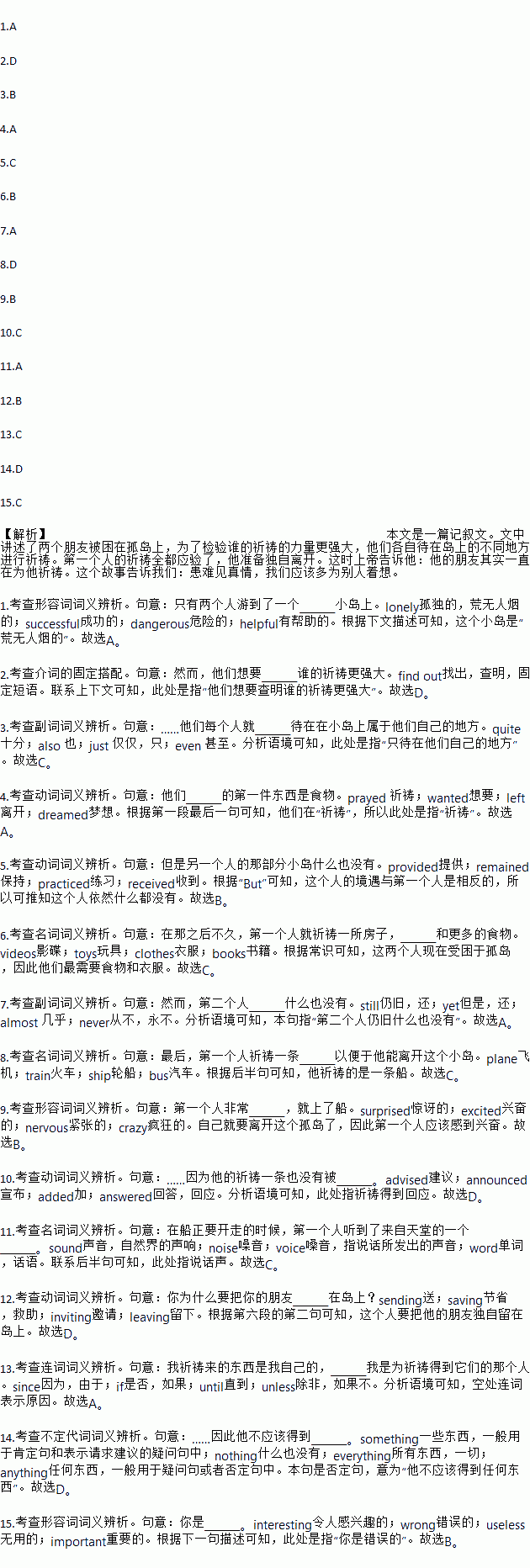
1.A 2.D 3.B 4.A 5.C 6.B 7.A 8.D 9.B 10.C 11.A 12.B 13.C 14.D 15.C 【解析】本文是一篇记叙文。文中讲述了两个朋友被困在孤岛上,为了检验谁的祈祷的力量更强大,他们各自待在岛上的不同地方进行祈祷。第一个人的祈祷全都应验了,他准备独自离开。这时上帝告诉...
练习册系列答案
相关题目

It seems that on every street corner in the world, there is a fast food restaurant. People everywhere are _____, so they do not want to wait for their food. _____ the world, $240 billion a year is spent on fast food. Yet, _____ fast food has become quite popular, there are many myths(荒诞的说法) about _____.

The first myth is that fast food is a recent _____. This is not true. More than 2000 years ago, the people of Rome _____ in the street to buy quick meals at small stands. One _____ of their most popular fast food looked a lot like a modern hamburger. All through _____, people have always eaten fast food.

A _____ myth is that all fast food is American. While many modern fast food restaurants are American, some very traditional Chinese food is ______ fast food. This includes mantou, noodles and Chinese dumplings. ______ one of the most popular fast food chains(连锁店)in the US is a Chinese fast food chain, Panda Express. It ______ more than 1600 restaurants in America.

Finally, many people think that fast food is always ______ for you. This is true of a lot of fast food. However, nearly ______ fast food restaurant has some healthy food on its menu, and some fast food restaurants only ______ healthy food. The problem is not fast food, but the choices we make. We can choose to eat healthy food, even at fast food restaurant.

1.A. slow B. busy C. bored D. tired

2.A. Around B. During C. At D. Of

3.A. so that B. even though C. as if D. in order to

4.A. them B. you C. us D. it

5.A. invention B. information C. story D. news

6.A. put up B. stood up C. lined up D. set up

7.A. copy B. piece C. bowl D. type

8.A. country B. restaurant C. history D. culture

9.A. first B. second C. third D. forth

10.A. really B. always C. even D. still

11.A. At last B. In fact C. Later on D. Just now

12.A. shows B. wins C. sells D. has

13.A. nice B. bad C. famous D. special

14.A. every B. all C. some D. either

15.A. keep B. eat C. take D. make

1.B 2.A 3.B 4.D 5.A 6.C 7.D 8.C 9.C 10.A 11.B 12.D 13.B 14.A 15.D 【解析】【主旨大意】本文是一篇说明文。主要针对快餐的一些荒诞的说法进行了解释。 1.考查形容词词义辨析。slow慢的;busy忙碌的;bored感到无聊的;tired疲惫的...

My father and I used to disagree about curfew(宵禁令). He always asked me to get back home by 9:30 on weekdays, and 11:00 on weekends. I often argued with him _____ it made no difference.

One day, my dad and I got two _____ to see our town’s professional football game. It happened that he had to do some business in another city. He _____ me to wait for him at home.

To make sure we could set off the moment he got home, I got _____ prepared. When a half hour had passed from the time he said he would be home, I _____ that he was a little late. But then, nearly a whole hour passed. I was getting _____. We were going to miss the beginning.

Another half _____ passed, I got really angry. How inconsiderate(不顾别人的) of my father! Now we were going to _____ the whole game! When another half hour passed, my anger turned to fear. What if something _____ had happened to my dad, like he had a heart attack or had been in an accident, or something? I began to really worry. I had called his cellphone over ten times, but there ______ no answer.

______, the phone rang, and my dad said breathlessly(上气不接下气地), “Son, I’m so sorry about the game, but...there was a terrible______...on the way home, and I stopped to help... and ended up going to the hospital. I ______ my cellphone in the car, so I couldn’t call you until now.”

On hearing my father’s words, I cried. I was so relieved(放心的) to hear ______ my father and to learn that he was safe. Right there and then, I ______ the importance of a curfew: Get home on time! It’s about knowing that someone you love is safe.

1.A. so B. or C. and D. but

2.A. tickets B. stamps C. books D. seats

3.A. said B. talked C. told D. spoke

4.A. anything B. everything C. nothing D. something

5.A. thanked B. forgot C. imagined D. understood

6.A. happy B. worried C. angry D. bored

7.A. day B. year C. month D. hour

8.A. miss B. guess C. remember D. watch

9.A. exciting B. terrible C. nervous D. strange

10.A. is B. are C. was D. were

11.A. Finally B. Suddenly C. Certainly D. Luckily

12.A. action B. accident C. argument D. activity

13.A. put B. sent C. lost D. left

14.A. of B. with C. from D. on

15.A. realized B. saw C. recognized D. won

1.D 2.A 3.C 4.B 5.D 6.C 7.D 8.A 9.B 10.C 11.A 12.B 13.D 14.C 15.A 【解析】本文是一篇记叙文。父亲规定我在平时晚上9点30分前回家,周末晚上11点前回家。我对此一直不同意,直到有一次父亲因为路上耽搁没有按时到家,我才明白了一个道理:父亲的规定其实...

During an experiment, a biologist put a shark into a large tank and then put several small fish into it, too.

As you would_____, the shark quickly swam around the tank(容器). When it found the smaller fish, it _____ began to attack and eat them. The biologist then placed a strong piece of _____ glass into the tank, creating two separate parts. She then put the shark in one part of the tank and a new group of fish in _____.

Again, the shark quickly attacked. This time, however, the shark knocked into _____ glass divider and bounced off(弹回). The shark kept repeating this behavior every few minutes but it _____. Meanwhile, the small fish swam around _____ in the other part. About an hour later, the shark_____ up. This experiment was repeated several _____ over the next few weeks. Each time, the shark got less aggressive(攻击性) and didn’t want to ______ attacking the small fish, until the shark got ______ of hitting the glass divider and simply stopped attacking.

The biologist then removed the glass divider, ______ the shark didn’t attack. The shark was trained to believe there was a barrier(障碍) between itself and the small fish, so the fish swam wherever they wished, without ______.

In fact, many of us, after experiencing setbacks and failures, emotionally give up and stop trying. Like the ______ in the story, we believe that because we were unsuccessful in the past, we will always be unsuccessful. In other words, we continue to see a barrier in our heads, even when there is no “real” barrier ______ where we are and where we want to go.

1.A. worry B. fear C. expect D. remember

2.A. heavily B. quickly C. carefully D. busily

3.A. dirty B. dark C. light D. clear

4.A. another B. other C. the other D. others

5.A. a B. an C. the D. (不填)

6.A. wanted B. failed C. left D. hit

7.A. happily B. quietly C. safely D. politely

8.A. took B. gave C. put D. cut

9.A. minutes B. months C. groups D. times

10.A. allow B. stop C. forget D. try

11.A. tired B. excited C. used D. surprised

12.A. and B. so C. or D. but

13.A. death B. danger C. interest D. hope

14.A. shark B. fish C. glass D. tank

15.A. among B. from C. through D. between

1.C 2.B 3.D 4.C 5.C 6.B 7.C 8.B 9.D 10.D 11.A 12.D 13.B 14.A 15.D 【解析】本文是一篇记叙文。讲述了一位生物学家把鲨鱼放在一个容器里,并为它设置了障碍,在屡次受阻后,鲨鱼放弃了尝试。虽然之后障碍物被拿掉,但鲨鱼已经形成了定式思维,一个无形的障碍已...

If you want to see a thing well, reach out and touch it!

That may seem a strange thing to say. 1. Your eyes can tell you that a glass ball is round. But by holding it in your hands, you can feel how smooth and cool the glass ball is. You can feel how heavy the glass is. When you feel all these about the ball, you really see it. 2.

For example, your fingers can tell the differences between two coins in your pocket. You can feel a little drop of water on the back of your hand, too.

  All children soon learn what “Don’t touch!” means. They hear it often. 3. In shops, we touch things that we might buy. To see something well, we have to touch it.

4. One way is to close your eyes and try to feel everything that is touching your skin. Feel the shoes on your feet, the clothes on your body and the air on your skin. At first, it is not easy to feel these things. You are too used to them!

Most museums are just for visiting. 5. Their signs say, “Do touch!” There you can feel everything on show. If you want to see better, reach out and touch. Then you will really see!

A. With your skin, you can feel better.

B. But touching things can help you see them better.

C. There are ways of learning to see better by feeling.

D. But today some museums have something to touch.

E. Yet most of us keep on touching things as we grow up.

F.Each of us should not touch the thing if we don’t know about it.

1.B 2.A 3.E 4.C 5.D 【解析】本文主要介绍了看一件东西,不但要用眼睛看,还要用手触摸或者用身体皮肤去感受,这样才能全面地、更好地了解这件东西。 1.B 根据前一句可知下一句应表示转折,再结合后两句“Your eyes can tell you that a glass ball is round. But by holding it in...

A survey has shown that only one third of people prefer to live in big cities. 1. In a big city or in the country? Maybe, wherever you are, there are advantages and disadvantages.

2. The transportation in big cities is convenient. There are many shopping centers. And the catering(餐饮) industry is developing very well. So it is easier for you to travel, to have dinners or go shopping. But there are some things that make us bored, such as rush hour traffic, noise pollution and fast-paced life.

3. The air is a lot fresher than that of the big cities. There is also a lower cost of living, good scenery, a slower pace and more green trees. You are eager and easy to get close to nature. It would be better if there is a river running through where you live. You will hear long-lost bird calls and see lots of animals and plants. The happy life in the country will make you forget the inconvenience here and the mosquito(蚊子) bite.

Nowadays, returning to nature has become a new trend. There are a lot of people working in big cities and on vacation in the countryside.

4. When they are free, they will go to the country to relax themselves.

In my opinion, young people should strive(打拼) in the big cities.

5. Maybe, a place that is fit for you is the best place. Every coin has two sides.

A.I prefer to live in the country.

B. Where would you prefer to live?

C. Older people can choose to live in the country.

D. As we all know, everything in the big cities is convenient.

E. But if you live in the country, you will have different feelings.

F. Besides, there are some people who buy their own houses in their favorite rural(乡村的) areas.

1.B 2.D 3.E 4.F 5.C 【解析】本文主要介绍的是现在只有少部分人喜欢生活在大城市里,有更多的人喜欢生活在乡村。无论生活在哪里,其实各有利弊。年轻人应多在城市里打拼,年长的人可以选择到乡村居住。 1.B 根据下一句“In a big city or in the country?”可知本句应是问你更喜欢住在哪里。结合备选项,B项“你更喜欢住在...

违法和不良信息举报电话:027-86699610 举报邮箱:58377363@163.com

精英家教网