题目内容
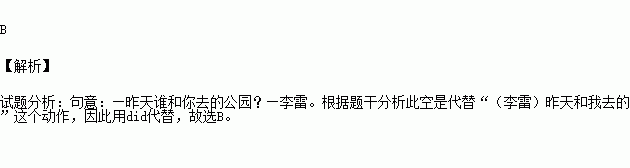
—Who went to the park with you yesterday?
—Li Lei _____ .
A.does B.did C.was D.do
Dear Boris,
Thanks for your nice letter.
After I had spent a week with my English family, I slowly began to understand their English a little better. It’s very different from what I learned at school! Students in my group are from different cities of Britain and their dialects (方言) are different too! Some of their accents (口音) are quite strong and they also have their own words and expressions.
But it’s not the language that’s different and surprising. Before I came to England I had thought that fish and chips were eaten every day. That’s quite wrong! I get rather mad now when I hear all the foolish words about typical (典型的) English food.
I had expected to see “London fog”. Do you remember our texts about it? We had no idea that most of this ‘thick fog’ disappeared many years ago when people stopped using coal in their homes. But the idea to speak about the weather was very helpful. The weather in London is really changeable.
On the other hand habits are different. People tell me what is typically British here in London is not always typical in Wales or Scotland. Local habits and traditions are not the same as what we knew.
But what is ordinary for all British is that they follow traditions. Probably Britain has more living signs of its past than many other countries. And people have always been proud of having ancient buildings in capitals, big cities and the countryside.
I will tell you more about Britain in my other letters.
Love from Britain,
Peter
1.What does Pete feel about the English language?
A. At first it was difficult for him to understand people.
B. He can understand different dialects and accents.
C. He can speak English better than others.
D. People can’t understand his English.
2.Typical English food _______.
A. makes people mad B. can’t be seen now
C. is always fish and chips D. is not what he knew
3.The British people like to talk about weather because ________.
A. there is thick fog in London
B. they like the weather in Britain
C. the weather changes a lot
D. it can be helpful
4.What do you know about habits in Britain from the passage?
A. They are not the same in different parts of Britain.
B. Habits in Wales and Scotland are typically British.
C. There are no typical British habits in Britain.
D. All that is typically British is in London.
5. Which is NOT true according to the passage?
A. What he’s seen is quite different from what he’d learned
B. British people like to follow traditions.
C. Peter had learned about Britain before.
D. Peter doesn’t like his life in Britain.
“What does he do? ” means “____________?”
A. Who is he B. Where is he
C. What is he D. What is he doing
There is ________ “m” and ________ “u” in the word “much”.
A. a; a B. an; an C. a; an D. an; a
Do you like _______ a bus to school?
A. takes B. taking C. take D. by
This year I go to a new middle school. I love very much. It’s very big and clean. We have buildings — one is for studying, and the other one is for living. We have three . We do experiments(实验) there. I like doing experiments. I think it’s very . There are 50 computers in the computer room, we all love Computer class. There are flowers, grass and trees on the playground. We often sit there and draw pictures of them in class.
In this school, teachers and students are like friends. I enjoy here. I like all the subjects and teachers. How your school life? Do you like it, too? Please write and me.
1.A. her B. it C. him D. you
2.A. two B. one C. three D. Four
3.A. libraries B. gyms C. buildings D. Labs
4.A. busy B. interesting C. nice D. clean
5.A. and B. so C. but D. or
6.A. much B. any C. no D. a lot of
7.A. Chinese B. English C. M.E. D. Art
8.A. studying B. singing C. drawing D. sleeping
9.A. for B. with C. about D. as
10.A. speak B. say C. tell D. ask
I________my clothes when the phone rang.
A.wash
B.washed
C.am washing
D.was washing
I didn’t stop working________it was quite late.
A.when
B.after
C.before
D.until
选出与white 含有相同元音音素的一项
A. difficult B.with C.habit D.ninth

 手拉手全优练考卷系列答案手拉手全优练考卷系列答案