题目内容

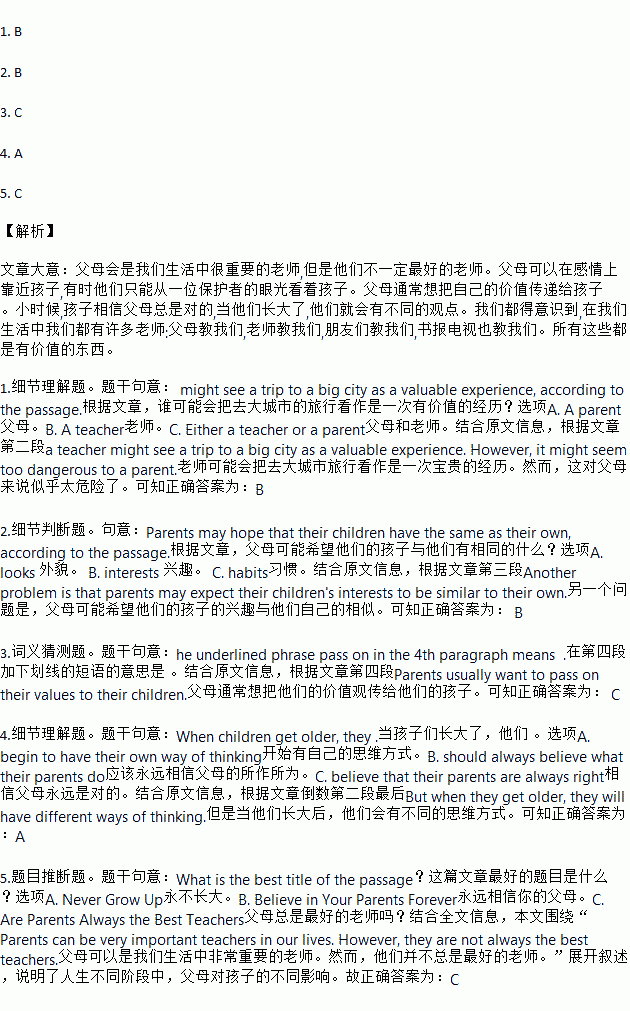
Parents can be very important teachers in our lives. However, they are not always the best teachers.

Parents may be too close to their children emotionally(感情上). Sometimes they can only see their children through the eyes of a protector. For example, a teacher might see a trip to a big city as a valuable experience. However, it might seem too dangerous to a parent.

Another problem is that parents may expect their children's interests to be similar to their own. If they love science, they may try to force(强迫) their children to love science too. But what if(要是……又怎样) the child's true love is art, or writing, or car repair?

Parents usually want to pass on their values to their children. But should children always believe what their parents do?When children are young, they believe that their parents are always right. But when they get older, they will have different ways of thinking.

The most important thing to realize is that we all have many teachers in our lives. Our parents teach us, our teachers teach us, and our friends teach us. Books and newspapers and televisions also teach us. All of them are valuable.

1. might see a trip to a big city as a valuable experience, according to the passage.

A. A parent

B. A teacher

C. Either a teacher or a parent

2.Parents may hope that their children have the same as their own, according to the passage.

A. looks B. interests C. habits

3.The underlined phrase “pass on” in the 4th paragraph means “ ”.

A. 跨过 B. 继承 C. 传递

4.When children get older, they .

A. begin to have their own way of thinking

B. should always believe what their parents do

C. believe that their parents are always right

5.What is the best title of the passage?

A. Never Grow Up

B. Believe in Your Parents Forever

C. Are Parents Always the Best Teachers
练习册系列答案
相关题目

Let's Explore(探究) the Nature!

Are you interested in animals and nature? Want to enjoy your winter holiday and learn something interesting and useful?

Here comes your chance! Youth Explorer has prepared you with a three?day program! You can meet with live animals—giraffes, pandas, tigers, and so on! More information about the program is as follows:

Age: Students aged 8~16

Groups: There are 2 programs for you to choose from. Each program needs at most 15 students.

Program A

Dates: 14~16 February, 2015

Time: 10:00 a.m.~4:00 p.m.

Program B

Dates: 1~3 March, 2015

Time: 10:00 a.m.~4:00 p.m.

Program cost: ¥230 for members; ¥250 for non?members(非会员).

How to do: Simply come to get an application form(申请表) and hand it in before 11th February, 2015.

Notes:

1.No free lunches are provided because people have different tastes. You may either bring a lunch?box or pay for lunch at our restaurants.

2.Both programs will start one day later if there is a rainstorm(暴风雨).

COME AND JOIN US NOW!! DON'T MISS THE CHANCE!

1.Two members and one non?member should pay for the program.

A. ¥690 B. ¥710 C. ¥730

2.Free lunches aren't provided because

A. the lunches cost too much

B. they may bring lunch?boxes

C. people have different tastes

3.If there is a rainstorm on 14th February, Program A will start on

A. 15th February

B. 17th February

C. 2nd March

4.What can we know from the passage?

A. Youth Explorer is the name of the program.

B. More than 15 students are in each program.

C. You need to hand in an application for the program.

Years ago, I lived in a building in a large city.The building next door was only a few feet away from mine.There was a woman who lived there. Although I never met her, I could see her seating by her window each afternoon, reading.

Several months later, I begin to notice that her window was dirty. Everything through the dirty window was unclea. I would say to myself, "why doesn't that woman wash her window?

It really looks terrible."One bright morning, I decided to clean my bouse and wash the window. Late in the afternoon whenI fnished the cleaning. I sat down by the window for a rest. What a suprise! I could see the woman siting by her window clearly. Her window was clean! I always criticized her dirty window, but all the time, I was watching hers through my own dirty window.

That was quite an important lesson for me. How often do I look at and criticize others through the d?rtу w?ndоw оf mу hеаrt оr thrоugh mу оwn ?hоrtсоm?ng? (缺点)? Аfеr thаt, whеnеvеr ? wаnt tо judgе(判断)someone, I will ask myself, “Am I looking at him through my own dirty window?"

1.The underlined word “criticized” means “_________”in Chinese in the second paragraph.

A. 批评 B. 观察 C. 反思 D. 擦拭

2.When did the writer find his own window dirty?

A. When they met each other for the first time.

B. When the woman sat by the window.

C. When the writer finished the cleaning that day.

D. When the writer lived in the building.

3.After the writer cleaned his window that day, he felt________.

A. happy and exciting B. surprised and sorry C. sad and angry D. terrible and tired

4.After reading the passage, we can infer that________.

A. the writer didn't criticize anyone after cleaning the window

B. the writer must be more careful when looking at someone later

C. the woman was lazy and liked sitting by the window

D. the woman often laughed at the writer through her window

违法和不良信息举报电话:027-86699610 举报邮箱:58377363@163.com

精英家教网