题目内容
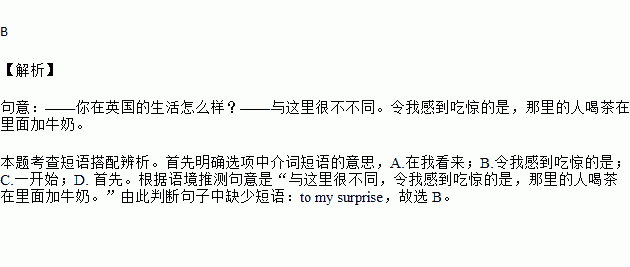
—How was your life in England?
—Quite different from here. ______, people there drink tea with milk.
A.In my opinion B.To my surprise C.At the beginning D.To start with
Four years ago,Chinese skater Wu Dajing introduced himself to the skating world by winning a silver medal at the Sochi Olympic Winter Games.At this year's Pyeong Chang Olympics,Wu not only returned,but also made history.
On Feb.22nd,2018,Wu won the gold medal in the men's short?track 500-?meter race.He set a new world record with a time of 39.584 seconds.He also became the first Chinese man to take home an Olympic short?track gold medal.BBC said Wu's win was “flawless”,because he was much faster than all of the other skaters.
“I didn't give them a chance and I kept my speed from the start,” he told the reporter after the match.
But China's short?track teams didn't do well in general at the Games.Chinese skaters in the women's 500 meters,3000-?meter relay and men's 1500 meters all failed to take home the gold.Wu was China's biggest hope,which put a lot of pressure on him.But he proved himself with his great performance.
Wu is now known as a highly talented skater.But things were not always that way.When Wu joined the national team in 2010,he was seen as almost “nothing” compared to gifted skaters like Zhou Yang and Fan Kexin,as his coaches said at the time.Their words made him quite upset.But Wu didn't want to give up and worked as hard as he could.He practiced skating all year round.He even didn't return to his home town for the holidays for 10 years.“I believe in myself,” he told the reporter after his match at the Olympics.
1.What does the underlined word “flawless” mean?
A.Ordinary. B.Common. C.Perfect. D.Difficult.
2.What does the last paragraph mainly tell us?
A.The national team and coaches regarded Wu as a talented skater all the way.
B.Wu kept on practicing skating all year round even in the holidays for 10 years.
C.Zhou Yang and Fan Kexin were more hard?working on skating than Wu Dajing.
D.Because of Wu's hard work,confidence and strong will,he finally succeeded.
3.According to the passage,which of the following is TRUE?
A.Wu won a gold metal at the Sochi Olympic Winter Games four years ago.
B.Wu broke the world record with a time of 39.584 seconds and made history.
C.Wu's coaches placed great hope on him when he joined the national team.
D.Chinese skaters in women's 500 metres and 3000?metre relay took home the gold.
4.Which one might be the best title of this passage?
A.From Zero to Skating Hero B.Short?track 500?meter Race
C.Pyeong Chang Winter Olympics D.Rising of China's Bright Skiing Star
根据要求完成句子,每空一词。
1.I have a bluejacket.(改为一般疑问句)
________you________a blue jacket?
2.Sam has a tape player.(改为否定句)
Sam________ ________a tape player.
3.Does your friend have a basketball?(作否定回答)
________,he________.
4.Tennis is difficult for me.(改为同义句)
Tennis is________ ________for me.
5.Tom and I often play basketball after school.(改为同义句)
Tom often plays basketball________ ________after school.
Do you mind sharing your test scores with others?
On May 16, Guo Ruiting , 14 from Shenzhen Foreign Language School, had a big debate (辩论) with her classmates on this topic.
Guo believed that making the scores public would make students study harder. At first, she explained many theories (理论) that she had collected on the Internet. But they were too difficult to understand. So she was easily beaten by her opponent (对方) Du Xiaoshe.
“Publishing the results of our tests is bad for us,” said Du. He came to this conclusion (结论) after he failed his history exam one month ago. He thought it was just an accident. But he felt so hurt when his parents got a list of his marks. It also showed the marks of other students in his class.
His experience seemed to have won over many students. But Guo’s team didn’t give up.
“Don’t you forget the time when we all worked harder after knowing the average mark of Class 2?” asked Guo. “We’d have never been so good if we didn’t know how far we were behind. So it’s good to know others’ marks,” said Guo.
These words encouraged Du. He partly agreed with Guo’s team. He thought it was good to show the average mark of each class but not individual (个人的) marks. This is the perfect way to respect their privacy (隐私) and make them work hard as well.
1.The students debated .
A.whether students’ marks should be made public
B.whether teachers should tell parents about students’ marks
C.how students’ marks should be made public
D.whether students’ marks could make them study harder
2.Guo Ruiting must have before the debate.
A.been beaten back B.collected some information on the Internet
C.got much support D.failed in exams
3.Du Xiaoshe’s accident was that .
A.he lost the debate B.the teacher made his mark public
C.he failed in an exam D.his parents got to know his poor mark
4.The passage is related to the ________.
A.art B.school life C.home education D.science
-----Final exam is coming, Tom. Don’t watch TV for too long.
-----I’m not a child any more. I ______ what to do.
A. should always be told B. should always tell
C. shouldn't always be told D. shouldn’t always tell
1.I was making model planeswhen my mother came back.(对画线部分提问)
_______ _______ _______ _______ when your mother came back?
2.I think classical music is boring.(改为否定句)
I _______ _______ classical music is boring.
3.My mother was doing the dishes at that time.(同义句转换)
My mother was _______ the _______ at that time.
4.He read a story-book last night.(改为过去进行时)
He _______ _______ a story-book at eight o’clock last night.
5.He wasn’t old enough to go to school. (同义句转换)
He was _______ young_______ go to school.
The old man died _______ a cold snowy night.
A.in B.on C.at D.Over
话题写作
假如你是学校英文周刊的特约小记者,刚刚采访了丹尼(Danny)一家对电视节目的喜好。请你根据下面的提示,写一篇调查报告。
提示:
1. What programs does your father love?
2. What programs can’t your mother stand?
3. What programs don’t you mind? ...
要求:
1. 语句通顺、符合逻辑,可适当发挥;
2. 80词左右。开头已给出,不计入总词数。
What do Danny’s family think of different TV shows? Let’s have a look. ______________________
________________________________________________________________________________________________________________________________________________________________________________________________________________________________________________________________________________________________________________________________________________________________________________________________________________________________________________________________________________________________________________________________________________________________________________________________________________________________________
If an American friend invites you to his or her home for dinner, keep in mind these important rules.
First of all, arrive on time but not early. Americans expect promptness. It’s OK to be ten or fifteen minutes late but not forty-five minutes late.
Second, it is polite to bring a small gift. Flowers or candies are always good. If you take a special gift that is made in your own country, your friend will certainly enjoy accepting that.
Wearing beautiful clothes and a smile are good but not enough. Table manners are also very important. Don’t talk when you are eating food. Also, chew food with your mouth closed. When you want to get food that is a little far from you, do not stretch your hands to reach for it. Ask others to pass the food to you.
Don’t leave at once after dinner, but don’t stay at your friend’s house for too long, either. When your friend seems to be getting tired, tell him or her that you need to leave. The next day, call or write to say how much you enjoyed the evening.
1.When you go to an American friend’s home for dinner, it is OK to arrive ________.
A.fifteen minutes early B.ten minutes late C.forty-five minutes late
2.Which of the following is acceptable in American culture?
A.Talking with others when you are eating food.
B.Bringing candies when you visit their homes.
C.Leaving their houses at once after dinner.
3.What does the underlined word “stretch” in Paragraph 4 mean in Chinese?
A.挥动 B.清洗 C.伸出
4.How many table manners are mentioned in the passage?
A.Two. B.Three. C.Four.
5.Where would you most probably read this passage?
A.In a diary. B.On a menu. C.In a magazine.