题目内容
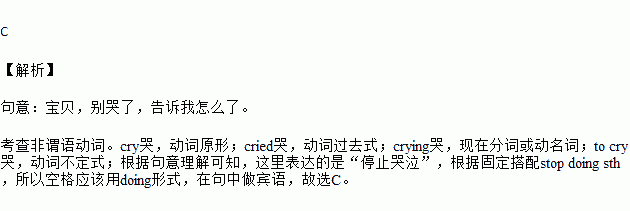
Baby,please stop ________ and tell me what's wrong.
A.cry B.cried C.crying D.to cry
Jimmy and Kathy ________ until last December.
A.got married B.didn't get married
C.would get married D.weren't getting married
— You may________your coat. It’s warm in this office.
— Thanks, but I have a bad cold.
A.take off B.put on C.pick up
By the time I got to the supermarket,all the tomatoes ________.
A.sell out B.have been sold out
C.sold out D.had been sold out
I was so sleepy that I didn't know when the alarm clock________.
A.ran off B.went off C.took off D.put off
Do you like go running? Some people think running is boring. But there are ways to make it more exciting – for example, “plogging”.
Plogging is a new exercise trend(趋势)from Sweden. The name comes from the words “pick up ” and “jogging”. It means picking up trash(垃圾)while running.
Ploggers go outside with a pair of gloves and a trash bag. They stop to pick up trash as they run. Nobody likes to see trash while they’re doing exercise. This new trend brings environmental protection (环境保护) and healthy living together.
Plogging may even be better for you than just running, since bending down (弯腰) to pick up trash is another kind of exercise itself. So try to plogging with your friends on your way to school. You can stay healthy and keep the environment clean at the same time.
1.What trend does this story talk about?
A.Making new words. B.Running with gloves.
C.Picking up trash while running. D.Throwing away trash in bags.
2.Where did the trend come from?
A.Switzerland B.The United States C.Sweden D.Spain
3.What is the best part of this new trend?
A.More people are wearing gloves while running.
B.Runners take their own bags, so there will be no trash.
C.It tells people to stop using public trash bags.
D.It’s good for the environment, as well as for people’s health.
4.The last paragraph mainly tells us that _________.
A.bending down while plogging is also good exercise. B.it is important to keep the environment clean.
C.plogging gives you a chance to make friends. D.you should run to school with your friends.
If you ________this bus, you’ll have to wait half an hour for the next one.
A.take B.miss C.lose D.catch
Different people have different ideas about time. People in the USA think that it is important to know the time. In cities in America, there are clocks in stations, factories and other buildings. Radio announcers (播音员) give you the correct time during the day. Most Americans also have watches with them wherever they go. They want to do certain (特定的) things at certain time, so they don’t like to be late.
But time is not so important to everybody in the world. When you visit a country in South America, you will find that people there don’t like to rush. If you had an appointment (约会) with somebody, he could probably be late, because he may not want to arrive on time.
In South America, even the radio programs may not begin on time. The men on the radio may not think it is important to tell the exact time. People in South America think that clocks or watches are just machines. They think that you let a clock or a watch control (控制) your life if you do everything on time.
1.You can see clocks in stations, factories and other buildings in the USA because ________.
A.Americans want to make these places beautiful.
B.Americans want to sell these clocks.
C.Americans think that it is important to know the time.
D.Americans always forget about time.
2.Americans don’t want to be late because ________.
A.they go to stations, factories or other buildings B.they do certain things at certain time
C.they are free D.they listen to radio announcers
3.The underlined word “rush” most probably means “________”.
A.jump B.hurry C.run D.have a watch
4.If you have an appointment with someone in South America, he may not arrive on time, and this is because ________.
A.he doesn’t have a watch B.he forgets to have a watch with him
C.he doesn’t think it is important to arrive on time D.he doesn’t like to meet you
5.In this passage, we can see that time is very important to ________.
A.people in the US B.people in South America
C.everybody in the world D.children in school
—Has Mike come ________?
—Yes,he has ________ been here for 10 minutes.
A.yet;already B.already;yet C.yet;yet D.already;already