题目内容

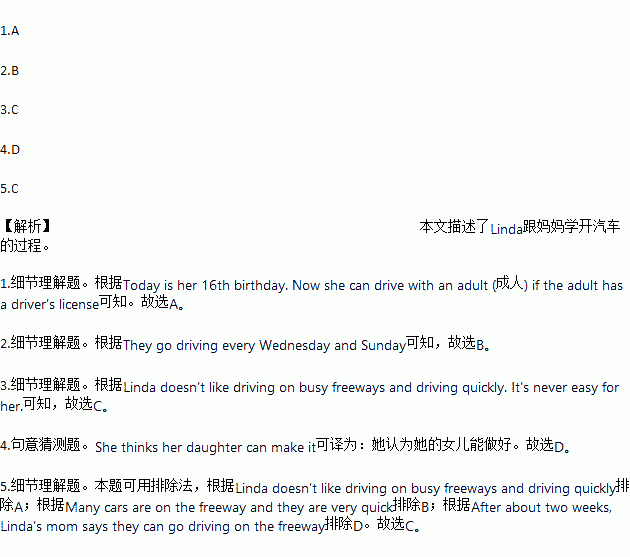
Linda comes from the US. Today is her 16th birthday. Now she can drive with an adult (成人) if the adult has a driver’s license (驾驶执照).

Linda’s mom teaches her how to drive. They go driving every Wednesday and Sunday. After about two weeks, Linda’s mom says they can go driving on the freeway (高速公路).

Linda is afraid. Many cars are on the freeway and they are very quick. Linda doesn’t like driving on busy freeways and driving quickly. It’s never easy for her. “Don’t be afraid. Just drive like we do these days,” says Linda’s mom. She thinks her daughter can make it

1.Linda starts to drive at the age of ______.

A. 16

B. 17

C. 18

D. 19

2.When does Linda learn to drive every week?

A. On Monday and Wednesday.

B. On Wednesday and Sunday.

C. On Tuesday and Sunday.

D. On Monday and Tuesday.

3.What does Linda think of driving on the freeway?

A. Boring.

B. Easy.

C. Difficult.

D. Interesting.

4.We can learn from the last sentence that Linda’s mother ______.

A. isn’t good at driving on the freeway

B. wants her daughter to drive well like her

C. doesn’t want her daughter to drive quickly

D. thinks her daughter can drive well on the freeway

5.Which of the following is TRUE?

A. Linda likes driving quickly.

B. No cars are on the freeway.

C. Linda’s mother has a driver’s license.

D. Linda’s mother teaches her to drive for one week.
练习册系列答案
相关题目

Students these days often have a lot of worries. Sometimes they have problems with their schoolwork, and sometimes with their friends.____Some people think the worst thing is to do nothing. Laura Mills, a teenager from Washington, agrees. “Problems and worries are normal in life,” says Laura. “But I think talking to someone helps a lot. If we don’t talk to someone, we’ll certainly feel worse.”

Laura once lost her purse, and worried for days. She was afraid to tell her parents about it. She even walked three miles to school each day because she didn’t have any money. She just kept thinking. “If I tell my parents, they’ll be angry!” But in the end, she talked to her parents and they were really understanding. Her dad said he sometimes made careless mistakes himself. They got her a new purse and asked her to be more careful. “I will always remember to share my problems in the future!” Laura says.

Robert Hunt advises students about common problems. He feels the same way as Laura. “It is best not to avoid our problems. We should always try to solve (解决) them.” He thinks that you can first find someone to talk to. This person doesn’t need to be an expert (专家) like himself. Students often forget that their parents have more experience than them, and are always there to help them.

In English, we say that sharing a problem is like cutting it in half. So you’re halfway to solving a problem if you talk to someone about it!

1.Which of the following can be put in the blank in Paragraph One?

A. What can they do about this?

B. Where do the problems come from?

C. When did they have these problems?

D. Why do they have so many problems?

2.In Paragraph 2, the writer used the story of Laura to ______.

A. answer a question B. give an example

C. introduce his friend D. share his experience

3.According to the passage Robert Hunt might be ______.

A. Laura’s teacher

B. the writer of the passage

C. a person with a problem

D. an expert on students’ problem

4.What is the main idea of this passage?

A. Few children are careful with their money.

B. Parents are more experienced than children

C. Talking to someone helps to solve problems.

D. Students often have a lot of worries at school

违法和不良信息举报电话:027-86699610 举报邮箱:58377363@163.com

精英家教网