题目内容

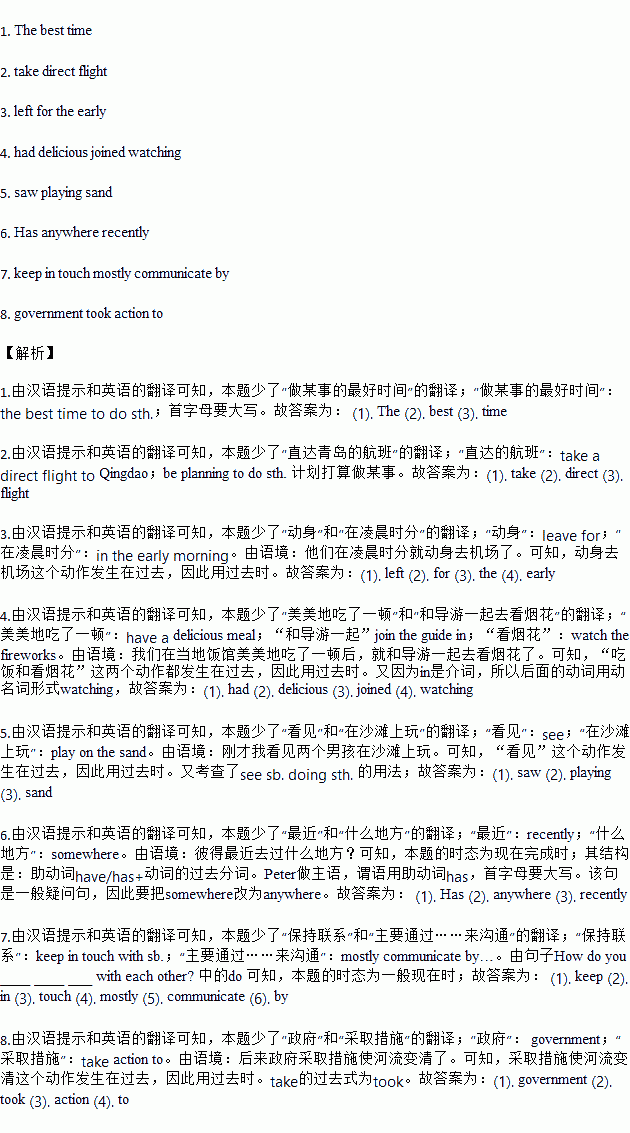
1.春天是参观中国园林的最好时间。

_______ _____ ____ to visit Chinese gardens is in spring.

2.你在计划乘坐去青岛的直达航班吗?

Are you planning to _____ a _____ _____ to Qingdao?

3.为了赶上飞机,他们在凌晨时分就动身去机场了。

To catch the plane, they _____ _______ the airport in ______ ______ morning.

4.我们在当地饭馆美美地吃了一顿后,就和导游一起去看烟花了。

After we _____ a ___ meal in the local restaurant, we _____ the guide in ______ the fireworks.

5.刚才我看见两个男孩在沙滩上玩。

Just now I _______ two boys ______ on the ______.

6.彼得最近去过什么地方?

____ Peter been ____ ____?

7.你们是怎样保持联系的呢?我们主要通过邮件来沟通。

How do you _____ _____ ____ with each other? We ____ ____ ___ email.

8.后来政府采取措施使河流变清了。

Later the ____ _____ ____ ____ make the river clean.
练习册系列答案
相关题目

A recent report from Dazhou Daily says about 18% of Dazhou teenagers can have problems with their minds(内心,精神). Some students become worried because they have to study very hard. Others have trouble getting on well with people like their parents and classmates.

Zhang Qiang, a Junior 2 student from Dazhou, could not understand his teachers in class and was doing badly in his lessons. He was afraid of exams. When he looked at the exam paper, he couldn’t think of anything to write. Another student, a 15-year-old girl called Wu Yan from Guang’an often argued with her classmates even her parents because of some different ideas. She became so annoyed about them that she started to cut her finger with a knife.

However, many students who have problems won’t go for advice or help. Some think they will look stupid(愚蠢的) if they go to see a doctor. Others don’t want to talk about their secrets. In order to solve the teenagers’ problems, here is some advice :

●Talk to your parents or teachers often.

●Take part in group activities and play sports.

●Go to see a doctor if you feel unhappy or unwell.

1.It is reported that ______students in Dazhou can have problems with their minds.

A. most B. many C. some D. all the above

2.From the passage we know teenagers have problems with their minds because of___.

A. Their study B. getting on with other people C. their hobbies D. A and B.

3.Wu Yan started to cut her finger with a knife because _____________.

A. she couldn’t get on well with her classmates and even her parents

B. she could not understand her teachers in class

C. she was afraid of exams

D. she had no money for a new shirt

4.Why don’t the students who have problems want to go for help ?

A. Because they think no one will help them.

B. Because they don’t want to talk about their secrets and they think it’s stupid to see a doctor.

C. Because they think they can solve the problems by themselves.

D. Because they think the doctors could do nothing with their problems.

5.How many pieces of advice are given to the teenagers who have problems in this passage?

A. Two. B. Three. C. Four. D. Five.

“How was school?" Millie's mother asked. "It was terrible! I never want to go ____ again!” Millie almost cried. Millie's mother went to the ____ and got Millie a glass of milk and some cakes that Millie likes. She also got a box ____ tissues(纸巾)for Millie. "What's wrong?" she asked when she sat clown next to Millie. Millie ____ at her mother and said; “I thought Kitty and Amy were my best friends, and I thought we could tell each ____ everything. But they kept a secret for me! Today I heard them whispering(小声说)in class and I saw them giving notes to each other. I asked them ____ it at lunch, but they are not my true ____. They said there wasn't any note and l was silly." Millie started to cry. "Poor Millie," mum said, "It's all right. Now go and get some ____, and tomorrow everything will be fine." The next morning, Millie went to school sadly, She did not think she had any friends now. She ____ into the classroom and went to her desk, but when she opened her desk she found that there were some colorful presents. "Happy birthday, Millie!" Kitty and Amy came to her and shouted ___, "This is our secret -- a birthday party for you! You are our best friend, Millie! "

1.A. study B. then C. there D. school

2.A. kitchen B. bedroom C. couch D. desk

3.A. about B. of C. at D. in

4.A. saw B. worried C. said D. looked

5.A. other B. others C. one D. person

6.A. for B. about C. from D. away

7.A. friendships B. friends C. friend D. friendly

8.A. sleeping B. sleepy C. sleeps D. sleep

9.A. walked B. walks C. walk D. walking

10.A. happy B. excited C. happily D. friendly

In 1834, the clock tower in London was burned down. People planned to build a new clock which would be the biggest and best in the world. So the clock had to be big and keep very good time. The big clock was made in two years. Five more years later the tower was finished. Then people put the big clock in the tower, and made it ring out for the first time on July 11, 1859.

In order to give the big clock a good name, people held a meeting. Someone wanted to call it the Queen of Bells, and someone thought Victoria was good. At last, a man named Benjamin Hall stood up. He was a big man. Before he started to speak, someone shouted, “Why not call it Big Ben?” Everybody laughed and agreed with him.

From then on, Big Ben became its name. And it also became a famous building of London. People all over the world write to Big Ben. They even send birthday presents---bottles of oil---to help keep Big Ben running. Big Ben is not only a clock but also a dear friend of people.

1.Big Ben’s birthday is __________.

A. July 11, 1854 B. July 11, 1834 C. July 11 1859 D. July 11, 1852

2.How did Big Ben get its name?

A. Benjamin Hall gave it the name. B. Big Ben got its name because of a joke.

C. Victoria gave it the name. D. Big Ben got its name from the Queen of the UK

3.“Keep very good time” means ___________

A. have a good time B. show people the correct time.

C. keep running D. be made in time

4.Which of the following is NOT true?

A. People all over the world look upon Big Ben as their friends.

B. People all over the world even send oil to Big Ben.

C. People think Big Ben will answer their letters.

D. People think Big Ben is the biggest and the best clock in the world.

5.Benjamin Hall is ___________.

A. a man who built Big Ben

B. a man who was always very funny

C. the man who burnt down the old clock

D. a man who attended the meeting which was held to make a name for the big clock

(A) No one knows why we sleep, but it’s certain that we need to. People who are prevented from sleeping begin to suffer obvious effects (产生明显的反应) after a few days—they think less clearly, and they fall asleep during the working hours; some may have hallucinations (幻觉).

There are no rules about sleep. Generally speaking, grown-ups sleep about 7 and a half hours each night and probably more than 60 per cent get between seven and eight hours. But perhaps eight per cent are quite happy with 5 hours or less, and four per cent or so find that they want ten hours or more. (B)如果你感觉好的话, you’re probably getting enough sleep. The important thing is not to worry how much other people get—their needs may be different. Exercise doesn’t seem to increase the need for sleep—office workers, for example, sleep for about as long as people doing physically active work.

Children sleep more than grown-ups—perhaps 14 to 18 hours soon after birth, going down to grown-up levels by early teenage. Sleep patterns (睡眠模式) also tend (倾向) to be different in the elderly, who may sleep less at night than they did when younger, find sleep getting worse, and often make it a rule to sleep during the daytime.

1.将(A)处画线部分译成汉语。

______________________________________________________________

2.将(B)处画线部分译成英语。

_______________________________________________________________

3.回答问题。

How many hours of sleep do children need?

_______________________________________________________________

4.在短文中找出与给句子意义相同的句子。

They are sleepy at work.

______________________________________________________________

5.请从下面的选项中给短文选个标题。

_____________________________________________________________

A. There are no rules about sleep. B. No one knows why we sleep.

C. Sleeping is very important to us. D. Make it a rule to sleep.

违法和不良信息举报电话:027-86699610 举报邮箱:58377363@163.com

精英家教网