题目内容

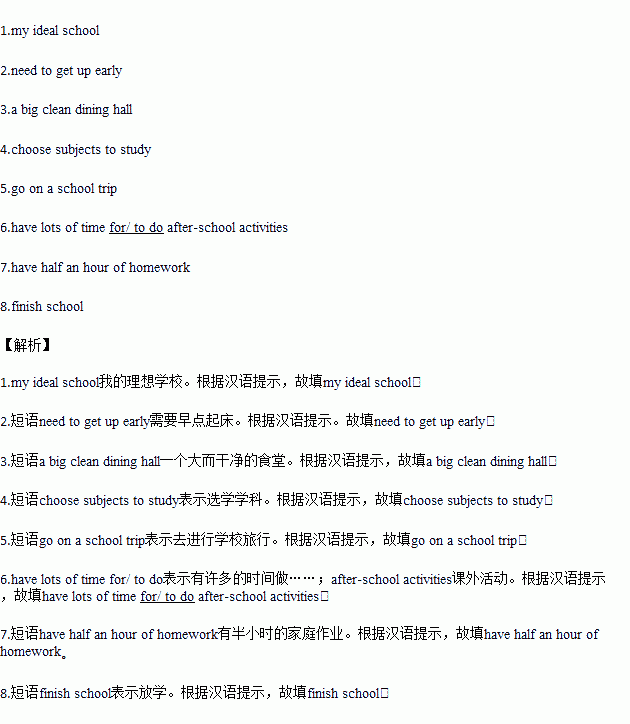
1.我理想的学校 ___________________

2.需要早起 _____________________________

3.一个大而干净的食堂 _____________

4.选学学科 _____________________________

5.去进行学校旅行 _________________

6.有很多时间参加课外活动________________

7.有半小时的家庭作业______________

8.放学 _________________________________
练习册系列答案
相关题目

Ask someone what they have done to help the environment recently and they will almost mention recycling. Recycling in the homes is very important. However, having to recycle often means we already have more products than we need. We are just dealing with the results of thatover-consumptionin the greenest way, but it would be much better if we did not bring so many goods home.

The total amount of packaging(外包装) has increased by 12% between 1999 and 2005. It is 1/3 of a home’s waste in the UK. In many supermarkets, food products are packaged twice with plastic and paper. Too much packaging is doing serious damage to the environment. The UK, for example, is running out of land because of this unnecessary waste. If such packaging is burnt, it gives off greenhouse gases which go on to cause the greenhouse effect. Besides, the plastic from the package puts some creatures in danger, especially birds and fish.

Recycling helps, but the recycling itself uses energy. The solution is not to produce such waste in the first place. Food waste is a serious problem, too. Too many supermarkets encourage customers to buy more than they need. However, few of them have the idea that this cannot continue. For example, supermarkets should encourage customers to reuse their plastic bags.

But this is not just about supermarkets. It is about all of us. We have been used to the idea that packaging means excellence while anything unpackaged is of poor condition. This is especially true of food. But this idea has spread to other products, which often have far more packaging than necessary.

There are signs of hope. As more of us recycle, we are beginning to realize just how many unnecessary goods are collected. We need to face the waste of our consumer culture, but we have a mountain to climb.

1.What does the underlined word “over-consumption” in Paragraph 1 refer to?

A. Using too much packaging.

B. Recycling too many wastes.

C. Buying more products than needed.

D. Making more products than necessary.

2.Which of the following damage of over packaging is NOT mentioned?

A. It may waste land.

B. It may pollute the food.

C. It may do harm to the living things.

D. It may make the green house effect worse.

3.According to the passage, which of the following is true about recycling?

A. It leads to a waste of land.

B. It means burning packaging for energy.

C. It is the only solution to the greenhouse effect.

D. It helps reduce the harm caused by too much packaging.

4.Why do people prefer packaged products?

A. Supermarkets encourage them.

B. People care more about packaging.

C. It is necessary for all the products to have package.

D. People think unpackaged products are of poor condition.

5.What does the writer tell us in the last paragraph?

A. Fighting waste is difficult.

B. People don’t waste any more.

C. People only recycle necessary goods now.

D. We should continue our consumer culture.

The baby is just one day old and has not left hospital yet. She is quiet but alert(警觉). The researchers have placed a white card with two black spots on it twenty centimeters from her face. She stares at it carefully.

A researcher removes the card and replaces it by another one, this time with the spots differently spaced. As the cards change from one to the other, her gaze(凝视)starts to lose its focus until a third card is presented. The third card has three black spots on it. Her gaze returns: she looks at it for twice as long as she did at the previous card. Can she tell that the number two is different from three, just 24 hours after coming into the world? Or do newborns simply prefer more to fewer?

The same experiment, but with three spots shown before two, shows the same return of interest when the number of spots changes. Perhaps it is just the newness? When a little older babies were shown cards with pictures of objects (a comb, a key, an orange and so on), changing the number of objects had an effect separate from changing the objects themselves. Could it be the pattern that two things make, as opposed to three? No again.

Babies paid more attention to squares moving randomly on a screen when their number changed from two to three, or three to two. The effect even crosses between senses. Babies who were repeatedly shown two spots became more excited when they then heard three drumbeats (鼓声)than when they heard just two; likewise(同样地)when the researchers started with drumbeats and moved to spots.

1.The experiment described in Paragraph 1 is mainly about the baby’s ______.

A. sense of hearing B. sense of sight C. sense of touch D. sense of smell

2.What does the underlined word it in paragraph 2 refer to?

A. the card B. the baby C. the comb D. the key

3.According to the passage, babies have a strong sense of changing in ______.

A. the size of cards B. the colour of pictures C. the shape of patterns

D. the number of objects

4.Why did the researchers test the babies with drumbeats?

A. To reduce the difficulty of the experiment.

B. To see how babies recognize sounds.

C. To carry their experiment further.

D. To keep the babies’ interest.

5.Where does this passage probably come from?

A. Science fiction. B. Children’s literature.

C. An advertisement. D. A science report

违法和不良信息举报电话:027-86699610 举报邮箱:58377363@163.com

精英家教网