题目内容
-____ levels does the game have?
-Five
- A.How long
- B.How many
- C.How often
- D.How much
本题考查疑问词短语。本题回答语表示的是数量,故本题的问句含义为这个游戏有多少级水平?修饰可数名词level表示数量使用how many。How long对时间长度进行提问,意思为多长,how often对频率进行提问,意思为多久一次,how much对不可数名词数量进行提问,后三者都不符合题意,故本题选B。

 灵星计算小达人系列答案
 孟建平错题本系列答案
Food waste has become a big problem in China.
Zhou Jinsong, a canteen(食堂) manager at Central South University, said that students produce over 12 barrels(桶) of leftovers every day — each barrel stands at one meter in height. Zhou’s canteen is just one of several on the campus.
According to Xinhua News Agency, the food wasted by Chinese people equates to about 50 million tons of grain every year, or 10 percent of the country’s total annual grain production. This food could feed another 200 million people. What students waste every year could feed over 10 million people. Students nowadays are well protected by their families and hardly know how hard farmers work to provide them with the food they eat.
“Since the 1980s, when Chinese gradually became richer, food waste has been a subject of debate. But things have hardly changed over the years,” said Yu Changjiang, a sociologist at Peking University. “It’s the Chinese way of showing respect to friends, often referred as Mianzi.”
But rather than tradition, huge public spending on government banquets(宴会) is also causing food waste, said Zhou Xiaozheng from the sociology department at Renmin University of China. “It’s the result of widespread reception meals at government levels. It is also important that everyone thinks about how they can do their best to reduce food waste.”
【小题1】Which of the following statements is not the reasons for food waste?
| A.Students hardly know farmers’ hard work on the farm. |
| B.The government spends a large amount of money on government banquets. |
| C.Leaving some food after a banquet is the Chinese way to show respect to guests. |
| D.The food in the college canteen is not delicious. |
| A.In a newspaper. | B.In a traffic report. |
| C.On a health website. | D.In a story book. |
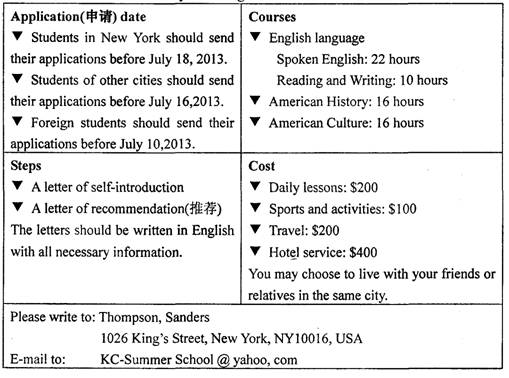

|
Developing school skills |
||||||||||||||||||||||||
|
Books to help you to become better teachers or better learners These materials can help both teachers and students of different levels and grades.
? Lessons with textbooks ? Activity Sheets ? Answer Key with Explanations Here are the lessons for you to choose |
1.Tom needs to improve his study skills. If he takes the lessons, he has to spend ______.
A.$75 B.$100 C.$ 120 D.$ 135
2.If you want to build your vocabulary, you will take ________lessons.
A.37 B.43 C.60 D.70
3.The books in the picture are for ___________ to develop school skills.
A.students of lower grades
B.students of different levels
C.both parents and children
D.both teachers and students
While I was waiting to enter university, I saw in a newspaper a teaching job wanted at a school about ten miles from where I 16 . Because I was in great need of 17 and wanted to do something useful, I applied(申请).
Three days later, a letter 18 . It asked me to see the 19 at Croydon. It proved to be an 20 journey—a train to Croydon station, a ten-minute bus ride and then a walk of at 21 a quarter of a mile. It was clearly that the headmaster himself opened the door. He was 22 and round.
“The school” he said, “has a group of twenty-four boys 23 seven and thirteen.”
I should have to teach all the 24 except art, 45 he taught himself. I should have to divide the class into 26 groups and teach them at three different 27 , and I was not 28 at the thought of teaching maths—a subject which I didn’t do very well in at school. It was 29 that I had to teach them on Saturday afternoon because most of my friends would be 30 themselves at that time.
Before I had time to ask about my salary(薪水), he got up to his feet. “ Now,” he said. “ you’d better meet my wife. She is the one who really runs this school.
|
1.A. lived |
B. played |
C. studied |
D. worked |
|
2.A. help |
B. money |
C. rest |
D. force |
|
3.A. arrived |
B. received |
C. returned |
D. wrote |
|
4.A. editor |
B. teacher |
C. headmaster |
D. student |
|
5.A.comfortable |
B. difficult |
C. unpleasant |
D. short |
|
6. A. first |
B. last |
C. least |
D. most |
|
7. A. bad |
B. glad |
C. short |
D. smiling |
|
8. A. between |
B. from |
C. by |
D. under |
|
9. A. people |
B. subjects |
C. boys |
D. knowledge |
|
10.A. who |
B. where |
C. what |
D. which |
|
11.A. two |
B. three |
C. four |
D. five |
|
12.A. subjects |
B. lessons |
C. levels |
D. regions |
|
13.A. glad |
B. surprised |
C. angry |
D. sad |
|
14. A. better |
C. more exciting |
C. worse |
D. nicer |
|
15.A. enjoying |
B. helping |
C. studying |
D. managing |