1.
图1-1-12
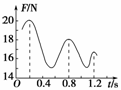
(1)将一个电动传感器接到计算机上,就可以测量快速变化的力,用这种方法测得的某单摆摆动时悬线上拉力的大小随时间变化的曲线如图1-1-12所示.某同学由此图象提供的信息作出的下列判断中,正确的是________.
A.t=0.2 s时摆球正经过最低点
B.t=1.1 s时摆球正经过最低点
C.摆球摆动过程中机械能减小
D.摆球摆动的周期是T=1.4 s
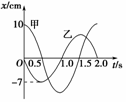
(2)如图1-1-13所示为同一地点的两单摆甲、乙的振动图象,下列说法中正确的是________.
图1-1-13
A.甲、乙两单摆的摆长相等
B.甲摆的振幅比乙摆大
C.甲摆的机械能比乙摆大
D.在t=0.5 s时有正向最大加速度的是乙摆
解析:(1)悬线拉力在经过最低点时最大,t=0.2 s时,F有正向最大值,故A选项正确,t=1.1 s时,F有最小值,不在最低点,周期应为T=1.2 s,因振幅减小,故机械能减小,C选项正确.
(2)振幅可从题图上看出甲摆大,故B对.且两摆周期相等,则摆长相等,因质量关系不明确,无法比较机械能.t=0.5 s时乙摆球在负的最大位移处,故有正向最大加速度,所以正确答案为A、B、D.
答案:(1)AC (2)ABD
1. What does the author try to argue in Paragraph 1?
A. The exercise of rights is a luxury.
B. The practice of choice is difficult.
C. The right of choice is given but at a price.
D. Choice and right exist at the same time.
[答案]B
[思路分析]此题考查作者的写作意图。从But for a good many people in the world, in rich and poor countries, choice is a luxury, something wonderful but hard to get, not a right中可以归纳出答案为B ( )2. Why do more choices of goods give rise to anxiety?
A. Professionals find it hard to decide on a suitable product.
B. People are likely to find themselves overcome by business persuasion.
C. Shoppers may find themselves lost in the broad range of items.
D. Companies and advertisers are often misleading about the range of choice.
[答案]C
[思路分析]此题考查细节理解。从Buying something as basic as a coffee pot is not exactly simple. Easy access to a wide range of everyday goods leads to a sense of powerlessness in many people, ending in the shopper giving up and walking away, or just buying an unsuitable item(商品) that is not really wanted中可以归纳出答案为C ( )3. By using computers as an example, the author wants to prove that .
A. advanced products meet the needs of people
B. products of the latest design flood the market
C. competitions are fierce in high-tech industry
D. everyday goods need to be replaced often
[思路分析]此题考查判断推理。作者借助计算机为例子来证明Products are almost out-of-date once they are bought. 这其中的原因就有the speed with which new types of products come on the market以及Advances in design and production help quicken the process. ( )4. What is this passage mainly about?
A. The variety of choices in modern society.
B. The opinions on people’s right in different countries
C. The problems about the availability of everyday goods.
D. The helplessness in purchasing decisions
[答案]D
[思路分析]此题考查主旨要义。通读全文,不难发现:本文主要分析在面临选择作出决定的艰难。
15.(2008·重庆卷)E
词数:284体裁:议论文 难度:4星 文章标题:很难做出选择It’s Hard to Make A Choice
Almost every day we come across situations in which we have to make decisions one way or another. Choice, we are given to believe, is a right. But for a good many people in the world. In rich and poor countries, choice is a luxury, something wonderful but hard to get, not a right. And for those who think they are exercising their right to make choices, the whole system is merely an illusion, a false idea created by companies and advertisers hoping to sell their products.
The endless choice gives birth to anxiety in people’s lives. Buying something as basic as a coffee pot is not exactly simple. Easy access to a wide range of everyday goods leads to a sense of powerlessness in many people, ending in the shopper giving up and walking away, or just buying an unsuitable item(商品) that is not really wanted. Recent studies in England have shown that many electrical goods bought in almost every family are not really needed. More difficult decision-making is then either avoided or trusted into the hands of the professionals, lifestyle instructors, or advisors.
It is not just the availability of the goods that is the problem, but the speed with which new types of products come on the market. Advances in design and production help quicken the process. Products also need to have a short lifespan so that the public can be persuaded to replace them within a short time. The typical example is computers, which are almost out-of-date once they are bought. This indeed makes selection a problem. Gone are the days when one could just walk with ease into a shop and buy one thing; no choice, no anxiety.
4. What can we infer from the passage?
A. Active learning is less important.
B. Passive learning may not be reliable.
C. Active learning occurs more frequently.
D. Passive learning is not found among scholars.
[思路分析]此题考查推理判断。此题可用排除法。A、C两项未提,而由最后一段第一句可知D项不正确。由文章第三段加后几段的例证可推知B 项正确。
3. The author mentions the game Rumor to show that _____.
A. a message may be changed when being passed on
B. a message should be delivered in different ways
C. people may have problems with their sense of hearing
D. people tend not to believe in what they know as rumor
[答案]A
[思路分析]此题考查作者的写作意图。通过第四段最后一句可知,原始的含义改变了,例证了第三段提出的论点“被动学习使我们接受被告知的事物,甚至有时是谣言。”因此A项为正确项。
2. The underlined word “it” in Paragraph 2 refers to _____.
A. active learning
B. knowledge
C. communication
D. passive learning
[思路分析]此题考查推测词义。根据it 所在句可知这个代词指代的是前句所提的被动学习,句意:在日常生活中依靠被动学习并不奇怪。
1. According to the passage, passive learning may occur in _______.
A. doing a medical experiment
B. solving a math problem
C. visiting an exhibition
D. doing scientific reasoning
[思路分析]此题考查推理判断。由文章第二段前两句we achieve knowledge passively by being told by some else,……in the classroom and the kind that happens when we watch TV of read newspaper or magazines is passive可知被动学习是指由别人告知所获得的知识。故选C. A、B、D都是主动学习。
14.(2008·天津卷) D
词数:315体裁:议论文 难度:4星 文章标题:被动学习The Passive Learning
We can achieve knowledge either actively or passively(被动地). We achieve it actively by direct experience, by testing and proving an idea, or by reasoning.
We achieve knowledge passively by being told by someone else. Most of the learning that takes place in the classroom and the kind that happens when we watch TV or read newspapers or magazines is passive. Conditioned as we are to passive learning, it’s not surprising that we depend on it in our everyday communication with friends and co-workers.
Unfortunately, passive learning has a serious problem. It makes us tend to accept what we are told even when it is little more than hearsay and rumor(谣言).
Did you ever play the game Rumor? It begins when one person writes down a message but doesn’t show it to anyone. Then the person whispers it, word for word, to another person. That person, in turn, whispers it to still another, and so on, through all the people playing the game. The last person writes down the message word for word as he or she hears it. Then the two written statements are compared. Typically, the original message has changed.
That’s what happens in daily life. The simple fact that people repeat a story in their own words changes the story. Then, too, most people listen imperfectly. And many enjoy adding their own creative touch to a story, trying to improve on it, stamping(打上标记)it with their own personal style. Yet those who hear it think they know.
This process is also found among scholars and authors: A statement of opinion by one writer may be re-stated as fact by another, who may in turn be quoted by yet another; and this process may continue, unless it occurs to someone to question the facts on which the original writer based his opinion or to challenge the interpretation he placed upon those facts.
4.Which of the following points does the author wish to make?
A.America should sell more of its products abroad.
B.A healthy society has to learn to live within its means.
C.People’s income determines their money management.
D.Government should prevent people from overborrowing.
[思路分析]此题考查作者的写作意图。由第一段“Spending beyond one’s means is becoming a national problem for Americans.”和最后一段“It is high time for us American people to learn the basics of long-term money management.”可知B正确。
3.What does the author suggests a way to deal with overborrowing?
A.Teaching people how to manage money.
B.Advising people on what to buy.
C.Limiting the use of credit cards.
D.Reducing average incomes.
[思路分析]此题考查细节理解。由文章是最后一段A可知正确。