第二节 书面表达(满分25分)
假定你是学生会主席,你所在的学校邀请南京大学的许教授在下个月8号下午3点,在508教室举办美式和英式英语的差异的讲座。请你根据以下要点写一则通知,主要内容包括:
1.讲座目的:提高学生对英语的学习兴趣;
2.讲座内容:美式英语和英式英语的差异;
3.讲座时间:1小时30分钟左右;
注意:
1.可以适当增加细节,使结构完整;
2.词数60左右。
高一英语第一模块月考试卷答案页
|
N= Nicola
A= Annie N.:Annie, Annie, would you please turn(76)d______ the TV ? It’s too loud. A: What are you doing? N: Well, I am (77)p__________ for my composition. A: Oh, your table is a (78)m_______. I think you are very busy. N: Yes, I have been writing, but I still can’t finish it. But I must turn it (79)i______tommorw morning. A: What is the composition about? N: About (80)a f______between two children and their parents. A. Oh, maybe it’s a(81)c______ to you, because you never quarrel with your parents. N: Yes, but I can imagine how they(82) d_____ with the problems. I think they should (83)c_________ with each other. A: You are right! Don’t worry. more hurry, less (84)s________.( 欲速则不达)I think you can. N: Thank you! I’ll do my (85)b__ |
76 __________________ 77_________________ 78___________________ 79__________________ 80________________ 81___________________ 82__________________ 83_________________ 84________________ 85____________________ |
Michel is a young girl who works for the police (36)a handwriting expert . She has helped (37) many criminals (罪犯) by using her special talents (天才). When she was fourteen, Michel was already (38) interested in the differences in her friends’ (39) that she would spend hours (40) them. After (41) college she went to France for a (42) two-year class in handwriting at the School of Police Science. Michel says that it is (43) for people at hide their handwriting. She can discover (44) of what she needs to know simply (45) looking at the writing with her own eyes, (46) she also has machines(47) help her make (48) different kinds of paper and ink. This knowledge is often (49) great help to the police. Michel believes that handwriting is a good (50) of what kind of person the (51) is. "I wouldn’t go out with a fellow (52) I didn’t like his handwriting. " She says. But she (53) she fell in love with her future husband, a young policeman (54) she studied his handwriting. It is later proved to be (55), however.
|
36.
|
A.with
|
B.
by |
C.like |
D.as |
|
37.
|
A.
search |
B.
follow |
C.
catch |
D.
judge |
|
38.
|
A.
so |
B.
too |
C.
quite |
D.
extra |
|
39.
|
A.
books |
B.
letter |
C.
tongues |
D.
handwriting |
|
40.
|
A.
writing |
B.
studying |
C.
settling |
D.
uncovering |
|
41.
|
A.
attending |
B.
finishing |
C
starting. |
D.
stepping into |
|
42.
|
A.
powerful |
B.
natural |
C.
special |
D.
common |
|
43.
|
A.
main |
B.
safe |
C.
easy |
D.
impossible |
|
44.
|
A.
most |
B.
nothing |
C.
little |
D.
sight |
|
45.
|
A.
with |
B.
by |
C.
of |
D.
about |
|
46.
|
A.
so |
B.
for |
C.
thus |
D.
but |
|
47.
|
A.
they |
B.
in which |
C.
that |
D.
those |
|
48.
|
A.
up |
B.
out |
C.
for |
D.
into |
|
49.
|
A.
of |
B.
to |
C.
with |
D.
for |
|
50.
|
A.
test |
B.
sign |
C.
means |
D.
habit |
|
51.
|
A.
thief |
B.
criminal |
C.
writer |
D.
policeman |
|
52.
|
A.
whether |
B.
unless |
C.
if |
D.
after |
|
53.
|
A.
adds |
B.
tells |
C.
repeats |
D.
cries |
|
54.
|
A.
before |
B.
after |
C.
shyly |
D.
and |
|
55.
|
A.
necessary |
B.
all right |
C.
important |
D.
quite easy |
(A) Miss Gogers taught physics in a New York school. Last month she explained to one of her classes about sound, and she decided to test them to see how successful she had been in her explanation. She said to them, Now I have a brother in Los Angeles. If I was calling him on the phone and at the same time you were 75 feet away, listening to me from across the street, which of you would hear what I said earlier, my brother or you and for what reason?” Tom at once answered, “Your brother. Because electricity travels faster than sound waves.” “That’s every good,” Miss Gogers answered; but then one of the girls raised her hand, and Miss Gogers said.“Yes, Kate.” “I disagree,”Kate said.“Your brother would hear you earlier because when it’s 11 o’clock here it’s only 8 o’clock in Los Angeles.” 56.Miss Gogers was teaching her class_________. A.how to telephone B. about electricity C. about time zone(时区) D. about sound 57.Miss Gogers raised this question because she wanted to know whether______. A.it was easy to phone to Los Angeles B.her student could hear her from 75 feet away C.her students had grasped her lesson D.sound waves were slower than electricity 58.Tom thought that electricity was _________. A.slower than sound waves B.faster than sound waves C.not so fast as sound waves D.as fast as sound waves 59.Kate thought Tom was wrong because _______. A. clocks in Los Angeles showed a different time from those in New York B. electricity was slower than sound waves C. Tom was not good at physics at all D. Tom’s answer had nothing to do with sound waves 60.Whose answer do you think is correct according to the law of physics? A. Tom’s B. Kate’s C. Bath A and B D. Neither A nor B
(B)
It was Monday. Mrs Smith’s dog was hungry, but there was not any meat in the house.
Considering that there was no better way. Mrs Smith took a piece of paper, and wrote the following words on it: “Give my dog half a pound of meat.” Then she gave the paper to her dog and said gently: “Take this to the butcher(*person whose job is selling meat). and he’s going to give you your lunch today.”
Holding the piece of paper in its mouth, the dog ran to the butcher’s. It gave the paper to the butcher. The butcher read it carefully, recognized that it was really the lady’s handwriting and soon did it as he was asked to. The dog was very happy, and ate the meat up at once.
At noon, the dog came to the shop again. It gave the butcher a piece of paper again. After reading it. he gave it half a pound of meat once more.
The next day, the dog came again exactly at noon. And as usual, it brought a piece of paper in the mouth. This time, the butcher did not take a look at paper, and gave the dog its meat, for he had regarded the dog as one of his customers (*people who buy sth. from a shop).
But, the dog came again at four o’clock. And the same thing happened once again. To the butcher’s more surprise, it came for the third time at six o’clock, and brought with it a third piece of paper. The butcher felt a bit puzzled. He said to himself, “This is a small dog. Why does Mrs Smith give it so much meat to eat today?”
Looking at the piece of paper, he found that there were not any words on it!
61.Mrs Smith treated her little dog quite_________. A. cruelly B. fairly C. rudely D. friendly
62.It seemed that the dog knew well that the paper Mrs Smith gave it_______. A. might do it much harm B. could do it much good C. would help the butcher D. was worth many pounds
63.The butcher did not give any meat to the dog __________. A. before he felt sure that the words were really written by Mrs Smith B. when he found that the words on the paper were not clear C. because he had sold out all the meat in his shop D. until he was paid enough by Mrs Smith
64.From its experience, the dog found that ________. A. only the paper with Mrs Smith’s words in it could bring it meat B. the butcher would give the meat to it whenever he saw it C. Mrs Smith would pay for the meat it got from the butcher D. a piece of paper could bring it half a pound of meat
65.At the end of the story, you’ll find that _______. A. the dog was clever enough to write on the paper B. the dog dared not go to the butcher’s any more C. the butcher was told not to give any meat to the dog D. the butcher found himself cheated (*act in a way that is not honest)by the clever animal
(C)
Started in 1636, Harvard University is the oldest of all the many colleges and universities in the United States. Yale, Princeton, Columbia and Dartmouth were opened soon after Harvard.
In the early years, these school were much alike(*similar).Only young men went to college. All the students studied the same subjects, and everyone learned Latin, Greek and Hebrew. Little was known about science then, and one kind of school could teach everything that was known about the world. When the students graduated, most of them became ministers or teachers.
In 1782, Harvard started a medical school for young men who wanted to become doctors. Later, lawyers could receive their training in Harvard’s law school. In 1825, besides Latin and Greek, Harvard began teaching modern languages, such as French and German. Soon it began teaching American history.
As knowledge increased, Harvard and other colleges began to teach many new subjects. Students were allowed to choose the subjects that interested them.
Today, there are many different kinds of colleges and universities. Most of them are made up of smaller schools that deal with special fields of learning. There’s so much to learn that one kind of school can’t offer it all.
66.The oldest university in the US is _________. A. Yale B. Harvard C. Princeton D. Columbia
67.From the second paragraph, we can see that in the early years,______. A. those colleges and universities were the same B. people, young or old, might study in the colleges C. students studied only some languages and science D. when the students finished their school, they became lawyers or teachers 68.Modern languages the Harvard taught in 1825 were ________. A. Latin and Greek B. Latin, Green, French and German C. American history and German D. French and German 69.As knowledge increased, colleges began to teach_______. A. everything that was known B. law and something about medicine C. many new subjects D. the subjects that interested students 70.On the whole, the passage is about___________. A. how to start a university B. the world-famous colleges in America C. how colleges have changed D. what kind of lesson each college teaches
(D) If you’re like most students, you probably read both at home and outside your home :perhaps somewhere on your schoolyard and maybe even at work during your breaks. Your reading environment can have a great effect on your understanding, so give some thought to how you can create or choose the right reading environments. The right environment allows you to stay alert(专注的) and to keep all of your attention on the text, especially when it is both interesting and difficult.
When you’re at home, you can usually create effective conditions for reading. You might want to choose a particular place-a desk or table, for example-where you always read. Make sure the place you choose is well lighted, and sit in a chair that requires you to sit straight. Reading in a chair that’s too soft and comfortable is likely to make you sleepy! Keep your active reading tools (pens, markers, notebooks or paper) and a dictionary close at hand.
Before you sit down for a reading period, try to reduce all possible interruptions. Turn off your phone,the television,and the radio, Tell your family members or roommates that you’ll be busy for a while.If necessary, put a“Do not disturb”sign on your door! The more interruptions you must deal with while you read,the harder it will be to keep your attention on the task at hand.
71.The author believes that the right reading environment_________.
A. helps readers a little in their reading task B. helps readers a lot in their reading tasks
C. can only be created at one’s home D. can only be created outside one’s home
72.Which type of the following interruptions is mentioned in the text?
A. Dictionaries. B. Paper. C. Phone calls. D. Notebooks.
73.What would be the best title for the text?
A. How to Read Fast B. Creating an Effective Reading Environment
C. The Ways to Reduce Possible Interruptions D. What to Read
E
Answer the following questions by using the four job advertisements A-D
from a newspaper. (You may read the questions first.)
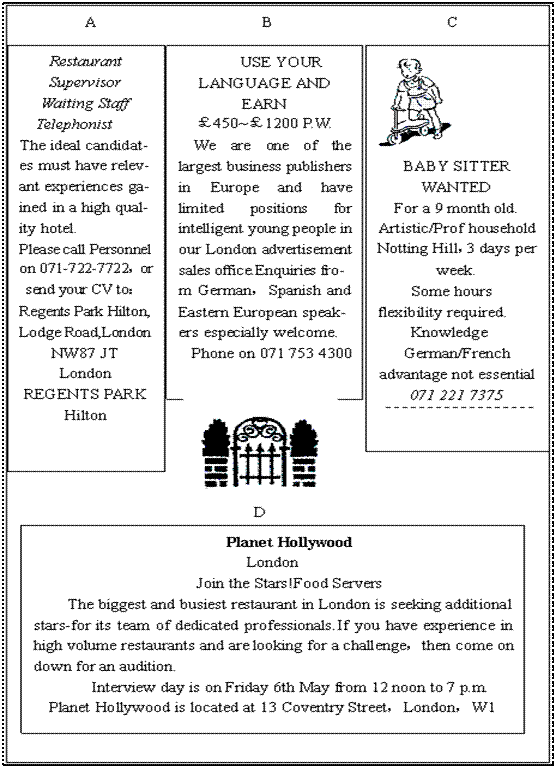
74.How many advertisements are for waiters?
A.One. B.Two. C.Three. D.Four.
75.According to advertisement B,we can learn that .
A. only German.Spanish and Eastern European speakers are needed
B. the job offers £450 -£1200 per month
C. the job is open to people of all ages
D you may call to get more information about the job