网址:http://m.1010jiajiao.com/timu3_id_3193753[举报]
D
This brief book is aimed at high school students , but speaks to anyone learning at any stage of life.
Its formal ,serious style closely matches its content ,a school-masterly book on schooling .The author , W .H . Armstrong ,starts with the basics : reading and writing . In his opinion , reading doesn’t just mean recognizing each word on the page ; it means taking in the information, digesting it and incorporating it into oneself just as one digests a sandwich and makes it a part of himself .The goal is to bring the information back to life , not just to treat it as dead facts on paper from dead trees . Reading and writing cannot be completely separated from each other ; in fact ,the aim of reading is to express the information you have got from the text .I’ve seen it again and again :someone who can’t express an idea after reading a text is just as ineffective as someone who hasn’t read it at all.
Only a third of the book remains after that discussion, which Armstrong devotes to specific tips for studying languages, math, science and history. He generally handles these topics thoroughly and equally, except for some weakness in the science and math sections and a bit too much passion regarding history. Well, he was a history teacher---if conveyed only a tenth of his passion to his students, that was a hundred times more than my history teachers ever got across .To my disappointment, in this part of the book he ignores the arts. As a matter of fact, they demand all the concentration and study that math and science do, though the study differs slightly in kind. Although it’s commonly believed that the arts can only be naturally acquired ,actually ,learning the arts is no more natural than learning French or mathematics.
My other comment is that the text aged. The first edition apparently dates to the 1960s—none of the references(参考文献)seem newer than the late 1950s. As a result, the discussion misses the entire computer age.
These are small points, though, and don’t affect the main discussion. I recommend it to any student and any teacher, including the self-taught student.
According to Armstrong, the goal of reading is to________.
A. gain knowledge and expand one’s view
B. understand the meaning between the lines
C. express ideas based on what one has read
D. get information and keep it alive in memory
The author of the passage insists that learning the arts_________.
A. requires great efforts
B. demands real passion
C. is less natural than learning math
D. is as natural as learning a language
What is a shortcoming of Armstrong’s work according to the author?
A. Some ideas are slightly contradictory.
B. There is too much discussion on studying science.
C. The style is too serious.
D. It lacks new information.
This passage can be classified as________.
A. an advertisement
B. a book review
C. a feature story
D. A news report
查看习题详情和答案>>A newly trained teacher named Mary went to teach at a Navajo Indian reservation. Every day, she would ask five of the young Navajo students to __1__ the chalkboard and complete a simple math problem from 2 homework.
They would stand there, silently, 3 to complete the task. Mary couldn’t figure it out. 4 she had studied in her educational curriculum helped, and she 5 hadn’t seen anything like it in her student-teaching days back in Phoenix.
What am I doing wrong? Could I have chosen five students who can’t do the 6 ? Mary would wonder. No, 7 couldn’t be that. Finally she 8 the students what was wrong. And in their answers, she learned a 9 lesson from her young 10 pupils about self-image and a(n) 11 of self-worth.
It seemed that the students 12 each other’s individuality and knew that 13 of them were capable of doing the problems. 14 at their early age, they understood the senselessness of the win-lose approach in the classroom. They believed no one would 15 if any students were shown up or embarrassed at the 16 . So they 17 to compete with each other in public.
Once she understood, Mary changed the system 18 she could check each child’s math problem individually, but not at any child’s expense 19 his classmates. They all wanted to learn, 20 not at someone else’s expense.
1. A.go to B.come to C.get close to D.bring
2. A.his B.their C.his own D.her
3. A.happy B.willingly C.readily D.unwilling
4. A.Anything B.Nothing C.Everything D.Neither
5. A.almost B.certainly C.hardly D.never
6. A.question B.chalkboard C.problem D.homework
7. A.they B.it C.everything D.each
8. A.asked B.questioned C.told D.understood
9. A.outstanding B.surprising C.annoying D.frightening
10.A.sunburned B.tender C.Indian D.naughty
11.A.sense B.image C.way D.aspect
12.A.had B.ignored C.respected D.cared
13.A.none B.no one C.each D.not all
14.A.Especially B.Even though C.Even so D.Even
15.A.lose B.win C.achieve D.answer
16.A.time B.situation C.chalkboard D.condition
17.A.refused B.rejected C.tried D.promised
18.A.if B.so that C.unless D.in case
19.A.in favour of B.of C.by means of D.in front of
20.A.and B.but C.so D.or
查看习题详情和答案>>A strong wind can be a dangerous thing — sometimes it is powerful enough to knock you off your feet. But to plants, the wind is a source of new life, carrying them or their spores (孢子) thousands of miles.
A NASA satellite called QuikSCAT has discovered highways of wind over the Earth's oceans. Scientists believe these invisible roads may explain why many nonflowering plants, such as mosses (苔) and lichens (地衣), grow where they do.
The satellite is able to send microwaves (微波) from space to the surface of the ocean. The pattern of signals that come back shows which way the winds are blowing.
Using this data, the scientists studied a group of islands in the southern hemisphere (半球), near Antarctica.Winds tend to blow anticlockwise (逆时针) in this region, but there are lots of local differences.
When the researchers compared these local patterns to botanical (植物学) data, they found that the wind had an important effect on where species of mosses, lichens, and other nonflowering plants grow.
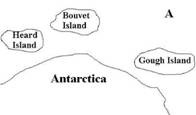
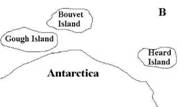
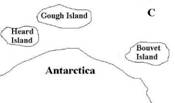
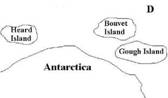
For example, Bouvet Island and Heard Island, share 30 per cent of their moss species, 29 per cent of liverworts (叶苔), and 32 per cent of lichens — even though they are 4,430 kilometers apart. In contrast, Gough Island and Bouvet Island, separated by just 1,860 kilometers of sea, share only 16 per cent of mosses and 17 per cent of liverworts. They have no lichens in common.
Ferns (蕨类植物) and flowering plants don't travel as well in the wind, so they don't show the same kinds of distribution (分布) patterns.
This story is about _____.
A.the discovery of wind highways B.how wind travels
C.how wind affects different plants D. one function of the wind
The underlined word "data" in the fourth paragraph means _____.
A.signal B.pattern C.information D. research
Which of the following is wrong?
A.Bouvet Island, Heard Island and Gough Island are all in the southern hemisphere.
B.Winds in the researched area blow anti-clockwise.
C.The scientists shouldn't base this research on how winds affect where ferns grow.
D. Without the discovery of QuikSCAT, the research wouldn't have made sense.
Which of the following diagrams shows the correct position of the islands?
A cheap drug that can stop bleeding in people recently injured in an accident could potentially save the lives of tens of thousands worldwide, a new study says.
Researchers studied the effects of tranexamic acid (凝血酸), or TXA, in more than 10,000 injured people in 40 countries who received the drug within 8 hours of being injured. The study was published in the medical journal Lancet. Doctors found that patients who got TXA had a 15percent lower chance of dying from hemorrhage than those who didn’t get it . They also had a 10 percent lower chance of dying from any other cause, including organ failure and a head injury. The study was paid for by the British government.
The drug is commonly used in wealthy countries during elective surgeries(外科手术) to stop bleeding , but isn’t used for accident victims. TXA is off-patent and made by many companies. It costs about $4.5 per gram, and a typical dose is two grams. It is usually given via an injection(注射) and would be relatively easy to introduce, even in poor countries, experts said.
Previous tests of the drug regarded its use in elective surgeries, such as heart operations, but this was the first study to test the drug on accident victims. Doctors were worried it might increase side effects such as blood clots (凝块)in the heart and lungs, strokes, or heart attacks. There was no evidence of that in the Lancet study, though the authors said it was possible they might have missed some of these incidents.
For people between 5 and 45, accidents are the second leading cause of death worldwide after AIDS, and about 600,000 injured patients bleed to death every year. Experts estimated that if TXA were readily available, between 70,000 and 100,000 lives a year could be saved. Though the drug wasn’t tested on children , experts said it would almost certainly work with them as well.
The underlined word” hemorrhage” in Paragraph 2 probably means ________
A. serious illness B. heart disease C. heavy bleeding D. lack of drug
What can we learn about TXA from the passage?
A. It can only be made in England B. It was only used in operations before
C. It is a patented drug D. It is mainly used in poor countries
Doctors were worried about using TXA because ________
A. a lot of patients died unexpectedly after using it
B. it has no treatment effect on patients
C. it can cause blood clots or stroke
D. they hadn’t used it on accident victims before
What do we know from the last paragraph?
A. It is a pity that TXA wasn’t widely used on injured patients before
B. Tests have proved that TXA can be used on children
C. People between 5 and 45 should be injected with TXA every year
D. Accidents are the first leading cause of death worldwide.
查看习题详情和答案>>A newly trained teacher named Mary went to teach at a Navajo Indian reservation. Every day, she would ask five of the young Navajo students to __1__ the chalkboard and complete a simple math problem from 2 homework.
They would stand there, silently, 3 to complete the task. Mary couldn’t figure it out. 4 she had studied in her educational curriculum helped, and she 5 hadn’t seen anything like it in her student-teaching days back in Phoenix.
What am I doing wrong? Could I have chosen five students who can’t do the 6 ? Mary would wonder. No, 7 couldn’t be that. Finally she 8 the students what was wrong. And in their answers, she learned a 9 lesson from her young 10 pupils about self-image and a(n) 11 of self-worth.
It seemed that the students 12 each other’s individuality and knew that 13 of them were capable of doing the problems. 14 at their early age, they understood the senselessness of the win-lose approach in the classroom. They believed no one would 15 if any students were shown up or embarrassed at the 16 . So they 17 to compete with each other in public.
Once she understood, Mary changed the system 18 she could check each child’s math problem individually, but not at any child’s expense 19 his classmates. They all wanted to learn, 20 not at someone else’s expense.
1. A.go to B.come to C.get close to D.bring
2. A.his B.their C.his own D.her
3. A.happy B.willingly C.readily D.unwilling
4. A.Anything B.Nothing C.Everything D.Neither
5. A.almost B.certainly C.hardly D.never
6. A.question B.chalkboard C.problem D.homework
7. A.they B.it C.everything D.each
8. A.asked B.questioned C.told D.understood
9. A.outstanding B.surprising C.annoying D.frightening
10.A.sunburned B.tender C.Indian D.naughty
11.A.sense B.image C.way D.aspect
12.A.had B.ignored C.respected D.cared
13.A.none B.no one C.each D.not all
14.A.Especially B.Even though C.Even so D.Even
15.A.lose B.win C.achieve D.answer
16.A.time B.situation C.chalkboard D.condition
17.A.refused B.rejected C.tried D.promised
18.A.if B.so that C.unless D.in case
19.A.in favour of B.of C.by means of D.in front of
20.A.and B.but C.so D.or
查看习题详情和答案>>