网址:http://m.1010jiajiao.com/timu3_id_3073081[举报]
D
The rising costs of health care have become a problem for many countries in the world. To deal with this problem, it is recommended that a big part of the government's health budget be used for health education and disease prevention instead of treatment. Actually, many kinds of diseases are preventable in many ways and preventing a disease is usually much cheaper than treating it. For example, people could avoid catching a cold if they dressed warmly when the weather starts getting cold. But many people get sick because they fail to do so, and have to spend money seeing a doctor.
Daily habits like eating more healthy food would have kept millions of families from becoming bankrupt if the patients had taken measures for early prevention. For instance, keeping a balanced diet, such as not consuming too much animal fat and insuring a steady intake of vegetables and fruits, seems to be quite important.
One very effective and costless way of prevention is regular exercise, which is necessary for a healthy mind and body. Regular exercise, such as running, walking, and playing sports is a good way to make people feel better or reduce stress.
In addition, health education plays a key role in improving people's health. By giving people more information about health, countries could help people understand the importance of disease prevention and ways to achieve it. For example, knowing one's family medical history is an effective way to help keep healthy. Information about health problems among close relatives will make them aware of what they should do to prevent certain diseases through lifestyle changes, which will work before it is too late.
However, stressing disease prevention does not mean medical treatment is unimportant. After all, prevention and treatment are just two different means toward the same effect. In conclusion, we could save money on health care and treat patients more successfully if our country spends more money on health prevention and education.
67.What’s the best title of the passage?
A.Prevention or Education? B.Prevention or Treatment?
C.Health or Illness? D.Exercise or Illness?
68.Which of the following can replace the underlined word “bankrupt’’?
A.Unable to be cured B.Unable to pay one’s debts
C.Stronger than ever before D.More successful than ever before
69.We learn from the passage that .
A.dressing warmly can prevent diseases
B.a balanced diet is cheaper than regular exercise
C.the more health education, the better
D.the government’s health budget should be increased
70.Which of the following shows the structure of the passage?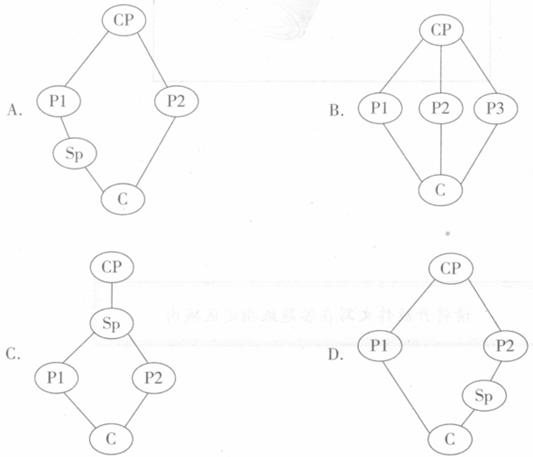
CP (Central Point) P (Point) Sp (Sub-point次要点) C (Conclusion)
D
The rising costs of health care have become a problem for many countries in the world. To deal with this problem, it is recommended that a big part of the government's health budget be used for health education and disease prevention instead of treatment. Actually, many kinds of diseases are preventable in many ways and preventing a disease is usually much cheaper than treating it. For example, people could avoid catching a cold if they dressed warmly when the weather starts getting cold. But many people get sick because they fail to do so, and have to spend money seeing a doctor.
Daily habits like eating more healthy food would have kept millions of families from becoming bankrupt if the patients had taken measures for early prevention. For instance, keeping a balanced diet, such as not consuming too much animal fat and insuring a steady intake of vegetables and fruits, seems to be quite important.
One very effective and costless way of prevention is regular exercise, which is necessary for a healthy mind and body. Regular exercise, such as running, walking, and playing sports is a good way to make people feel better or reduce stress.
In addition, health education plays a key role in improving people's health. By giving people more information about health, countries could help people understand the importance of disease prevention and ways to achieve it. For example, knowing one's family medical history is an effective way to help keep healthy. Information about health problems among close relatives will make them aware of what they should do to prevent certain diseases through lifestyle changes, which will work before it is too late.
However, stressing disease prevention does not mean medical treatment is unimportant. After all, prevention and treatment are just two different means toward the same effect. In conclusion, we could save money on health care and treat patients more successfully if our country spends more money on health prevention and education.
67.What’s the best title of the passage?
A.Prevention or Education? B.Prevention or Treatment?
C.Health or Illness? D.Exercise or Illness?
68.Which of the following can replace the underlined word “bankrupt’’?
A.Unable to be cured B.Unable to pay one’s debts
C.Stronger than ever before D.More successful than ever before
69.We learn from the passage that .
A.dressing warmly can prevent diseases
B.a balanced diet is cheaper than regular exercise
C.the more health education, the better
D.the government’s health budget should be increased
70.Which of the following shows the structure of the passage?

CP (Central Point) P (Point) Sp (Sub-point次要点) C (Conclusion)
查看习题详情和答案>>We can make mistakes at any age. Some mistakes we make are about money. But most mistakes are about people. “Did Jerry really care when I broke up(分开) with Helen?” “When I got that great job, did Jim, as a friend, really feel good about it?” “And was Paul friendly just because I had a car?” When we look back, these thoughts can make us feel bad. But when we look back, it is too late.
Why do we go wrong with our friends, or our enemies? Sometimes what people say hides their real meanings. And if we do not really listen, we miss the feeling behind the words. When someone tells you, “You’re a lucky dog!” Is he really on your side? If he says, “You’re a lucky guy!” That is being friendly. But “a lucky dog”? There is a bit of envy (嫉妒) in those words. What he may be saying is that he does not think you deserve (应得) your luck.
“Just think of all the things you have to be thankful for” is another phrase(短语) that says one thing and means another. It could mean that the speaker is trying to get you to see your problem. But this phrase contains the thought that your problem is not at all important.
How can you tell the real meaning behind someone’s words? One way is to take a good look at the person talking. Do his words fit the way he looks? Is what he says shown by the tone of voice? The look in his eyes? Stop and think. The minute you spend thinking about the real meaning of what people say to you may save your another mistake.
【小题1】When the writer thinks of some of the things that happened between him and his friends, he .
| A.feels happy, thinking how nice his friends are to him |
| B.feels he might not have understood his friend’s true feelings |
| C.thinks it a mistake to have broken up with his girl friend |
| D.is sorry that his friends let him down |
| A.the speaker is just friendly |
| B.this sentence suggests the same as “You’re a lucky guy!” |
| C.the word “dog” should not be used to apply to(运用到) people. |
| D.sometimes the words show that the speaker is a bit envious. |
| A.avoid mistakes about money and friends |
| B.get an idea of friendly people |
| C.avoid mistakes in understanding what people tell you |
| D.keep people friendly without trusting them |
| A.everybody | B.nobody | C.all the people | D.not all the people |
We can make mistakes at any age. Some mistakes we make are about money. But most mistakes are about people. “Did Jerry really care when I broke up with Helen?” “When I got that great job, did Jim, as a friend, really feel good about it?” “And was Paul friendly just because I had a car?” When we look back, these thoughts can make us feel bad. But when we look back, it is too late.
Why do we go wrong with our friends, or our enemies? Sometimes what people say hides their real meanings. And if we do not really listen, we miss the feeling behind the words. When someone tells you, “You’re a lucky dog!” Is he really on your side? If he says, “You’re a lucky guy!” that is being friendly. But “a lucky dog”? There is a bit of envy (嫉妒) in those words. What he may be saying is that he does not think you deserve (应得) your luck.
“Just think of all the things you have to be thankful for” is another phrase that says one thing and means another. It could mean that the speaker is trying to get you to see your problem. But this phrase contains the thought that your problem is not at all important.
How can you tell the real meaning behind someone’s words? One way is to take a good look at the person talking. Do his words fit the way he looks? Is what he says shown by the tone of voice? The look in his eyes? Stop and think. The minute you spend thinking about the real meaning of what people say to you may save your another mistake.
【小题1】When the writer thinks of some of the things that happened between him and his friends, he .
| A.feels happy, thinking how nice his friends are to him |
| B.feels he might not have understood his friend’s true feelings |
| C.thinks it a mistake to have broken up with his girl friend |
| D.is sorry that his friends let him down |
| A.the speaker is just friendly |
| B.this sentence suggests the same as “You’re a lucky guy!” |
| C.the word “dog” should not be used to apply to people |
| D.sometimes the words show that the speaker is a bit envious |
| A.avoid mistakes about money and friends |
| B.get an idea of friendly people |
| C.avoid mistakes in understanding what people tell you |
| D.keep people friendly without trusting them |
| A.everybody | B.nobody | C.all the people | D.not all the people |
We can make mistakes at any age. Some mistakes we make are about money. But most mistakes are about people. “Did Jerry really care when I broke up(分开) with Helen?” “When I got that great job, did Jim, as a friend, really feel good about it?” “And was Paul friendly just because I had a car?” When we look back, these thoughts can make us feel bad. But when we look back, it is too late.
Why do we go wrong with our friends, or our enemies? Sometimes what people say hides their real meanings. And if we do not really listen, we miss the feeling behind the words. When someone tells you, “You’re a lucky dog!” Is he really on your side? If he says, “You’re a lucky guy!” That is being friendly. But “a lucky dog”? There is a bit of envy (嫉妒) in those words. What he may be saying is that he does not think you deserve (应得) your luck.
“Just think of all the things you have to be thankful for” is another phrase(短语) that says one thing and means another. It could mean that the speaker is trying to get you to see your problem. But this phrase contains the thought that your problem is not at all important.
How can you tell the real meaning behind someone’s words? One way is to take a good look at the person talking. Do his words fit the way he looks? Is what he says shown by the tone of voice? The look in his eyes? Stop and think. The minute you spend thinking about the real meaning of what people say to you may save your another mistake.
1.When the writer thinks of some of the things that happened between him and his friends, he .
A.feels happy, thinking how nice his friends are to him
B.feels he might not have understood his friend’s true feelings
C.thinks it a mistake to have broken up with his girl friend
D.is sorry that his friends let him down
2.When the writer talks about the saying, “You’re a lucky dog!”, he is saying that .
A.the speaker is just friendly
B.this sentence suggests the same as “You’re a lucky guy!”
C.the word “dog” should not be used to apply to(运用到) people.
D.sometimes the words show that the speaker is a bit envious.
3.This passage tries to tell you how to .
A.avoid mistakes about money and friends
B.get an idea of friendly people
C.avoid mistakes in understanding what people tell you
D.keep people friendly without trusting them
4.The writer suggests that should be trusted.
A.everybody B.nobody C.all the people D.not all the people
查看习题详情和答案>>