网址:http://m.1010jiajiao.com/timu3_id_3006749[举报]
Students across China, studying in the fields of engineering, science and technology, are developing a
range of inventions that they hope will one day be marketable. Here are three examples from the minds of China's young inventors.
Foot-Controlled Mouse
This new kind of mouse is controlled by the feet instead of the hands, to help handicapped people
when surfing the Internet.
The new device is called a "surf mouse", and looks like a pair of blue slippers. When users press the
slippers with their forefeet, they are clicking the left mouse button; when people press with their heels,
they are clicking the right mouse; when they roll their feet over the slippers, they can view Web pages.
Dirty Water Filter
The "pump of life", a filter, can make dirty water drinkable. The pump is over 30 centimeters long and
has a diameter of four centimeters. It has an in-pipe at the top and out-pipe at the end. There are two
main parts: the drive zone to pump water and the material zone to eliminate (去除) harmful substances.
Rain, fish tank water and coalmine water can all be cleaned in the material zone. The invention could be
used for many kinds of disaster relief. Pan told us that water was delivered by helicopters to Wenchuan.
If they had sent water-purifying equipment instead, people could have had more water faster after the
earthquake.
Transformer Vehicle
The multi-functional vehicle is named Tranfus. By changing the breadth of tires and the structure of a
car, it can become a motorbike or a luggage carrier. The name Tranfus is a contraction of "transforming
for us."
Traffic jams can make a driver go crazy. The Tranfus can change into luggage carrier, and users
could walk with it. When started, the roof transforms, turning into a motorbike. But its inventor doesn't
think Tranfus will be on the market soon as some auto companies like it, but none are willing to invest.
B. Those absent-minded in classes.
C. Those hoping cheating in exams.
D. Those having disability in hands.
B. They can raise their heels.
C. They can roll their feet.
D. They can press their heels.
B. When there are natural disasters causing clean water shortage.
C. When there are earthquakes in the mountainous areas.
D. When there are too many people in a crowded city.
B. It is too small to be a car and too big to be a luggage carrier.
C. There are no auto companies offering to invest in it.
D. There are no auto companies showing interest in it.
You may not pay much attention to your daily elevator ride. Many of us use a lift several times during the day without really thinking about it. But Lee Gray, PhD, of the University of North Carolina, US, has made it his business to examine this overlooked form of public transport. He is known as the “Elevator Guy”.
?? “The lift becomes this interesting social space where etiquette(礼仪)is sort of strange,” Gray told the BBC. “They are socially very interesting but often very awkward places.”
?? We walk in and usually turn around to face the door. If someone else comes in, we may have to move. And here, according to Gray, liftusers unthinkingly go through a set pattern of movements. He told the BBC what he had observed.
?? He explained that when you are the only one inside a lift, you can do whatever you want – it’s your own little box.
?? If there are two of you, you go into different corners, standing diagonally(对角线地)across from each other to create distance.
?? When a third person enters, you will unconsciously form a triangle. And when there is a fourth person it becomes a square, with someone in every corner. A fifth person is probably going to have to stand in the middle.
?? New entrants to the lift will need to size up the situation when the doors slide open and then act decisively. Once in, for most people the rule is simple – look down, or look at your phone.
?? Why are we so awkward in lifts?
?? “You don’t have enough space,” Professor Babette Renneberg, a clinical psychologist at the Free University of Berlin, told the BBC. “Usually when we meet other people we have about an arm’s length of distance between us. And that’s not possible in most elevators.”
?? In such a small, enclosed space it becomes very important to act in a way that cannot be construed(理解)as threatening or strange. “The easiest way to do this is to avoid eye contact,” she said.
1.The main purpose of the article is to _______.
A. share an interesting but awkward elevator ride
B. tell us some unwritten rules of elevator etiquette
C. analyze what makes people feel awkward in an elevator
B. remind us not to behave strangely when in an elevator
2.According to Gray, when people enter an elevator, they usually _______.
A. turn around and greet one another
B. look around or examine their phone
C. try to keep a distance from other people
D. make eye contact with those in the elevator
3. Which of the following describes how people usually stand when they are in the elevator?

4. The underlined phrase “size up” in Paragraph 7 is closest in meaning to _______.
A. judge??????? B. ignore????? C. put up with???? D. make the best of ????????????? ?????????????
查看习题详情和答案>>
You may not pay much attention to your daily elevator ride. Many of us use a lift several times during the day without really thinking about it. But Lee Gray, PhD, of the University of North Carolina, US, has made it his business to examine this overlooked form of public transport. He is known as the “Elevator Guy”.
“The lift becomes this interesting social space where etiquette (礼仪) is sort of odd (奇怪的),” Gray told the BBC. “They [elevators] are socially very interesting but often very awkward places.”
We walk in and usually turn around to face the door. If someone else comes in, we may have to move. And here, according to Gray, liftusers unthinkingly go through a set pattern of movements. He told the BBC what he had observed.
He explained that when you are the only one inside a lift, you can do whatever you want – it’s your own little box.
If there are two of you, you go into different corners, standing diagonally (对角线地) across from each other to create distance.
When a third person enters, you will unconsciously form a triangle. And when there is a fourth person it becomes a square, with someone in every corner. A fifth person is probably going to have to stand in the middle.
New entrants to the lift will need to size up the situation when the doors slide open and then act decisively. Once in, for most people the rule is simple – look down, or look at your phone.
Why are we so awkward in lifts?
“You don’t have enough space,” Professor Babette Renneberg, a clinical psychologist at the Free University of Berlin, told the BBC. “Usually when we meet other people we have about an arm’s length of distance between us. And that’s not possible in most elevators.”
In such a small, enclosed space it becomes very important to act in a way that cannot be construed (理解) as threatening or odd. “The easiest way to do this is to avoid eye contact,” she said.
1.The main purpose of the article is to _____.
A. remind us to enjoy ourselves in the elevator
B. tell us some unwritten rules of elevator etiquette
C. share an interesting but awkward elevator ride
D. analyze what makes people feel awkward in an elevator
2.According to Gray, when people enter an elevator, they usually _____.
A. turn around and greet one another
B. look around or examine their phone
C. make eye contact with those in the elevator
D. try to keep a distance from other people
3.Which of the following describes how people usually stand when there are at least two people in an elevator?
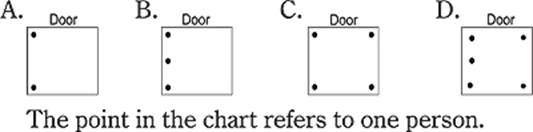
4.The underlined phrase “size up” in Paragraph 7 is closest in meaning to _____.
A. judge B. ignore C. put up with D. make the best of
5.According to the article, people feel awkward in lifts because of _____.
A. someone’s odd behaviors
B. the lack of space
C. their unfamiliarity with one another
D. their eye contact with one another
查看习题详情和答案>>
You may not pay much attention to your daily elevator ride. Many of us use a lift several times during the day without really thinking about it. But Lee Gray, PhD, of the University of North Carolina, US, has made it his business to examine this overlooked form of public transport. He is known as the “Elevator Guy”.
“The lift becomes this interesting social space where etiquette (礼仪) is sort of odd (奇怪的),” Gray told the BBC. “They [elevators] are socially very interesting but often very awkward places.”
We walk in and usually turn around to face the door. If someone else comes in, we may have to move. And here, according to Gray, liftusers unthinkingly go through a set pattern of movements. He told the BBC what he had observed.
He explained that when you are the only one inside a lift, you can do whatever you want – it’s your own little box.
If there are two of you, you go into different corners, standing diagonally (对角线地) across from each other to create distance.
When a third person enters, you will unconsciously form a triangle. And when there is a fourth person it becomes a square, with someone in every corner. A fifth person is probably going to have to stand in the middle.
New entrants to the lift will need to size up the situation when the doors slide open and then act decisively. Once in, for most people the rule is simple – look down, or look at your phone.
Why are we so awkward in lifts?
“You don’t have enough space,” Professor Babette Renneberg, a clinical psychologist at the Free University of Berlin, told the BBC. “Usually when we meet other people we have about an arm’s length of distance between us. And that’s not possible in most elevators.”
In such a small, enclosed space it becomes very important to act in a way that cannot be construed (理解) as threatening or odd. “The easiest way to do this is to avoid eye contact,” she said.
50.The main purpose of the article is to _____.
A. remind us to enjoy ourselves in the elevator
B. tell us some unwritten rules of elevator etiquette
C. share an interesting but awkward elevator ride
D. analyze what makes people feel awkward in an elevator
51.According to Gray, when people enter an elevator, they usually _____.
A. turn around and greet one another
B. look around or examine their phone
C. make eye contact with those in the elevator
D. try to keep a distance from other people
52.Which of the following describes how people usually stand when there are at least two people in an elevator?

53.The underlined phrase “size up” in Paragraph 7 is closest in meaning to _____.
A. judge B. ignore C. put up with D. make the best of
54.According to the article, people feel awkward in lifts because of _____.
A. someone’s odd behaviors
B. the lack of space
C. their unfamiliarity with one another
D. their eye contact with one another
查看习题详情和答案>>
You may not pay much attention to your daily elevator ride. Many of us use a lift several times during the day without really thinking about it. But Lee Gray, PhD, of the University of North Carolina, US, has made it his business to examine this overlooked form of public transport. He is known as the “Elevator Guy”.
“The lift becomes this interesting social space where etiquette (礼仪) is sort of odd (奇怪的),” Gray told the BBC. “They [elevators] are socially very interesting but often very awkward places.”
We walk in and usually turn around to face the door. If someone else comes in, we may have to move. And here, according to Gray, liftusers unthinkingly go through a set pattern of movements. He told the BBC what he had observed.
He explained that when you are the only one inside a lift, you can do whatever you want – it’s your own little box.
If there are two of you, you go into different corners, standing diagonally (对角线地) across from each other to create distance.
When a third person enters, you will unconsciously form a triangle. And when there is a fourth person it becomes a square, with someone in every corner. A fifth person is probably going to have to stand in the middle.
New entrants to the lift will need to size up the situation when the doors slide open and then act decisively. Once in, for most people the rule is simple – look down, or look at your phone.
Why are we so awkward in lifts?
“You don’t have enough space,” Professor Babette Renneberg, a clinical psychologist at the Free University of Berlin, told the BBC. “Usually when we meet other people we have about an arm’s length of distance between us. And that’s not possible in most elevators.”
In such a small, enclosed space it becomes very important to act in a way that cannot be construed (理解) as threatening or odd. “The easiest way to do this is to avoid eye contact,” she said.
36.The main purpose of the article is to _____.
A. remind us to enjoy ourselves in the elevator
B. tell us some unwritten rules of elevator etiquette
C. share an interesting but awkward elevator ride
D. analyze what makes people feel awkward in an elevator
37. According to Gray, when people enter an elevator, they usually _____.
A. turn around and greet one another B. look around or examine their phone
C. make eye contact with those in the elevator
D. try to keep a distance from other people
38. Which of the following describes how people usually stand when there are at least two people in an elevator?

39. The underlined phrase “size up” in Paragraph 7 is closest in meaning to _____.
A. judge B. ignore C. put up with D. make the best of
40. According to the article, people feel awkward in lifts because of _____.
A. someone’s odd behaviors B. the lack of space
C. their unfamiliarity with one another D. their eye contact with one another