摘要: Which word can best describe the feelings of Pansanians when he heard about the modern Olympics?

网址:http://m.1010jiajiao.com/timu3_id_2961103[举报]

完形填空

  Are supermarkets designed to persuade us to buy more?When you enter a supermarket,   1   knows better than you do how you will   2  -which way you will walk, where you will   3  , what will make you   4   one product rather than another.When customers go into a shop, they   5   look to their left but move   6   towards the right.So supermarket   7   are usually on the left of the building, and the layout is designed to take shoppers   8   the store, aisle after aisle, from left to right.Then shoppers will pay attention to all the   9  

  Fresh fruit and vegetables are   10   near supermarket entrances.This gives the impression that only   11   food is sold in the shop.  12   food that everyone buys, like sugar and tea are put near each other.They are kept in different aisles so that customers are taken past other   13   foods before they find what they want.In this way, shoppers   14   to buy products that they do not   15  

  People walk quickly through   16   aisles, but they move more slowly in wide aisle and give more attention to the products.One bestselling   17   for products is at the end of aisles, because shoppers slow down to turn into the next aisle.

  Sweets are often placed at children’s   18   at the checkout.While parents are   19   to pay, children   20   the sweets and put them in the trolley.

(1)

[  ]

A.

the assistant

B.

the manager

C.

the leader

D.

the shop owner

(2)

[  ]

A.

behave

B.

select

C.

move

D.

take

(3)

[  ]

A.

go

B.

stop

C.

look

D.

stand

(4)

[  ]

A.

enjoy

B.

ask for

C.

refuse

D.

buy

(5)

[  ]

A.

naturally

B.

simply

C.

easily

D.

hurriedly

(6)

[  ]

A.

down

B.

clockwise

C.

back

D.

ahead

(7)

[  ]

A.

exits

B.

toilets

C.

entrances

D.

centers

(8)

[  ]

A.

into

B.

around

C.

out of

D.

close to

(9)

[  ]

A.

products

B.

signs

C.

prices

D.

shelves

(10)

[  ]

A.

stored

B.

hidden

C.

displayed

D.

bought

(11)

[  ]

A.

daily

B.

nice

C.

necessary

D.

healthy

(12)

[  ]

A.

Important

B.

Basic

C.

Fast

D.

Fresh

(13)

[  ]

A.

good

B.

cheap

C.

expensive

D.

attractive

(14)

[  ]

A.

are invited

B.

are ready

C.

are encouraged

D.

are willing

(15)

[  ]

A.

really need

B.

eat

C.

know

D.

like at all

(16)

[  ]

A.

long

B.

short

C.

high

D.

narrow

(17)

[  ]

A.

location

B.

position

C.

situation

D.

action

(18)

[  ]

A.

hand level

B.

eye level

C.

low level

D.

high level

(19)

[  ]

A.

sitting

B.

asked

C.

waiting

D.

going

(20)

[  ]

A.

search for

B.

call for

C.

look for

D.

reach for

查看习题详情和答案>>

阅读理解

  THE names of William Shakespeare, Charles Dickens, and Jane Austen are probably not new to you.They are stars of the literary landscape and their works add to the charm of their British homeland.This week, we take you to the places where these literary masters grew up, lived or got their inspiration from.

  Stratford-upon-Avon

  Located on the banks of the river Avon in the north of England, Stratford-upon-Avon provides a beautiful glimpse into Britain’s rural life.Every year, thousands of tourists flock to the town to see the land that produced Britain’s greatest playwright.They visit the house where Shakespeare lived and go to the Royal Shakespeare Theatre to enjoy his plays.

  William Shakespeare(1564-1616)

  Stratford-upon-Avon would be on an ordinary small city in Britain if it was not the birthplace of William Shakespeare.Shakespeare left the town when he was 18, but even at the height of his career in London, Shakespeare returned here regularly to visit his family.Shakespeare thought of it as his real home, even though London brought him fame.

  Bath

  UNESCO World Heritage city.Bath has the country’s only natural hot springs.The city is named after its most popular sight:the Roman Baths, which were built by the Romans in the first century as a public bath house.For centuries, people went there to bathe in the natural mineral water.

  Jane Austen(1775-1817)

  Bath was one of Austen’s favorite places.It appears in her novels ?Persuasion and Northanger Abbey. In the latter she wrote:“I do like it very much.If I could have papa and mamma, and the rest of them here, I suppose I should be too happy!”

  London

  LONDON is the cultural centre of Britain.Its historical attractions draw numerous visitors.Treasures such as Westminster Abbey, Big Ben and Buckingham Palace are among the world’s top tourist attractions.Museums like the British Museum and the National Gallery, all free, make London a favorite for art lovers.

  Charles Dickens(1812-1870)?

  Dickens spent most of his life in London and wrote extensively about this city.Born in Hampshire, south of London, Dickens moved to London when he was two years old.He depicted London as foggy, dirty, with villains everywhere, as shown in his works Oliver Twist, Great Expectations, Bleak House and A Tale of Two Cities

(1)

Which of the following doesn’t belong to the world’s top tourist attractions?

[  ]

A.

Stratford-upon-Avon.

B.

Westminster Abbey.

C.

Big Ben.

D.

Buckingham Palace.

(2)

Which of the following is true?

[  ]

A.

Stratford-upon-Avon made Shakespeare famous.

B.

In Shakespeare’s opinion, London was his real home.

C.

Stratford-upon-Avon was the birthplace of Shakespeare.

D.

Shakespeare returned to London regularly to visit his family.

(3)

________ appears in the novels Persuasion and Northanger Abbey

[  ]

A.

Stratford-upon-Avon

B.

London

C.

Britain

D.

Bath

(4)

________ is not Charles Dickens’s works.

[  ]

A.

Oliver Twist?

B.

Great Expectation?

C.

Bleak House?

D.

Northanger Abbey?

(5)

What’s the main idea of the passage?

[  ]

A.

Introduce the places where three literary masters grew up and lived.

B.

Introduce the works of three literary masters.

C.

Compare the three literary masters.

D.

Describe the three literary masters.

查看习题详情和答案>>

完形填空

  Anna Douglas was 72 years old when she started writing her newspaper column.She had been a school teacher before she retired(退休), but she needed to keep   1  .She was even willing to work without pay.She then offered her   2   with a business that helped other businesses find jobs for old people.Every day she   3   other old folks like her.By talking with them, she   4   two things.Old people had abilities that were not   5  .But old people also had some   6  .She found a new purpose for herself then.

  Through the years, she   7   to write stories about people for national magazines.There was now a new   8  ; old people tike herself.She began to write a newspaper column called“Sixty plus”, which was about   9   old.She writes about the problems of old people, especially their problems with being   10  

  Anna Douglas uses her   11   ability to see the truth behind a problem.She understands   12   problems begin.For example, one of her   13   said that his grandchildren   14   the houses as soon as he came to visit.Mrs.Douglas   15   some ways for him to understand his grandchildren.

  “It’s important to know   16   about your grandchildren’s world,”says Mrs.Douglas.“That means questioning and listening, and   17   is not what old people do best.Say good things to them and about them,”she continues.“Never try to   18   your grandchildren or other young people.Never   19   your opinion.Don’t tell them what they should do.  20  , they have been taught they should have respect for old people.The old should respect them as well.”

(1)

[  ]

A.

free

B.

rich

C.

powerful

D.

busy

(2)

[  ]

A.

service

B.

money

C.

students

D.

books

(3)

[  ]

A.

observed

B.

met

C.

comforted

D.

answered

(4)

[  ]

A.

recognized

B.

followed

C.

enjoyed

D.

demanded

(5)

[  ]

A.

studied

B.

agreed

C.

gave

D.

used

(6)

[  ]

A.

mistakes

B.

problems

C.

questions

D.

characters

(7)

[  ]

A.

had

B.

ought

C.

was

D.

used

(8)

[  ]

A.

subject

B.

life

C.

way

D.

plan

(9)

[  ]

A.

getting

B.

respecting

C.

employing

D.

supporting

(10)

[  ]

A.

unknown

B.

refused

C.

misunderstood

D.

discouraged

(11)

[  ]

A.

thinking

B.

working

C.

writing

D.

leading

(12)

[  ]

A.

that

B.

when

C.

why

D.

whether

(13)

[  ]

A.

visitors

B.

readers

C.

listeners

D.

friends

(14)

[  ]

A.

got

B.

entered

C.

left

D.

passed

(15)

[  ]

A.

invented

B.

chose

C.

suggested

D.

imagined

(16)

[  ]

A.

everything

B.

something

C.

anything

D.

nothing

(17)

[  ]

A.

listening

B.

speaking

C.

pleasing

D.

advising

(18)

[  ]

A.

praise

B.

scold

C.

trouble

D.

encourage

(19)

[  ]

A.

speak out

B.

give up

C.

get back

D.

stick to

(20)

[  ]

A.

Commonly

B.

Surprisingly

C.

Happily

D.

Naturally

查看习题详情和答案>>
Getting Around in Beijing

  Taxis

  Taxis are in the streets 24 hours a day.Simply raise your hand, and a taxi will appear in no time.They are usually red, and they display the price per kilometre on the window.You should check whether the cab has a business permit, and make sure you ask for a receipt.

  Buses and trolleybuses

  Public transport provides a cheap way to get around in Beijing.There are 20,000 buses and trolleybuses in Beijing, but they can get very crowded.It’s a good idea to avoid public transport during the rush hour(6∶30 a.m.~8∶00 a.m.and 5∶00 p.m.~6∶30 p.m.).Fares are cheap, starting at 1 yuan.Air-conditioned buses cost more.Buses numbered 1 to 100 are limited to travel within the city centre.Higher numbers have destinations in the suburbs.Tourists shouldn’t miss the 103 bus which offers one of the most impressive routes, past the Forbidden City and the White Pagoda in Beihai Park.If you get on a double-decker bus, make sure you sit upstairs.You’ll have a good view of the rapidly changing city.
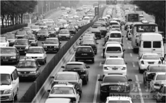
  Most buses run from about 5∶00 a.m.to midnight.However, there is also a night bus service, provided by buses with a number in the 200s.

  Minibuses

  Minibuses with seats for 12 passengers offer an alternative to expensive taxis and crowded public transport in some areas.They run regular services and follow the same routes as large public buses.And in a minibus you always get a seat even in rush hours.

  Underground

  There are four underground lines in Beijing, and several lines are under construction.Trains are fast and convenient, but rush hours can be terrible.A oneway trip costs 3 yuan.Station names are marked in pinyin.The underground is open from 5∶00 a.m.to 11∶00 p.m.

  Pedicabs

  Tourists like these human-pedalled“tricycle taxis”, but they can be expensive.You should talk to the driver, and make sure you know the price before you begin the journey.For example, if it is per person, single or return.Tricycles are worth using if you want to explore the narrow alleys(hutong)of old Beijing.

Questions:

1.What’s the problem with buses?

2.What are the advantages of the underground?

3.What can you visit in a pedicab?

查看习题详情和答案>>

违法和不良信息举报电话:027-86699610 举报邮箱:58377363@163.com

精英家教网