网址:http://m.1010jiajiao.com/timu3_id_2959789[举报]
完形填空
A couple from Minneapolis, in the north, decided to go to Florida, in the south, for a long weekend during one particularly icy cold winter. They both had jobs, and had 1 managing their travel schedules(日程安排)It was decided the husband would fly to Florida on a Thursday, and his wife would 2 him the next day. Upon arriving as 3 , the husband checked into the 4 There he decided to 5 his laptop(computer)and send his wife an email back in Minneapolis. However, he 6 left off one letter in her 7 and sent the e-mail without 8 his error.
In the 9 in Houston, a widow(寡妇)had just returned from her husband’s burial service He was a minister of many years who had been“called home to glory”following a heart 10 (died and gone to report in heaven). The widow checked her e-mail, 1l messages from family and friends. Upon 12 the first message, she was so shocked as to fall to the floor, The widow’s son 13 into the room, found his mother on the floor and saw the computer 14 which read:
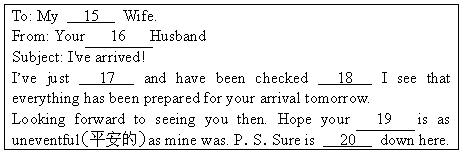
|
(1)A.confidence |
B.argument |
C.doubt |
D.difficulty |
|
(2)A.visit |
B.detect |
C.follow |
D.track |
|
(3)A.aimed |
B.planned |
C.meant |
D.programmed |
|
(4)A.hotel |
B.office |
C.airport |
D.station |
|
(5)A.open |
B.set |
C.show |
D.begin |
|
(6)A.willingly |
B.accidentally |
C.purposely |
D.aimlessly |
|
(7)A.article |
B.sentence |
C.address |
D.letter |
|
(8)A.looking |
B.watching out |
C.noticing |
D.observing |
|
(9)A.absence |
B.course |
C.meantime |
D.case |
|
(10)A.blow |
B.knock |
C.strike |
D.attack |
|
(11)A.hearing |
B.typing |
C.hoping |
D.expecting |
|
(12)A.taking |
B.reading |
C.staring |
D.bringing |
|
(13)A.rushed |
B.charged |
C.hurried |
D.walked |
|
(14)A.screen |
B.keyboard |
C.window |
D.mouse |
|
(15)A.Living |
B.Loving |
C.Brave |
D.Poor |
|
(16)A.Disappeared |
B.Deserted |
C.Departed |
D.Dead |
|
(17)A.gone |
B.died |
C.left |
D.arrived |
|
(18)A.over |
B.back |
C.out |
D.in |
|
(19)A.arrangement |
B.journey |
C.voyage |
D.adventure |
|
(20)A.hot |
B.sad |
C.new |
D.quiet |
—So,Nancy,you had no difficulty finding your way here??
—_____________.?
A.Yes,no difficulty B.No,none at all
C.Yes,no problem D.Nonsense?
查看习题详情和答案>>While I studied at school, I felt great difficulty in learning my Latin translations. I was always very 36 in using a dictionary, and 37 it most difficult, while to other boys it seemed no 38 .
I formed an alliance(盟友) with a boy in the Sixth Grade. He was very clever and 39 read Latin as easily as English. My friend for his part was almost as 40 troubled by the English essays he had to write for the headmaster as I was 41 these Latin words. We agreed together that he should 42 me my Latin translations and that I should do his essays. The arrangement 43 wonderfully. The headmaster seemed quite 44 with my work, and I had more time to myself in the morning. On the other hand, once a week 45 I had to compose the essays of my friend. For several months no difficulty 46 , but once we were nearly caught out.
One afternoon, the headmaster 47 my friend to discuss one essay with him in a lively spirit. “I was interested in this 48 you make here. I think you might have gone further. Tell me 49 you had in your mind.” The headmaster continued in this 50 for some time to fear of my friend. However, the headmaster, not wishing to 51 an occasion of praise into 52 of fault-finding, finally 53 him go. He came back to me like a man who had had a very narrow 54 and I made up my mind to make every effort to study my 55 .
1.A. quick B. slow C. hard D. good
2.A. made B. got C. found D. left
3.A. trouble B. difference C. labor D. worry
4.A. might B. would C. should D. could
5.A. very B. little C. much D. few
6.A. for B. by C. in D. to
7.A. change B. take C. forgive D. tell
8.A. worked B. tried C. happened D. developed
9.A. angry B. satisfied C. frightened D. sad
10.A. or so B. or else C. as usual D. as far
11.A. became B. seemed C. lay D. appeared
12.A. called B. taught C. arranged D. sent
13.A. aim B. goal C. point D. opinion
14.A. why B. how C. which D. what
15.A. excitement B. way C. meaning D. disappointment
16.A. turn B. leave C. grow D. become
17.A. none B. one C. either D. some
18.A. ordered B. asked C. took D. let
19.A. surprise B. escape C. hope D. chance
20.A. reading B. writing C. translations D. essays
查看习题详情和答案>>
When other nine-year-old kids were playing games, she was working at a petrol station. When other teens were studying or going out, she struggled to find a place to sleep on the street. But she overcame these terrible setbacks to win a highly competitive scholarship and gain entry to Harvard University. And her amazing story has inspired a movie, “Homeless to Harvard:The Liz Murray Story” , shown in late April.
Liz Murray , a 22-- year-- old American girl, has been writing a real--life story of willpower and determination. Liz grew up in the shadow of two drug--addicted parents. There was never enough food or warm clothes in the house. Liz was the only member of the family who had a job. Her mother had AIDS and died when Liz was just 15 years old. The effect of that loss became a turning point in her life. Connecting the environment in which she had grown up with how her mother had died, she decided to do something about it.
Liz went back to school. She threw herself into her studies, never telling her teachers that she was homeless. At night, she lived on the streets. “What drove me to live on had something to do with understanding, My understanding was that there was a whole other way of being. I had only experienced a small part of society,” she wrote in her book Breaking Night.
She admitted that she used envy to drive herself on. She used the benefits that come easily to others, such as a safe living environment, to encourage herself that "next to nothing could hold me down". She finished high school in just two years and won a full scholarship to study at Harvard University. But Liz decided to leave her top university a couple of months earlier this year in order to take care of her father, who has also developed AIDS. "I love my parents so much. They are drug addicts. But I never forget that they love me all the time."
Liz wants moviegoers to come away with the idea that changing your life is "as simple as making a decision".
【小题1】 The word “setback” in the first paragraph most probably means___________?
| A.danger | B.difficulty | C.unhappiness | D.disaster |
| A.Liz’s Harvard Dream | B.Bitter Childhood of Liz |
| C.Liz’s Love for Her Parents | D.Liz’s Struggle for Her Life |
| A.Her parents’ addiction to drugs | B.Her mother’ s disease |
| C.Lack of food and clothes | D.Her mother’ s death |
| A.strong-- willed | B.envious | C.determined | D.respectful |
The easy way out isn’t always easiest. I learned that lesson when I decided to treat Doug, my husband of one month, to a special meal. I glanced through my cookbook and chose a menu which included homemade bread. Knowing the bread would take time, I started on it as soon as Doug left for work. As I was not experienced in cooking, I thought if a dozen was good, two dozen would be better, so I doubled everything. As Doug loved oranges, I also opened a can of orange and poured it all into the bowl. Soon there was a sticky dough (面团) covered with ugly yellowish marks. Realizing I had been defeated, I put the dough in the rubbish bin outside so I wouldn't have to face Doug laughing at my work, I went on preparing the rest of the meal, and, when Doug got home, we sat down to Cornish chicken with rice. He tried to enjoy the meal but seemed disturbed. Twice he got up and went outside, saying he thought he heard a noise. The third time he left, I went to the windows to see what he was doing. Looking out, I saw Doug standing about three feet from the rubbish bin, holding the lid up with a stick and looking into the container. When I came out of the house, he dropped the stick and explained that there was something alive in our rubbish bin. Picking up the stick again, he held the lid up enough for me to see. I felt cold. But I stepped closer and looked harder. Without doubt it was my work. The hot sun had caused the dough to double in size and the fermenting yeast (酵母) made the surface shake and sigh as though it were breathing. I had to admit what the ‘living thing’ was and why it was there. I don’t know who was more embarrassed by the whole thing, Doug or me.
1.The writer’s purpose in writing this story is ________.
A. to tell an interesting experience
B. to show the easiest way out of a difficulty
C. to describe the trouble facing a newly married woman
D. to explain the difficulty of learning to cook from books
2.Why did the woman’s attempt at making the bread turn out to be unsuccessful?
A. The canned orange had gone bad.
B. She didn’t use the right kind of flour.
C. The cookbook was hard to understand.
D. She did not follow the directions closely.
3.Why did the woman put the dough in the rubbish bin?
A. She didn’t see the use of keeping it
B. She meant to joke with her husband.
C. She didn’t want her husband to see it.
D. She hoped it would soon dry in the sun.
4.What made the dough in the rubbish bin look frightening?
A. The rising and falling movement.
B. The strange-looking marks.
C. Its shape.
D. Its size.
5.When Doug went out the third time, the woman looked out of the window because she was ________.
A. surprised at his being interested in the bin
B. afraid that he would discover her secret
C. unhappy that he didn't enjoy the meal
D. curious to know what disturbed him
查看习题详情和答案>>