网址:http://m.1010jiajiao.com/timu3_id_2951810[举报]
C
With smart phones taking the world by Storm,a phone that Can only send and receive voice
calls and text messages may seem like a relic from a bygone age.Yet in East Africa,simple
phones like these are changing the face of the economy,thanks to the mobile money services that are spreading across the region.
Usilng the text-messaging function built into the GSM system(全球通)used by most cell
phone networks,these services allow people without a bank account or credit card to use their
phone as an electronic walletthat can be used to store.send or receive cash.
It works like this:you pay cash to your local agent who then tops up your mobile money
account using a secure form of text messaging.That money can be transferred(转账)to another
person by sending a message to their cell phone account.
For some the system is a lifeline.“If I didn,t have my mobile phone.1 would be very
poor,”says Neyasse Neemur,a mother of four children who lives in northern Kenya.“Now I
can sell fish.”
Neemur took up fishing in July last year,but making money from it was a little tricky,
especially as Turkana people do not usually eat fish.A truck from Ethiopia to Tanzania passes
through her village once a week,and she arranged to have the driver transport the fish several
hundred kilometres south to market in Kisumu.where relatives sell the fish.
“I get the money transfer immediately.”says Neemur.“Then I can pay for my children to go to school and for vegetables and beans,”she adds,“so I don’t need to eat fish.”
According to the Central Bank of Kenya,payments worth around l billion Kenyan shillings
($13 million)per day were transferred through Kenya,s mobile money systems in 2009,equalling
the country,s credit card transactions(业务).The bank expects mobile money transfers to overtake credit cards in 2010.
49.In Paragraph l,the author uses“simple phones”to________.
A.make a comparison B.introduce a topic
C.describe a scene D.offer an argument
50.What can we learn about the simple phones in East Africa?
A.They might help the local people apply for a bank account.
B.They will replace the banks completely in the near future.
C.They provide a safe means for the locals to do business.
D.They can do nothing except send and receive calls or messages.
51.The word“it”in the third paragraph refers to_______.
A.the GSM system B.the mobile money service
C.the credit card service D.the cell phone networks
52.The story of Neyasse Neemur suggests that_______.
A.the mobile money service plays a key rote in the locals, life
B.Neemur uses her mobile phone to contact her customers
C。her relatives tricks Turkana people to eat the fish they sell
D.the Bank of Kenya helps her improve her living condition
查看习题详情和答案>>
When you are at odds with someone close to you, the One-Minute Drill can show you how to express your feelings effectively – and how to listen more skillfully. All it requires is two individuals who are committed to improving their relationship.
Set aside at least ten minutes, and then sit facing each other. Decide who will be the Talker and who will be the Listener. It makes no difference, because later you will change roles.
How to perform the One-Minute Drill
For approximately 30 seconds, the Talker can say anything he or she wants. Your job will be to express your thoughts and feelings. You can discuss problems you've had a hard time talking about. Remember to limit yourself to about 30 seconds. When the Talker finishes, the Listener will summarize what the Talker just said, as well as how the Talker was feeling inside, as accurately as possible.
The Talker now gives the Listener a grade between 0 and 100 per cent to indicate how accurate the summary was. If the rating is 95 per cent or more, you can change roles; the new Talker can continue with the same topic or move on to something entirely new.
However, if the grade is below 95 per cent, the Talker should point out what the Listener missed or got wrong, and repeat the process until the overall rating is 95 per cent or more. Then you can change roles and repeat the exercise for as long as you both like.
How it works
Thirty seconds of emotionally charged information is sufficiently challenging for anyone. Express your feelings in strong, clear, direct language, but as your partner will be listening attentively, you won't need to shout, exaggerate or put your partner down.
The Listener should sit and listen respectfully without interrupting. Look into your partner's eyes, but avoid using negative body language. If you like, take a few notes.
So the Talker might say: "When I come home from work, I feel tired and I need some quiet time. But you tell me I'm supposed to spend time with the kids. This makes me feel frustrated. I work hard and I'm exhausted at the end of the day. I feel like I deserve a little time to relax, not listen to more demands."
In response, the Listener might summarize like this: "You just told me that you feel exhausted when you come home at night because you've been working hard all day. When I tell you I want you to spend time with the kids, you feel frustrated and ticked off because you're tired and you need time to relax. You see me as very demanding, and you're probably feeling like I don't appreciate you."
The first time you attempt the One-Minute Drill, you may get a low score. Don't worry, because you'll get up to speed quickly. Once you've tried this exercise a few times, you'll find that you can nearly always get ratings of 95 per cent or better on the first or second try.
【小题1】 Who is the One-Minute Drill intended for?
| A.Those who are to act some roles in a certain play for the first time in their life. |
| B.Those who are preparing for the interview in order to make a good first impression. |
| C.Those who have difficulty communicating with their colleagues or family members. |
| D.Those who have troubled relationships with their friends or family members and try to improve them. |
| A.In the One-Minute Drill, the Talker and the Listener change roles in the process. |
| B.The Talker should talk about his / her thoughts and feelings in a brief way. |
| C.The Listener should listen carefully, respectfully and later summarize accurately. |
| D.After the Talker finishes talking, the Listener is to give him / her a grade. |
| A.husband and wife | B.father and son | C.mother and daughter | D.sister and brother |
| A.fast asleep | B.very angry |
| C.burst into tears | D.marked with a symbol |
第二节:完形填空(共20小题;每小题1.5分,满分30分)
阅读下面短文,从短文后所给各题的四个选项(A、B、C和D)中,选出可以填入空白处的最佳选项,并在答题卡上将该项涂黑。
I was told just now in the hospital that I was having a Bell's palsy attack, a condition in which the face muscles tighten because of stress. During the long car ride home, all I could think about was my coming interview. But now I could not even 31 myself in the mirror and my lips was unable to open normally, surely all the other applicants would have the 32 , I concluded.
However, I wouldn’t let my own self-consciousness 33 me. Not now, not when I had 34 so hard for so long to be given this opportunity. This was the kind of position I'd dreamed of for all these years. “Mom, 35 me off on Jacob Street. I'm going to the 36 .”
“Honey, I don't think you should. You look... 37 ,” she said, ever so gently.
I knew she was 38 . But if I didn't, I'd always 39 if I could have gotten my dream job.
"No, Mom, take me there.”
40 , she took me where I wanted to go.
"Hello,” a gray-haired man sitting behind the large desk 41 me. “Miss Jenkins?”
“Yes. Please excuse me. I'm having a Bell's palsy attack. My doctor explained to me that it would last a few days. I came right from the 42 .”
“You're very 43 to come when you're in such a state,” he 44 , after a pause.
He spent a few minutes looking through my 45 . “Is everything on here 46 ?” he asked.
“Yes, but I 47 to mention I type seventy-five words per minute.”
“Well, you have an impressive background with related experience, you are 48 qualified. When are you 49 ?” he asked.
I took a deep breath and asked, “You're hiring me?”
“Not only have you got the skills I'm looking for, you also have the 50 .” He gave me a big smile.
31. A.forgive B.recognize C.believe D.control
32. A.chance B.advantage C.courage D.sympathy
33. A.pardon B.stop C.help D.transform
34. A.driven B.turned C.prepared D.worked
35. A.take B.pull C.drop D.send
36. A.supermarket B.interview C.doctor D.office
37. A.weak B.annoying C.angry D.strange
38. A.right B.kind C.wrong D.sensitive
39. A.regret B.believe C.wonder D.quit
40. A.Hopefully B.Unwillingly C.Fortunately D.Unexpectedly
41. A.doubted B.greeted C.examined D.discouraged
42. A.hospital B.home C.office D.work
43. A.determined B.crazy C.disrespectful D.funny
44. A.stressed B.interrupted C.commented D.complained
45. A.face B.health C.application D.situation
46. A.correct B.normal C.incredible D.contradictory
47. A.pretended B.demanded C.focused D.failed
48. A.narrowly B.possibly C.impossibly D.certainly
49. A.accessible B.convenient C.energetic D.available
50. A.qualification B.appearance C.character D.disadvantage
Ma Wendi graduated from a veterinary(兽医的) school several years ago. And now she is used to 1 (glance) at curiously when she walks six dogs at the same time. They are not all 2 . The 25-year-old veterinary graduate is a full-time dog walker.
“I have to take care of twelve dogs at most,” said Ma. She charges 500 yuan a month per dog, and most customers leave their dogs at her house for a week. The 3 (busy) time is around the Spring Festival, because many people go back to their hometowns for family reunions 4 go traveling.
“Compared with people who have to be in their offices during the day, I don’t have to get up early to squeeze into the subway carriages in rush hour, and I still make 5 decent(体面的) salary. It seems to give me great 6 (encourage) to go on with my job. ” she said.
“But it’s still a tiring job. Whenever there are dogs at home, I can’t leave them alone. I have to work and caring them is bound to be busy, 7 means that I have no time to enjoy myself. Sometimes I want to go out for a meal or shopping, but I can’t do so because I worry about them, and it really makes me 8 (annoy) ” she said.
Most of the dogs seem to adapt 9 the life there. Ma knows all the dogs’ names, and when she calls one’s name, the dog instantly knows she 10 (refer) to it.
查看习题详情和答案>>
任务型阅读 (共10小题; 每小题1分,满分10分)
请认真阅读下列短文,并根据短文的内容要点完成文章后的表格列单。
注意:补全填空应符合语法和搭配要求,每格只填一个单词。
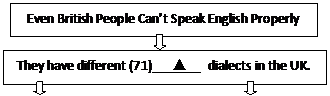
Even British People Can’t Speak English Properly
There are different regional accents across the UK, and a number of regions have several different dialects, that is, they have their own unique vocabulary and grammatical phrases. There were at least six different accents born to London the last time I counted.
Worse than that, it is not just where a person is born in the UK that decides their accent. For example, a language and its accents often vary across class or level of education. Another example is how language can differ among age groups in the UK. The words and pronunciations used by young people in the UK can be radically different compared with those used by adults.
Yoof culture
The word ‘yoof’ is a slang spelling of ‘youth’. Some people consider ‘yoof’ to be a negative term, since its pronunciation is easier and lazier than ‘youth’. Other people see the term as positive, because it describes how young people are creating their own language, concepts and identity. When people find it difficult to understand their children, the children can say more things than without censorship(审查,检查) of their parents. In this way, young people are starting to find freedom, independence and self-expression. They are creating a ‘yoof culture’.
It is not possible to come up with a complete list of words used by yoof. By the time the list was completed, it would be out of date. New words come and go like fashions. However, a few features of the yoof style of language are as follows:
◆instead of saying something like ‘That’s good!’ or ‘I understand’, yoof will use a single adjective like ‘Safe!’, ‘Sorted!’, ‘Sound!’, ‘Cool!’ or ‘Wicked!’.
◆instead of ‘He then said no!’, yoof will say ‘She was like: no!’
◆Instead of ‘She’s attractive!’, yoof will say ‘She’s fine!’ or ‘She’s fit!’
◆Instead of ‘I don’t care!’, a yoof will say ‘Whatever!’.
New social and political language
Certain groups of society feel threatened by ‘yoof culture’ or by the British working classes having more social freedom. As a result, a negative term now commonly used in the UK is ‘chav’. It is insult and is meant to describe someone who is uneducated and anti-social (e.g. ‘He’s a chav!’). A young person who wears a jacket with a hood(风帽,头巾) (after all, it rains a lot in the UK) is sometimes called a ‘hoodie’. It is a negative term and suggests that the young person is interested in committing crime.
Where does that leave us?
Learners of English often feel that the best test of their English is how well they can talk to a native speaker. Yet learners should not worry about communicating with native speakers so much. Research conducted by the British Council shows that 94 per cent of the English spoken in the world today is spoken between non-native speakers of the language. In fact, when we think about ‘international English’, there is no such thing as native or non-native speakers. The UK no longer owns the English language.
 |
|