网址:http://m.1010jiajiao.com/timu3_id_2940101[举报]
阅读理解。
阅读下面短文,掌握其大意,然后从每小题所给的四个选项中,选出最佳答案。
Dear Daniel,
It's New Year's Eve, and as I look back over my life tonight, there are things I've learned in this time that I want to pass along to you. Hopefully, you won't find yourself making some of the same mistakes in your life that I have made in mine.
Always be honest with others, but most importantly, with yourself.Now, this is not to say you must always tell the absolute truth to everyone, all the time. Don't use the truth as a weapon to hurt someone. Somebody who asks, “Do you like my jacket?” doesn't want to hear that maybe you think it's terrible. They are proud of it and happy and just trying to show off a little. It's okay to say you like it if it makes them happy. But for the really important things in life you should always try to be as honest as you can be.
Hold on to your friends. Some friends you will have for a lifetime, others will just seem to enter your life and pass on through. But every one of them is a treasure beyond measure. There will be times in your life when you will need them, and good friends will do that for you. When a friend needs you, be there for them, help them and get them back on their feet again.
Never make a promise unless you are sure you can keep it, and then try your best to keep it. A man is often judged by how he keeps his word. People will pardon you for breaking a promise sometimes when it was given honestly but had to be broken for reasons beyond your control, just don't make a habit of it.
Life is funny! Never be afraid to laugh about it. You are going to make mistakes and look silly at times, so always be willing to laugh at yourself.If you ever find yourself unable to laugh at your own mistakes, you are taking your way too seriously and need to lighten up.
No matter how bad today is, or how terrible yesterday was, tomorrow is a new chance. Put a smile on your face and do what need to be done.
If it's silly but it works, it isn't silly. Don't be afraid to try something new or unusual.
There is a lot more to life than these things Daniel, and hopefully I'll be in your life for a long time to come to help you learn them.
With love, always,
Dad
1.From the letter we can know that Daniel is the writer's ________.
[ ]
2.The letter shows that ________.
[ ]
A.Daniel made a lot of mistakes
B.the writer went through a hard time
C.the writer loves his son deeply
D.Daniel is a silly boy
3.The sentence in the letter “… get them back on their feet again” Means
[ ]
A.teach them how to keep word
B.laugh at them
C.help them to pick themselves up
D.try to hold on
4.Which of the following is true according to the writer?
[ ]
A.Always tell the whole truth to everyone.
B.Never make a promise if no one helps you.
C.Take your way seriously and make less mistakes.
D.Be brave to try something unusual in your life.
查看习题详情和答案>>Part I Listening Comprehension(30 marks)
Section A(22.5 marks)
Directions:In this section, you'll hear six conversations between two speakers.For each conversation, there are several questions, and each question is followed by three choices marked A, B and C.Listen carefully and then choose the best answer for each question.You will hear each conversation TWICE.
Conversation 1
1.How long does the woman need to work every day?
A.Three hours.
B.Four hours.
C.Five hours.
2.How much can the woman earn each day?
A.5 dollars.
B.10 dollars.
C.20 dollars.
Conversation 1
M:Do you have any work experience?
W:No, I’ve never worked in a restaurant before.
M:Do you think you can get along will with customers?
W:Yes, I think so.
M:Can you make sure to be here from four to eight in the afternoon?
W:Yes, I'm always on time.
M:Then you can start tomorrow.Monday through Friday.Five dollars an hour.
W:That's fine.
Conversation 2
3.What's the possible relationship between the speakers?
A.Boss and employee.
B.Mother and son.
C.Teacher and student.
4.When will the man come back?
A.This Monday.
B.This Wednesday.
C.This Friday.
Conversation 2
M:Mrs.Sharon, I say…, I have to …
W:What's the matter, Richard?
M:Er, I'd like to take two days off.My mother's ill.I need to stay with her.
W:I'm sorry to hear that.You mean you will be back here this Wednesday?
M:Yes, I hope I can come back earlier.
W:That's all right.By the way, don't worry about your lessons.I'll certainly help you with them.
Conversation 3
5.What can we know about Nancy and Steve?
A.They will divorce soon.
B.They have two daughters.
C.They divorced last year.
6.Who will help Nancy out in the woman's opinion?
A.Her daughter.
B.Her parents.
C.Her friends.
Conversation 3
M:Kate, Nancy and Steve are breaking up.
W:It's really a shame.I’ve heard that they quarrel, but they’ve always made up afterward.
M:Things are not working out this time.They are getting a separation soon.
W:What will happen to their daughter, Bonnie?
M:Nancy is going to take her.
W:The cost of living is so high.It will be difficult for her to take te responsibility.
M:She seems to have made up her mind.She said she would rather be a single parent than cope with an unhappy marriage.
W:Well, I hope her parents will be able to help her out.
Conversation 4
7.How often does the woman pay the tax?
A.Once a month.
B.Twice a year.
C.Once a year.
8.Why does the woman have to pay more taxes?
A.The government has raised the tax rate.
B.She didn't pay taxes last year.
C.She has got extra money.
9.What can we know about the woman?
A.She is an accountant.
B.She taught in a night school.
C.She lives upon a small income.
Conversation 4
W:Henry, our income tax is due soon.Did you call our accountant?
M:He's figuring out our taxes right now.I gave him all the records on our income and expenses last week.
W:The government has taken away taxes from our paychecks all year.I hope we get some of that money back or at least that we won't have to pay more.
M:Remember the money your aunt left us when she died, and the money you made when you taught in a night school?
W:Yes.
M:Well, that's all taxable income.That money has put us in a higher tax bracket.
W:What does that mean?
M:It means we have to pay more taxes.
W:Well, it looks like we'll have to make more money this year just to pay last year's taxes.
Conversation 5
10.What can we know about the kid from Haiti?
A.He doesn't get on well at school.
B.He is often late for school.
C.He doesn't speak much English.
11.How many countries are mentioned in the conversation?
A.Six.
B.Five.
C.Four.
12.How does the woman help the immigrant kids?
A.She has spent much time with them after class.
B.She gives them more lessons than other kids.
C.She pays more attention to them at class.
Conversation 5
M:Kate, how's the new student in your class doing?
W:The kid from Haiti? He's having a rough time communicating since he doesn't speak much English.However, the other kids seem to involve him pretty well.
M:Our students are used to new kids who don't speak much English since we have had so many new immigrant families moving into our school district.
W:Don't I know it! This year I have had a Vietnamese, an Ethiopian, a Cuban and the kid from Haiti in my class.I spend a lot of time with them after class so that they can catch up.
M:It must have been hard for you since you have to give them special attention in order to help them.
W:It has been.Nevertheless, it's really rewarding to see them progress and make friends.
Conversation 6
13.When will the speakers have the exams?
A.In one week.
B.In two weeks.
C.In three weeks.
14.What will the woman do this summer?
A.Teach English.
B.Find a job.
C.Study Chinese.
15.How did the man learn Chinese?
A.By speaking.
B.By reading.
C.By listening.
Conversation 6
M:Well, Jenny.The school year is almost over.We just have two weeks before exams.What are you going to do this summer?
W:I'm going to teach English to some immigrants in the university's community service program.
M:That sounds interesting.Don't you need to speak a foreign language for the job?
W:No.You just have to present the language simply and give the students a chance to practice speaking.
M:But that's the way I was taught to speak Chinese.But speaking Chinese didn't help me learn to read and write Chinese.
W:My students don't want to read and write English.They are more interested in speaking.
M:You sound very knowledgeable about all this.How do you know so much?
W:I took teaching English as a second language course last year when you were in China.I’ve also talked with the program administrators quite a lot.I think I would like to be an ESL teacher when I graduate.
SECTION B
Directions:In this section, you'll hear a mini-talk.Listen carefully and then fill in numbered blanks with the information you’ve got.Fill each blank with NO MORE THAN 3 WORDS.
You'll hear the mini-talk TWICE.
About friendship
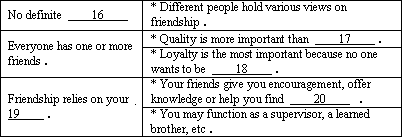
Section B
We often say, “A friend in need is a friend indeed.” But what is the exact meaning of friendship? No one can really offer a definite concept, because different people hold various views on friendship.
Everyone has his own friendship and some have a lot of friends.But in fact, quantity is not so important as quality.Loyalty is the most important for friendship.No one wants to make friends with those who will betray them.
No matter whether you are married or not, no matter where you live and work, your friends are your friends.It is not based on bloodline.It relies on your intention.To you, some friends are fun-loving, some give encouragement, some offer knowledge, and others help you to find your own identity.Before your friends, you may act as a supervisor, a learned brother, a lovely child, a gentleman or a playmate.In a word, friendship helps you to be a full person.So friendship can benefit.
Keys:
听力
第一节
听下面5段对话。每段对话后有一个小题,从题中所给的A、B、C三个选项中选出最佳选项。听完每段对话后,你都有10秒钟的时间来回答有关小题和阅读下一小题。每段对话仅读一遍。
W:Oh, Michael…I didn’t tell you.My sister phoned yesterday.She wants to get married.
M:Married! She’s only seventeen.
1.What does Michael think of the woman’s sister?
A.She is not old enough to get married.
B.She is too old to get married.
C.She is married.
M:Waitress! I’d like the menu, please.
W:Here you are, sir.
2.Where is the man?
A.In a bookstore.
B.In a train station.
C.In a restaurant.
M:Has the TV been repaired?
W:Yes.We’d expected the repairs to cost us about dollars, but they charged us twice as much.
3.How much did the lady pay?
A.$15.
B.$20.
C.$30.
M:Hello, Jane.How lucky to run into you.Can you and Tom come to dinner tomorrow evening?
W:I think so.I don’t think we’re going out.
4.How does the woman respond?
A.She refuses to go to dinner.
B.She agrees to go to dinner.
C.She is angry.
M:I have to go to class because I have a test, but if I could, I’d go with you to the cinema.
W:That’s too bad.I wish that you could come along.
5.Where is the man going?
A.To class.
B.To the cinema.
C.To the doctor’s office.
第二节
听下面5段对话或独白。每段对话或独白后有几个小题,从题中所给的A、B、C三个选项中选出最佳选项。听每段对话或独白前,你将有时间阅读各个小题,每小题5秒钟;听完后,各小题将给出5秒钟的作答时间。每段对话或独白读两遍。
听第6段材料,回答第6~8题。
M:Hello, Mrs Smith.How are you?
W:Fine, thanks, Mr Downs.How’s your boy, Jack?
M:He is a bit tired.You know, he goes to school at eight o’clock every morning.He doesn’t get home till after four.Then he does his homework after ten.It often takes him a couple of hours to finish it.
W:Poor boy.Children work hard at school nowadays, don’t they? Does he like it?
M:School, you mean? Yes, he does.He likes his teachers, and that always makes a difference.
W:Yes, it does.Does he go to school by bus?
M:No, he walks.He likes walking.He meets some of his friends at the corner and they go together.
W:What does he do when it rains?
M:His uncle takes him in the car.He passes the school on the way to the office.
6.What are the two talking about?
A.Mrs Smith.
B.Mr Downs.
C.Mr Downs’ son.
7.How long does a school day last?
A.At least 8 hours.
B.About 6 hours.
C.Nearly 7 hours.
8.How does Jack usually go to school?
A.By bus.
B.On foot.
C.By car.
听第7段材料,回答第9~11题。
M:Hello! Can I speak to Susan, please?
W:Speaking.Is that you, Tom?
M:Yes, it is.I am going to New Zealand in two weeks’ time, and my wife is going with me.
W:Oh, how lucky you are! How long are you going for?
M:For a couple of months, maybe half a year.My boss wants me to help set up a branch company there.Well, Susan, you have been to New Zealand several times.Can you give us some suggestions, or just tell us about that country?
W:I’d love to.We can have a talk sometime.
M:Why not come over to dinner in my house this weekend.My wife wants to meet you as well.
W:All right.What about Saturday?
M:OK.See you at 6∶00 p. m., this coming Saturday.Goodbye!
9.Who answered the phone?
A.Tom.
B.Tom’s wife.
C.Susan.
10.When are they going to New Zealand?
A.In half a year.
B.In a couple of months.
C.In two weeks.
11.Where are they going to meet?
A.At Susan’s.
B.At Tom’s.
C.In New Zealand.
听第8段材料,回答第12~14题。
M:As you can see, Maria, the railway station is very crowded during rush hours.
W:How many people do you suppose ride into New York every day to work?
M:I don’t know.Must be several hundred thousand at least.Maybe a million.
W:I’m glad they’re not all taking this train.
M:Oh, they come from all directions, and by many different means, by railroads, ferries and subways.Then of course, some people drive in.
W:I’m a little afraid I’ll get lost.
M:You’ll soon learn that New York is a very easy city to get around.
W:Let’s see, the “Avenues” run north and south and the “Streets” run east and west, don’t they?
M:That’s right.You won’t get lost when you travel alone.
W:I hope not.
12.What can Maria see?
A.Many trains.
B.Many planes.
C.Many people.
13.What’s the woman afraid of?
A.Driving in.
B.Taking ferries(摆渡).
C.Getting lost.
14.What kind of city is New York, according to the man?
A.An easy city to get around.
B.A city full of subways.
C.A city difficult to get around.
听第9段材料,回答第15~17题。
W:Good afternoon.
M:Good afternoon.My name’s William Turner.I want to make an appointment to see Dr Smith please.
W:Yes, of course, Mr Turner.May I have your address please?
M:108 Park Road, London.
W:Yes, we have you on our records.Can you manage this afternoon at 3:00?
M:Fine.
W:Will 3:00 be all right?
M:Well, yes, but I prefer a later time so I can come along after work.
W:Then what about 5:30?
M:Well, that’s fine.Thank you.Goodbye.
W:Goodbye.
15.Who is William Turner?
A.A close friend of Dr Smith’s.
B.A patient of Dr Smith’s.
C.Both A and B.
16.When will Mr Turner go to see Dr Smith?
A.At 4∶00 p. m.
B.At 5∶00 p. m.
C.At 5∶30 p. m.
17.What’s the main idea of this dialogue?
A.Mr Turner wants to make an appointment with Dr Smith.
B.Mr Turner will go to see Dr Smith at 5∶30 p. m.
C.Mr Turner is a patient of Dr Smith’s.
听第10段材料,回答第18~20题。
If a Chinese comes to England and wants to drive his car there, he must know the English rules of the road and the English traffic signs.One rule is that he must always drive on the left.Another rule is that he mustn’t drive faster than thirty mph through town and villages.If he does not pay attention to this speed limit, the police will soon be after him.The third rule is that cars on the main road have right of way.It is not easy to drive in London, because the traffic is so busy and buses and trucks sometimes block the roads.It is much less difficult to find your way if you go by one of the red buses or the underground.There are bus stops at every street corner.And if you cannot find one, ask a policeman.He will help you at once.
18.On which side of the road are cars driven in England?
A.On the left.
B.On the right.
C.The passage doesn’t tell about that.
19.What can we know from the passage?
A.We know police in England are often after you.
B.We know police in England are often helpful.
C.We know police in England are often impolite.
20.What’s the best title for this passage?
A.English Traffic
B.Come to England
C.Traffic Rules
听力(共20小题;每小题1.5分,满分30分)
第一节
听下面5段对话。每段对话后有一个小题,从题中所给的A、B、C三个选项中选出最佳选项。听完每段对话后,你都有10秒钟的时间来回答有关小题和阅读下一小题。每段对话仅读一遍。
W:What about those in England?
M:The fifty-pence’s the biggest, and the half-penny is the smallest.
W:Really? In America, the biggest is the fifty-cents, and the smallest is the cent.
1.What are the speakers doing?
A.Comparing goods.
B.Doing shopping.
C.Talking about coins.
M:This meat is like old leather! It’s enough to break every tooth in your head.
W:Perhaps you’d like to change your order, sir.The fish is very tender.
2.How does the man feel?
A.Unsatisfied.
B.Impatient.
C.Pleased.
M:Tomorrow is the Tenth of June.It’s my birthday and I’m going to the George and Dragon.Would you like to come?
W:To celebrate your birthday? Of course I would.What group’s playing?
M:The Red Rose, I think.
3.What is the woman interested in?
A.The man.
B.The party.
C.The band.
W:Why are you so late?
M:My alarm clock failed to work again.
4.Why is the man late?
A.He could not walk fast.
B.He slept late last night.
C.His clock was out of order.
M:Where’s the book about cars I was reading last night? I laid it down on the table, and now it’s gone.
W:I don’t know.I cleaned early this morning and I don’t remember where I put it.
5.What is the man looking for?
A.A book about cards.
B.A book about furniture.
C.A book about cars.
第二节
听下面5段对话或独白。每段对话或独白后有几个小题,从题中所给的A、B、C三个选项中选出最佳选项。听每段对话或独白前,你将有时间阅读各小题,每小题5秒钟;听完后,各小题将给出5秒钟的作答时间。每段对话或独白读两遍。
听第6段材料,回答第6~8题。
M:Why aren’t you doing your homework?
W:I’ll do it later, Dad.I must get these things right first.Our group’s playing in a concert on Saturday.
M:Oh, is it? You’ll be making records next, will you?
W:We hope so.The man from “Dream Discs” is coming to the concert.So I’d better play well.
M:You’d better get on with your homework! You can practise the guitar all day Saturday.
W:Oh, Dad, you don’t understand at all.This concert could change my life.
M:It certainly could! You’ve got exams next month.Important ones.If you don’t pass them, you won’t get a good job.
W:I don’t want a boring old job in a bank.
M:Oh, don’t you? Whose boring old job paid for this house? And for what?
W:Yours, I know.But I’d rather be happy than rich.
6.What is the girl doing now?
A.Repairing a guitar.
B.Practising the guitar.
C.Preparing for making records.
7.What does the girl expect?
A.To be chosen by a band.
B.To pass the coming exams.
C.To get a job in a bank.
8.What is the man?
A.A school teacher.
B.A guitar player.
C.A bank clerk.
听第7段材料,回答第9~11题。
W:Hello?1523852.
M:Hello, may I speak to Anna?
W:I’m afraid Anna isn’t in.
M:Is that Tracy speaking?
W:No, this is Jane.
M:Oh, I’m sorry…er…well, could you please leave Anna a passage for me?
W:Sure, what is it?
M:Well, I’ll meet Anna for lunch at my home.Would you ask her to see if she has my French dictionary? And if she does, tell her to bring it along.
W:All right.And where are you calling from?
M:My home.I’m Anna’s friend, Pat.
W:Thank you for calling, Pat.
M:And thank you, Jane.
9.Where is Pat calling from?
A.His home.
B.His school.
C.His office.
10.Who does Pat want to call?
A.Tracy.
B.His friend Anna.
C.Tracy and Anna.
11.Why can’t Pat speak to Anna now?
A.Because Anna is at work.
B.Because Anna is out for lunch.
C.Because Anna is not at home.
听第8段材料,回答第12~14题。
W:Good evening, sir.I’m Assistant Manager.I’m afraid we’ve had a complaint about the noise from your neighbour who’s trying to get some sleep.
M:Oh, I see.
W:Could you please ask your friends to be a little quieter so that our guests can get a good night’s sleep?
M:Oh, I’m so sorry.I suppose we were talking rather loudly.We won an important prize.We were having a celebration.
W:I’m pleased to hear it.Shall I have some coffee brought to you?
M:No, that won’t be necessary.We were just about to pack up anyway.
12.Where does the conversation take place?
A.At a hotel.
B.In a flat building.
C.In the manager’s office.
13.What is the woman pleased to hear?
A.The man’s apology.
B.The man’s story.
C.The man’s explanation.
14.What were the man and his friends about to do?
A.End their activity.
B.Leave where they were.
C.Apologize to their neighbor.
听第9段材料,回答第15~17题。
W:So, what do you think? How do you like New York?
M:I’m having a good time.I love it.I’m glad we came.
W:Yeath really like the stores and the shopping centers?.
M:I love the museums, too.
W:But the traffic is pretty bad.
M:Yeah.I hate all the traffic.It’s really noisy.
W:Listen, it’s almost dinner time.There are lots of restaurants around here.What do you want to try? Italian? Greek? Japanese? Chinese?
M:I can’t stand making decisions.You choose.
W:OK, let’s go American.Where is the nearest McDonald’s?
15.What do you know about the speakers from the dialogue?
A.They are native American.
B.They are tourists to New York.
C.They are from Japan.
16.What do they dislike here?
A.The museum.
B.The restaurants.
C.The traffic.
17.Which restaurants are NOT mentioned in their dialogue?
A.Chinese restaurants.
B.Thai restaurants.
C.American restaurants.
听第10段材料,回答第18~20题。
Scientists are trying to make desert into good land again.They want to bring water to the deserts, so people can live and grow food.They are learning a lot about the deserts.But more and more of the earth is becoming desert all the time.Scientists may not be able to change the desert in time.
Why is more and more land becoming desert? Scientists think that people make deserts.
People are doing bad things to the earth.
Some places on the earth don’t get much rain.But they still don’t become deserts.This is because some green plants are growing there.Green plants and grass are very important to dry places.Plants don’t let the wind blow away the dirt.When a bit of rain falls, the plants hold the water.Without plants, the land can become desert more easily.
18.Why is land becoming desert little by little according to the passage?
A.Because plants can’t grow there.
B.Because there is not enough rain.
C.Because people do bad things to the earth.
19.Why are green plants very important to dry places?
A.Because they don’t let the wind blow the earth away?.
B.Because they hold water.
C.Both of the above.
20.From this passage, what can we learn?
A.Plants can keep dry land from becoming desert.
B.All places without a lot of rain will become deserts?.
C.It is better to grow crops on dry land than on wet land.
听力测试(共20小题;每小题1.5分,满分30分)
第一节
听下面5段对话。每段对话后有一个小题,从题中所给的A、B、C三个选项中选出最佳选项,并标在试卷相应的位置。听完每段对话后,你都有10秒钟的时间来回答有关小题和阅读下一小题。每段对话仅读一遍。
W:What about those in England?
M:The fifty-pence’s the biggest, and the half-penny is the smallest.
W:Really? In America, the biggest is the fifty-cents, and the smallest is the cent.
1.What are the speakers doing?
A.Comparing goods.
B.Doing shopping.
C.Talking about coins.
M:This meat is like old leather! It’s enough to break every tooth in your head.
W:Perhaps you’d like to change your order, sir.The fish is very tender.
2.How does the man feel?
A.Unsatisfied.
B.Impatient.
C.Pleased.
M:Tomorrow is the tenth of June.It’s my birthday and I’m going to the George and Dragon.Would you like to come?
W:To celebrate your birthday? Of course I would.What group’s playing?
M:The Red Rose, I think.
3.What is the woman interested in?
A.The man.
B.The party.
C.The band.
W:Why are you so late?
M:My alarm clock failed to work again.
4.Why is the man late?
A.He could not walk fast.
B.He slept late last night.
C.His clock was out of order.
M:Where’s the book about cars I was reading last night? I laid it down on the table, and now it’s gone.
W:I don’t know.I cleaned early this morning and I don’t remember where I put it.
5.What is the man looking for?
A.A book about cards.
B.A book about furniture.
C.A book about cars.
第二节
听下面5段对话或独白。每段对话或独白后有几个小题,从题中所给的A、B、C三个选项中选出最佳选项。听每段对话或独白前,你将有时间阅读各小题,每小题5秒钟;听完后,各小题将给出5秒钟的作答时间。每段对话或独白读两遍。
听第6段材料,回答第6~8题。
M:Why aren’t you doing your homework?
W:I’ll do it later, Dad.I must get these things right first.Our group’s playing in a concert on Saturday.
M:Oh, is it? You’ll be making records next, will you?
W:We hope so.The man from “Dream Discs” is coming to the concert.So I’d better play well.
M:You’d better get on with your homework! You can practise the guitar all day Saturday.
W:Oh, Dad, you don’t understand at all.This concert could change my life.
M:It certainly could! You’ve got exams next month.Important ones.If you don’t pass them, you won’t get a good job.
W:I don’t want a boring old job in a bank.
M:Oh, don’t you? Whose boring old job paid for this house? And for what?
W:Yours, I know.But I’d rather be happy than rich.
6.What is the girl doing now?
A.Repairing a guitar.
B.Practising the guitar.
C.Preparing for making records.
7.What does the girl expect?
A.To be chosen by a band.
B.To pass the coming exams.
C.To get a job in a bank.
8.What is the man?
A.A school teacher.
B.A guitar player.
C.A bank clerk.
听第7段材料,回答第9~11题。
W:Hello?1523852.
M:Hello, may I speak to Anna?
W:I’m afraid Anna isn’t in.
M:Is that Tracy speaking?
W:No, this is Jane.
M:Oh, I’m sorry…er…well, could you please leave Anna a message for me?
W:Sure, what is it?
M:Well, I’ll meet Anna for lunch at my home.Would you ask her to see if she has my French dictionary? And if she does, tell her to bring it along.
W:All right.And where are you calling from?
M:My home.I’m Anna’s friend, Pat.
W:Thank you for calling, Pat.
M:And thank you, Jane.
9.Where is Pat calling from?
A.His home.
B.His school.
C.His office.
10.Who does Pat want to call?
A.Tracy.
B.His friend Anna.
C.Tracy and Anna.
11.Why can’t Pat speak to Anna now?
A.Because Anna is at work.
B.Because Anna is out for lunch.
C.Because Anna is not at home.
听第8段材料,回答第12~14题。
W:Good evening, sir.I’m Assistant Manager.I’m afraid we’ve had a complaint about the noise from your neighbour who’s trying to get some sleep.
M:Oh, I see.
W:Could you please ask your friends to be a little quieter so that our guests can get a good night’s sleep?
M:Oh, I’m so sorry.I suppose we were talking rather loudly.We won an important prize.We were having a celebration.
W:I’m pleased to hear it.Shall I have some coffee brought to you?
M:No, that won’t be necessary.We were just about to pack up anyway.
12.Where does the conversation take place?
A.At a hotel.
B.In a flat building.
C.In the manager’s office.
13.What is the woman pleased to hear?
A.The man’s apology.
B.The man’s story.
C.The man’s explanation.
14.What were the man and his friends about to do?
A.End their activity.
B.Quarrel with the Assistant Manager.
C.Apologize to their neighbor.
听第9段材料,回答第15~17题。
W:So, what do you think? How do you like New York?
M:I’m having a good time.I love it.I’m glad we came.
W:Yeath I really like the stores and the shopping centers.
M:I love the museums, too.
W:But the traffic is pretty bad.
M:Yeah.I hate all the traffic.It’s really noisy.
W:Listen, it’s almost dinner time.There are lots of restaurants around here.What do you want to try? Italian? Greek? Japanese? Chinese?
M:I can’t stand making decisions.You choose.
W:OK, let’s go American.Where is the nearest McDonald’s?
15.What do you know about the speakers from the dialogue?
A.They are native American.
B.They are tourists to New York.
C.They are from Japan.
16.What do they dislike here?
A.The museum.
B.The restaurants.
C.The traffic.
17.Which restaurants are NOT mentioned in their dialogue?
A.Chinese restaurants.
B.Thai restaurants.
C.American restaurants.
听第10段材料,回答第18~20题。
Scientists are trying to make desert into good land again.They want to bring water to the deserts, so people can live and grow food.They are learning a lot about the deserts.But more and more of the earth is becoming desert all the time.Scientists may not be able to change the desert in time.
Why is more and more land becoming desert? Scientists think that people make deserts.People are doing bad things to the earth.
Some places on the earth don’t get much rain.But they still don’t become deserts.This is because some green plants are growing there.Green plants and grass are very important to dry places.Plants don’t let the wind blow away the dirt.When a bit of rain falls, the plants hold the water.Without plants, the land can become desert more easily.
18.Why is land becoming desert little by little according to the passage?
A.Because plants can’t grow there.
B.Because there is not enough rain.
C.Because people do bad things to the earth.
19.Why are green plants very important to dry places?
A.Because they don’t let the wind blow the earth away.
B.Because they hold water.
C.Both of the above.
20.From this passage, what can we learn?
A.Plants can keep dry land from becoming desert.
B.All places without a lot of rain will become deserts.
C.It is better to grow crops on dry land than on wet land.