网址:http://m.1010jiajiao.com/timu3_id_2705823[举报]
听力
第一节 听对话或独白(共15小题,每小题2分,满分30分)
听下面五段对话或独白,每段对话或独白后有几个小题,从题中所给的A、B、C三个选项中选出最佳选项,并标在试卷的相应位置.听每段对话或独白前,你将有时间阅读各小题,每小题5秒钟;听完后,各小题将给出5秒钟的作答时间.每段对话或独白读两遍.
听第1段材料,回答第1-3题.
1.What does the woman want to do?
A.To get to the cinema.
B.To go to a shoe shop.
C.To go to a post office.
2.Where is the place the woman is going to?
A.Not far from the Queen’s Road.
B.Across the road.
C.Behind the post office.
3.How will the woman go to the place?
A.On foot.
B.By taxi.
C.By bus.
听第2段材料,回答第4-7题.
4.How many countries are mentioned in the dialogue?
A.four
B.six
C.five
5.Why did the man visit those countries in most cases?
A.For holiday.
B.For work.
C.On business
6.What country do you think the man has visited the most often?
A.China
B.Britain
C.Japan
7.How long did the man work in France?
A.One year
B.Two years
C.Three years
听第3段材料,回答第8-9题.
8.When is Alice's birthday?
A.The next day
B.The day after next
C.The day they had the talk.
9.What will the man and the woman buy for Alice?
A.A record
B.Some books
C.A box of chocolates.
听第4段材料,回答第10-12题.
10.What is the man?
A.A farmer
B.An engineer
C.A pilot
11.What did the object do?
A.It stayed still all the time
B.It moved round from time to time
C.It flew away quickly
12.How did the man describe the object?
A.It was bigger than a normal plane
B.It was smaller than normal plane
C.It was as big as a normal plane
听第5段材料,回答第13-15题.
13.What is the speaker mainly talking about?
A.The importance of money
B.The development of money
C.Different kinds of money
14.When was paper money invented?
A.No one knows
B.Around the 10th century in China
C.Around the 9th century
15.What does the speaker believe?
A.The Euro dollar will be used instead of the American dollar
B.The American dollar will be used for international trade
C.All the world will use the same money
第二节 听取信息(共5小题,每小题2分,满分10分)
下面你将听到一段录音,请根据题目要求,从听到的内容中获取必要的信息,填入空格中.录音内容播放两遍.第一遍播音后,你有一分钟的时间填写你所听到的内容,而后播放第二遍;播放第二遍后,你有半分钟的时间检查答案.

听力
一.根据听到的内容选出一个正确的选项,将其序号填入题前的括号内:(每题听两遍)(5分)
( )1、A、PRC
B、VIP
C、RMB
( )2、A、13
B、15
C、30
( )3、A、clean the floor
B、close the door
C、clean the wall
( )4、A、three balls
B、their books
C、hair clips
( )5、A、black shirt
B、brown skirt
C、blue shoes
二.根据听到的内容选择正确的答语,仔细听哟!(听两遍)(5分)
( )1、A、My name is Jill.
B、Yes, you are.
C、NO, I’m not.
( )2、A、He’s fine.
B、He’s a doctor.
C、He’s twenty-five.
( )3、A、Yes, she is.
B、Yes, they are.
C、Yes, we are.
( )
4、A、Yes.There is one box.
B、There are ten.
C、NO, there aren’t.
( )5、A、Yes, it’s mine.
B、Yes, they are.
C、It’s yours.
三.根据下面同学们的交谈,找出与所听句子相符的图画。(5分)
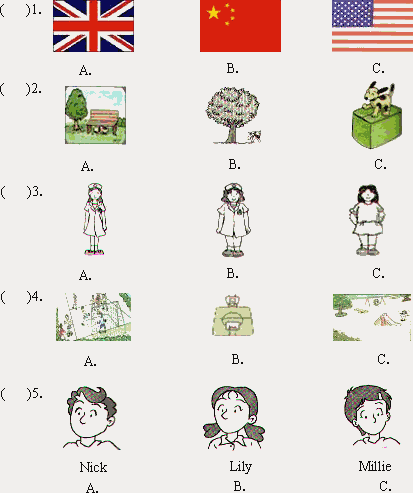
四.听短文,选择合适的选项。(10分)
( )1、What colour is Peter’s coat?
A、Brown
B、Green
C、Blue
( )2、Who has a teddy bear?
A、Peter
B、Peter’s sister
C、Peter’s mother
( )3、What is his father?
A、doctor
B、A student
C、A teacher
( )4、Is there a dog in the photo?
A、Yes, there is.
B、No, there isn’t.
C、I don’t know.
( )5、Where is Peter?
A、In front of Mother.
B、Behind Father.
C、Between Mother and Father.
听力部分(满分20分)
第一部分 听对话回答问题(计10分)
本部分共有10道小题,每小题你将听到一段对话,每段对话听两遍.在听每段对话前,你将有5秒钟的时间阅读题目;听完后,你还有5秒钟的时间从题中所给的A、B、C三个选项中选出最佳选项.
1.What does Mr.Smith like to do?
A.
B.
C.
2.Where was Sam born?
A.
B.
C.
3.Who is Linda?
A.
B.
C.
4.How does Tom learn English?
A.
B.
C.
5.A.6∶45.
B.7∶00.
C.7∶15.
6.A She likes smoking.
B She doesn't mind the man's smoking.
C She doesn't want him to smoke.
7.A.By plane.
B.By car.
C.By train.
8.A.Peter's
B.Jack's
C.Lily's
9.A.By bus.
B.By bike.
C.On foot.
10.A.He was watching a match
B.He was going to bed
C.He was doing homework
第二部分 听对话和短文回答问题(计10分)
你将听到两段对话和一篇短文,各听两遍,听每段对话或短文前,你将有时间阅读相关小题,每小题5秒钟;听完后,每小题你仍有5秒钟时间从题中所给的A、B、C三个选项中选出最佳选项.
听第一段对话,回答第11-12小题.
11.What is the man's favorite sport?
A.Table tennis.
B.Tennis.
C.Football.
12.What can we learn about the woman's brother?
A.He is a good player.
B.He is interested in table tennis.
C.He often plays with the man.
听第二段对话,回答第13-15小题.
13.How many cups of coffee has the mad had so far(到目前为止)today?
A.Three.
B.Four.
C.Five.
14.What does the woman think of coffee?
A.It's not good for health.
B.It tastes nice.
C.It's her favorite.
15.What can we learn from the dialogue?
A.The man doesn't know coffee is bad for him.
B.The man doesn't believe what the woman said.
C.The man doesn't want to give up coffee.
听一篇短文,回答第16-20小题.
16.From this writing we know many students wear glasses because they ________
A.study too hard
B.read many books.
C.watch too much TV
17.How many bad sides are said in the passage?
A.Two.
B.Three.
C.Four.
18.The parents think ________ make children think more.
A.Tvs
B.books
C.programmes
19.In the end, the writer decided to ________.
A.sell the television set
B.write books for children
C.buy a pair of glasses for herself
20.This passage is ________.
A.an interesting story
B.a programme report on TV
C.about a parent's mind or idea
People today have 6 time than ever for hobbies.In early times,people were 7 busy making a living to have hobbies.Nowadays machines have taken the 8 of many workers.More people retire (退休)at an earlier age.They have hobbies 9 these activities offer them enjoyment, 10 ,knowledge,and relaxation(放松).
(1).A.can B.must C.has to D./?
(2).A.on B.up C.in D.off?
(3).A.play B.take C.grow D.smell?
(4).A.buy B.sell C.collect D.use?
(5).A.trees B.mountains C.the wall D.down?
(6).A.much B.more C.less D.little?
(7).A.very B.so C.too D.such?
(8)A.place B.job C.time D.room?
(9).A.so B.because C.with D.if
(10).A.friendship(友谊) B.money
C.books D.feeling
查看习题详情和答案>>阅读下面短文,掌握大意,然后从每题所给的A、B、C、D四个选项中选出最佳选项。
Look! __ is my friend. Her _ is Meimei. Well, can you _ it? Yeah! M-e-i,m-e-i. She is thirteen _ old. She studies in No.1 Middle School. She is _ new student here. There _ eighteen boys and fifteen girls in her class. Her mother a teacher. She is an teacher. Her father, Mr Wang is a teacher, . Their students all love them because they love their students. They have(有)a dog. The dog and Meimei are ___ friends.
1.A. These B. Those C. This D. They
2.A. name B. shop C. school D. friend
3.A. say B. spell C. see D. meet
4.A. bags B. yea rs
C. books D. chairs
rs
C. books D. chairs
5.A. an B. a C. the D. /
6.A. are B. is C. am D. be
7.A. am B. is C. are D. be
8.A. Engl ish
B. Chinese
C. French(法国的) D. England
ish
B. Chinese
C. French(法国的) D. England
9.A. to B. too C. either D. also
10.A. right B. fine C. nice D. good
查看习题详情和答案>>