网址:http://m.1010jiajiao.com/timu3_id_2691590[举报]
完形填空
Are you carrying too much on your back at school? I'm sure lots of the (1) of your age will say“Yes”.
Not only the students in China have this problem, but also children in the United States have (2) schoolbags.
Doctors are starting to (3) that younger and younger students are having (4) problems as a result of school bags being too heavy for them.
“It's hard for me to (5) with my bag because it's so heavy.”said Rick Hammond, an 11-year-old student in the US.
Rick is (6) the students who have common schoolbags with two straps (带子)to carry them, (7) many students choose rolling(滚动的)bags.
But even with rolling bags, getting upstairs and buses is still a problem for children. Many of them (8) their necks and backs because of the heavy schoolbags.
But (9) is too much? Doctors say students should carry no more than 10% to 15% of their own body weight(重量).
Scott Bautch, a back doctor, said children (10) Grade 4 should stay with 10%. But it is also important that older children don't stay over 15%, because their bodies are (11) .“Children are losing their balance(平衡)and (12) with their schoolbags,”he said.
Parents and teachers are starting to tell children to only take home the books they be reading (13) . Some teachers are using pieces of paper or (14) workbooks for students to take home.
One of the best answers is, as some children said, to have (15) homework at all!
(1)
[ ]
|
A. teachers |
B. parents |
|
C. children |
D. old people |
(2)
[ ]
|
A. small |
B. big |
|
C. heavy |
D. light |
(3)
[ ]
|
A. forget |
B. remember |
|
C. worry |
D. hope |
(4)
[ ]
|
A. arm and leg |
B. hand and arm |
|
C. head and neck |
D. back and neck |
(5)
[ ]
|
A. go to bed |
B. go into the classroom |
|
C. go upstairs |
D. go shopping |
(6)
[ ]
|
A. among |
B. of |
|
C. between |
D. in |
(7)
[ ]
|
A. because |
B. so |
|
C. but |
D. if |
(8)
[ ]
|
A. break |
B. hurt |
|
C. carry on |
D. look after |
(9)
[ ]
|
A. what size |
B. how many |
|
C. how |
D. how much |
(10)
[ ]
|
A. of |
B. over |
|
C. under |
D. like |
(11)
[ ]
|
A. important |
B. growing |
|
C. moving |
D. interesting |
(12)
[ ]
|
A. catching up |
B. standing up |
|
C. going on |
D. falling down |
(13)
[ ]
|
A. next night |
B. that night |
|
C. tomorrow evening |
D. last night |
(14)
[ ]
|
A. thick |
B. thin |
|
C. heavy |
D. big |
(15)
[ ]
|
A. some |
B. much |
|
C. few |
D. no |
完形填空
Are you carrying too much on your back at school? I'm sure lots of the (1) of your age will say“Yes”.
Not only the students in China have this problem, but also children in the United States have (2) schoolbags.
Doctors are starting to (3) that younger and younger students are having (4) problems as a result of school bags being too heavy for them.
“It's hard for me to (5) with my bag because it's so heavy.”said Rick Hammond, an 11-year-old student in the US.
Rick is (6) the students who have common schoolbags with two straps (带子)to carry them, (7) many students choose rolling(滚动的)bags.
But even with rolling bags, getting upstairs and buses is still a problem for children. Many of them (8) their necks and backs because of the heavy schoolbags.
But (9) is too much? Doctors say students should carry no more than 10% to 15% of their own body weight(重量).
Scott Bautch, a back doctor, said children (10) Grade 4 should stay with 10%. But it is also important that older children don't stay over 15%, because their bodies are (11) .“Children are losing their balance(平衡)and (12) with their schoolbags,”he said.
Parents and teachers are starting to tell children to only take home the books they be reading (13) . Some teachers are using pieces of paper or (14) workbooks for students to take home.
One of the best answers is, as some children said, to have (15) homework at all!
(1)
[ ]
|
A. teachers |
B. parents |
|
C. children |
D. old people |
(2)
[ ]
|
A. small |
B. big |
|
C. heavy |
D. light |
(3)
[ ]
|
A. forget |
B. remember |
|
C. worry |
D. hope |
(4)
[ ]
|
A. arm and leg |
B. hand and arm |
|
C. head and neck |
D. back and neck |
(5)
[ ]
|
A. go to bed |
B. go into the classroom |
|
C. go upstairs |
D. go shopping |
(6)
[ ]
|
A. among |
B. of |
|
C. between |
D. in |
(7)
[ ]
|
A. because |
B. so |
|
C. but |
D. if |
(8)
[ ]
|
A. break |
B. hurt |
|
C. carry on |
D. look after |
(9)
[ ]
|
A. what size |
B. how many |
|
C. how |
D. how much |
(10)
[ ]
|
A. of |
B. over |
|
C. under |
D. like |
(11)
[ ]
|
A. important |
B. growing |
|
C. moving |
D. interesting |
(12)
[ ]
|
A. catching up |
B. standing up |
|
C. going on |
D. falling down |
(13)
[ ]
|
A. next night |
B. that night |
|
C. tomorrow evening |
D. last night |
(14)
[ ]
|
A. thick |
B. thin |
|
C. heavy |
D. big |
(15)
[ ]
|
A. some |
B. much |
|
C. few |
D. no |
If a country wants to develop rapidly, education must come first. However, in China, many poor families in some villages can’t an education for their children. Some children reach the school age, they have to stay at home and do some farm work.
Luckily, Project Hope started October 30th, 1989. It has mainly two . One is to help the poor children who can’t go to school without money, the other is to build for the students in poor areas so that they can have a better studying environment.
With the help of Project Hope, a lot of poor children have returned to school and many new schools have been built it started. So the children can get much knowledge and their dreams. they get knowledge, they will have ability(能力) to build their hometown. At the same time, their living conditions will be as well.
There are still many poor children in of help. As for the project, there is still a long way to go.
1.A. give B. offer C. afford
2.A. so B. but C. and
3.A. in B. for C. on
4.A . purposes B. ways C. uses
5.A. stations B. schools C. hospitals
6.A. since B. after C. before
7.A. shake B. create C. realize
8.A. If B. Once C. Though
9.A. well B. worse C. better
10.A. need B. detail C. public
查看习题详情和答案>>
Luckily, Project Hope started October 30th, 1989. It has mainly two . One is to help the poor children who can’t go to school without money, the other is to build for the students in poor areas so that they can have a better studying environment.
With the help of Project Hope, a lot of poor children have returned to school and many new schools have been built it started. So the children can get much knowledge and their dreams. they get knowledge, they will have ability(能力) to build their hometown. At the same time, their living conditions will be as well.
There are still many poor children in of help. As for the project, there is still a long way to go.
小题1:A. give B. offer C. afford
小题2:A. so B. but C. and
小题3:A. in B. for C. on
小题4:A . purposes B. ways C. uses
小题5:A. stations B. schools C. hospitals
小题6:A. since B. after C. before
小题7:A. shake B. create C. realize
小题8:A. If B. Once C. Though
小题9:A. well B. worse C. better
小题10:A. need B. detail C. public
听力部分
Ⅰ.听句子,选出句子中所包含的信息。(共5小题,每小题1分,计5分)
1.A.dress
B.address
C.advice
2.A.taken away
B.given back
C.given away
3.A.256
B.265
C.526
4.A.I will go to the park.
B.My friends will go to the park.
C.My friends and I will go to the park.
5.A.Mr.Black is not in.
B.Mr.Black is answering the phone.
C.Mr.Black will come to answer the phone soon.
Ⅱ.听句子,选出该句的最佳答语。(共5小题,每小题1分,计5分)
6.A.Your school is great!
B.Thank you.I hope so.
C.You, too.Thank you.
7.A.All right.
B.Thanks a lot.
C.Never mind.
8.A.Twice a week.
B.By car.
C.Two days ago.
9.A.Yes, please.
B.Yes, I'd love to.
C.Coffee, please.
10.A.From London.
B.For a meeting.
C.In England.
Ⅲ.听对话和问题,选择适当的选项。(共5小题,每小题1分,计5分)
11.A.Buying a birthday present.
B.Learning English.
C.Having a birthday party.
12.A.Because he was doing his homework carefully.
B.Because he put his heart into the newspaper.
C.Because it was noisy in the room.
13.A.Red.
B.Black.
C.Blue.
14.
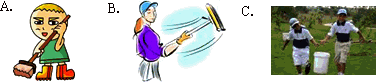
15.

Ⅳ.听短文、对话和问题,选择正确答案。(共10小题,每小题1分,计10分)
16.A.He ran into a chicken.
B.He was knocked down by a bike.
C.He fell on his right arm.
17.A.He went to hospital.
B.He went to school.
C.He went home.
18.A.The uses of sports.
B.Different kinds of sports.
C.Ways of playing table tennis.
19.A.It helps the working speed of the brain.
B.It works better than other sports in keeping us fit.
C.It helps the eyes and brain work together.
20.A.Cloudy.
B.Rainy.
C.Sunny.
21.A.From 6 ℃ to 16℃.
B.From 7℃ to 15℃.
C.From 19℃ to 28℃.
22.A.Playing golf.
B.Collecting stamps.
C.Doing gardening.
23.A.Keeping pets.
B.Taking pictures.
C.Collecting coins.
24.A.To China.
B.To Japan.
C.To Mexico.
25.A.He prefers to work.
B.He is too busy.
C.He has no hobby at all.
(第二节)Ⅴ.听短文填空(共5小题,每小题1分,计5分)
Information Sheet
26.People at the age from 12 to ________ can become a volunteer.
27.Hospitals need volunteers to look after children while their parents are ________.
28.Animal lovers can help with the dogs and cats ________.
29.Susan feels happy when she sees the ________ happy faces.
30.Anyone who is interested in volunteer work can call them or ________ the website.