网址:http://m.1010jiajiao.com/timu3_id_2669637[举报]
听力录音材料:
一、听对话,从下面各题所给的A、B、C三幅图片中选择与对话内容相符的图片。每段对话你将听两遍。
Number 1
M: Hey, Betty! How do you study for a test?
W: I study by listening to tapes.
Number 2
M: Sally, did you use to be afraid of tigers?
W: Yes, I did.
Number 3
M: I think we should be allowed to play soccer after class.
W: I agree.
Number 4
M: It’s Celia’s birthday tomorrow. I don’t know what I should get her.
W: If I were you, I would get her a scarf.
二、听对话或独白,根据对话或独白的内容,从下面各题所给的A、B、C三个选项中选择最佳选项。每段对话或独白你将听两遍。
请听一段对话,完成第5至第6小题。
M: Hi, Maria! Whose backpack is this?
W: I don’t know. Look, there is a hair band in it. So the owner can’t be a boy.
M: It could be Lily’s hair band. She has long hair.
W: You’re right. The backpack might belong to Lily.
请听一段对话,完成第7至第8小题。
W: Have you done your homework, John?
M: Not yet.
W: Then why are you watching TV now?
M: This is my favorite baseball game.
W: You can watch it after you finish your homework.
M: But the show will be over.
W: There will be another game next week.
M: Please?
W: You know the rules, John.
M: I hate the rules! I can’t wait till I grow up.
请听一段对话,完成第9至第10小题。
W: Hi, Lewis! I’m so glad the holiday is finally here.
M: Me too. Imagine! We’ve got three days in a row.
W: So, where’re you going?
M: I don’t have any plans yet. I’ll just play it by ear. How about you, Tina?
W: We’re going hiking and camping in the mountains.
M: That sounds exciting!
W: Would you like to join us?
M: Hmm, let me think about it. I’ll let you know later.
请听一段对话,完成第11至第13小题。
M: Gina, I was invited to a party. I don’t know what to wear and I need your help.
W: Well, what kind of party is it?
M: It is an important party for all junior students.
W: When is the party?
M: 8:00 pm, next Friday evening.
W: Oh, that is one week from today. You have enough time to get prepared. And if I were you, I
would wear a shirt and tie. But don’t wear a suit. That makes you look old.
M: I agree. But what if I don’t know anyone?
W: Well, if I were you, I would talk to someone first. It is not good to be too shy, right?
M: Yes, you are right.
W: Don’t worry. Everything will be fine. Have a good time at the party.
M: Thanks.
请听一段独白,完成第14至第16小题。
Hello, boys and girls. Welcome to our Summer Camp Day! It is a team competition taking place once every year both at the festival and on our website!
There are four teams: red, yellow, blue, and purple. You can join a team by joining the team’s Facebook group. Within each group, team members work together on how they can win the competition, and decide more fun things like team songs, team flags and so on.
Each year, one team will be named the Summer Camp Day Champion. The winning team will be decided at the end of the festival, and we will fly their flag that day. The winning team will also get a party.
As a team member, you have to wear your team color and encourage your teammates, or join in games. The games include spelling game, guessing game, water ball game and soccer game. If you win a game, you will get prizes like T-shirts or some other souvenirs. Most of the games will be during the day on Saturdays, and the winning team’s party will be on Sunday afternoon.
I hope you will enjoy yourself in our summer camp!
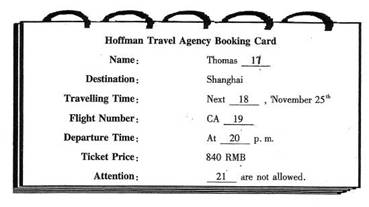
三、听对话,根据所听到的对话内容和提示词语,将所缺的关键信息填写在答题卡的相应位置上。对话你将听两遍。
W: Hello, Hoffman Travel Agency.
M: Hello. I’d like to book a flight from Beijing to Shanghai, please.
W: I see. May I have your name, please?
M: Thomas Green. T-H-O-M-A-S. Thomas. G-R-E-E-N, Green.
W: Got it. So when are you travelling?
M: I’d like to fly next Monday, November 25th.
W: Wait a moment, please. (Pause) We have one ticket left.
M: Perfect! How much is the ticket?
W: It is only 840 RMB.
M: Well, that’s a pretty fair price.
W: A ticket to Shanghai for next Monday, November 25th. OK, your ticket has been booked. The flight number is CA1589 from Beijing International Airport Terminal Three to Shanghai Hongqiao Airport. The departure time is 8:30 p.m.
M: Thank you so much! By the way, can I bring my pet with me?
W: I’m sorry. Pets are not allowed.
M: Oh, I see. Thanks.
W: You are welcome. Goodbye.
M: Bye.
一、听对话,从下面各题所给的A、B、C三幅图片选项与对话内容相符的图片。每段对话你将听两遍。(共4分,每小题1分)
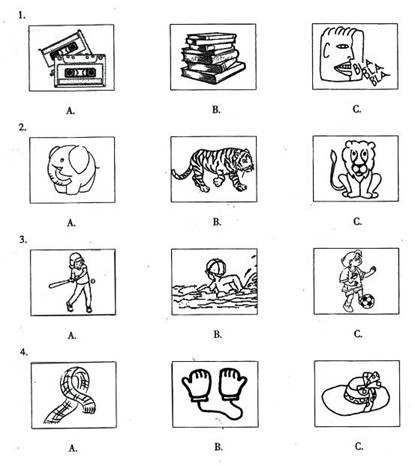
二、听对话或独白,根据对话或独白的内容,从下面各题所给的A、B、C三个选项中选择最佳选项。每段对话或独白你将听两遍。(共12分,每小题1分)
5. What’s in the backpack?
A. A notebook. B. A pencil box. C. A hair hand
6. Whose backpack could it be?
A. Jack’s B. Lily’s C. Maria’s
请听一段对话,完成第7至8小题。
7. What is John doing now?
A. Watching TV. B. Doing homework. C. Playing baseball.
8. What does John hate?
A. The shows. B. The rules C. The games.
请听一段对话,完成第9至10小题。
9.How long will the holiday be?
A. Two days. B. Three days. C. Four days.
10. What is Tina going to do during the holiday?
A. Go hiking and camping. B. Go to the beach. C. Visit the museum.
请听一段对话,完成第11至13小题。
11. When is the party?
A. Next Sunday evening. B. Next Saturday evening. C. Next Friday evening.
12. What will the boy probably wear for the party?
A. A shirt and tie. B. A suit and shirt. C. A suit and tie.
13. What can we know about the boy?
A. He has no friends. B. He needs more time. C. He wants some advice.
请听一段对话,完成第14至16小题。
14. How can you join the team?
A. By joining a party on Saturdays.
B. By joining a group on Facebook.
C. By joining games on the Internet.
15. Which game is not talked about?
A. Guessing game. B. Spelling game. C. Dancing game.
16. What does the speaker want to do?
A. To tell us about a competition.
B. To introduce a competition team.
C. To encourage us to win the game.
三、听对话,根据所听到的对话内容和提示词语,将所缺的关键信息填写在答题卡的相应位置上。对话你将听两遍。(共10分,每小题2分)
知识运用
查看习题详情和答案>>A
:David, look at your room. It's so dirty!B
:Oh, sorry, Mum.A
:Please clean your room and take out the trash(垃圾).B
:But I need to do my homework now. I have a lot today.A
:Could you take out the trash now? I really need help, David.B
:What's wrong, Mum?A
:Your grandmother is coming in an hour. So we should make all good.B
:Sure, I will do that soon. But could I use the car after I do my homework and clean my room?A
:No. You know your grandmother and I have to go shopping. It is very important for her. So I am sorry. But I can give you a ride.B
:OK. I am going to the library with my friend, Peter. So could you give him a ride, too?A
:Sure. But where does he live? Is it very far?B
:No. He lives near our home. It takes only five minutes.A
:That's good. It's easy.B
:Oh, Mum. Could I borrow some money for some books? They are pretty good.A
:Of course, you can. Here you are.B
:Thanks, Mum.根据对话内容,判断正
(T)误(F)(1)Mum tells David to clean his room and clean the dishes.
(2)David needs to do his homework now.
(3)David's grandfather will come to his home in an hour.
(4)David wants to use the car before he cleans his home.
(5)Mum and grandmother will go shopping by car.
查看习题详情和答案>>— _____.
B. Why not know
C. Thank you all the same
D. Not at all
— _____.
B. That's right
C. That's all right
D. You're right
— _____.
B. No, you may not
C. Sorry, he isn't here
D. Sure, he is out
— _____.
B. It's Lily
C. That's Kate
D. It's me
— _____
B. Here you are.
C. Where is it?
D. Whose is it?
— _____.
B. Yes, only a few
C. No, I can't
D. No, you don't
— She's an office worker.
B. What does she do
C. How do you do
D. How is she
— Of course, here you are.
B. Would you like to have a picnic
C. May I take your order
D. Could you do me for a favor
— _____.
B. I think so
C. I'm looking for a shirt for my son
D. How much do you want for the watch
— _____.
B. You're welcome
C. It's very kind of you
D. Thanks a lot
听力部分
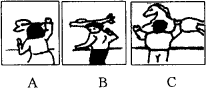
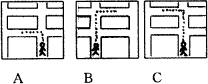
Ⅰ.图句理解,听录音,根据问题选出与其意思相符的图画(每小题1分,共5分)
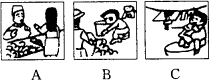
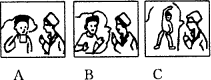
1.
2.
3.
4.
5.
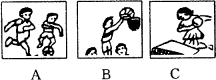
Ⅱ.对话理解,听录音,根据对话内容选择正确答案(每小题1分,共5分)
6.A.In 1986.
B.In Sydney.
C.In 1986, in Sydney.
7.A.Because the farmers needed help.
B.Because the farmers were ill.
C.Because the children needed help.
8.A.He went to the shop.
B.He bought some books.
C.He bought some food.
9.A.She is cooking.
B.She is working.
C.She is reading.
10.A.Bob.
B.Jim.
C.Li Lei.
Ⅲ.情景反应,听句子,选择恰当的答语(每小题1分,共10分)
11.A.Yes, a little.
B.No, I don't
C.Yes, I'm very well.
12.A.To make a toy car.
B.I want a book.
C.I want to buy a pumpkin.
13.A.I'm not full.
B.Let's go and have a look.
C.OK.Let's take that one.
14.A.Yes, I do.
B.No, thanks.I'm full.
C.No, they are nice.
15.A.Mine is good.
B.Mary is better.
C.Lily's is the best of all.
16.A.It's very cold.
B.It's very hot.
C.It's cool.
17.A.That's right.
B.Can you guess?
C.Yes, it is.
18.A.Summer is the warmest season.
B.The coldest season of the year is winter.
C.I think I like spring best.
19.A.It's from about November to January.
B.It lasts from May to July.
C.It comes in February to April.
20.A.Yes, it is.You need to wear warmer clothes.
B.Yes, it is.Why don't you take off your sweater?
C.Yes, it is.Put away your sweater.
Ⅳ.短文理解,听录音,根据短文内容选择正确答案(每小题2分,共10分)
21.Mr Clock likes buying ________.
A.pictures
B.stamps
C.clocks
22.Mr Clock has ________ clocks now.
A.five hundred
B.eight hundred
C.nine hundred
23.Does Mr Clock's wife like buying clocks, too?
A.Yes, she does.
B.No, she doesn't.
C.We don't know.
24.________ make all the clocks clean every day.
A.Mr Clock's wife
B.Mr Clock
C.No one
25.From this passage we know ________.
A.all the clocks have the sound only at night
B.every clock tells the right time
C.few of the clocks can keep the right time
Even friends may never exchange presents. When I go to foreign countries, I try to bring back little things for close friends, but nobody would feel unhappy if I didn't. I don't often remember a friend's birthday, and few people outside of my family remember mine. If someone gave me presents too often, I'd get unpleasant. But a present from a foreigner - that kind from his or her homeland — won't go wrong, except to government employees (政府职员) who can't be given presents.
You usually open a present at once and in front of the person who gives it except Christmas and birthday presents. You should only say, "It's so nice. Thanks…" when you get Christmas or birthday presents.
You may want to bring a bottle of wine (葡萄酒) or flowers to a dinner party, but you're
never asked to. Nobody will mind if you bring wine, but your friend may not use it that evening.
At Christmas we often give presents to our family and sometimes our friends. We also give presents to people who have been helpful during the year- doormen, babysitters, housecleaners, newspaper senders— anyone who has often helped us.
【小题1】 What does "close friends" mean in the passage?
| A. The friends who are very kind. |
| B. The friends who live close to each other. |
| C. The friends who were once classmates. |
| D. The friends who you like most. |
| A.The small presents. | B. Christmas or birthday presents. |
| C. The expensive presents. | D. The presents for dinner party. |
| A. To pay them. | B. To help them. |
| C. To thank them. | D. To make them work harder. |
| A. American business people don't want presents because they are rich enough. |
| B. The writer of this passage must be an American. |
| C. Everyone must give presents to one's family and friends at Christmas. |
| D. Government employees can get little presents from a foreigner. |
| A. Present-giving in the United States. |
| B. Customs (习俗) in the United States. |
| C. American people and present-giving. |
| D. When and how to give presents. |