网址:http://m.1010jiajiao.com/timu3_id_2635669[举报]
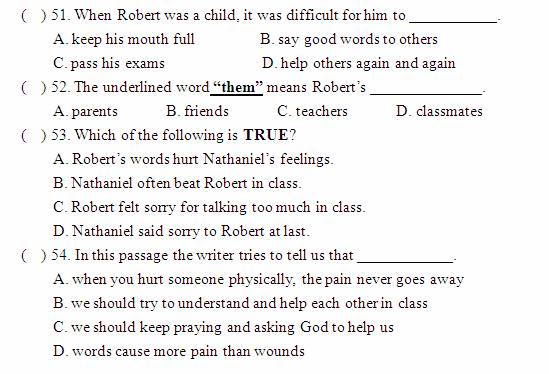
Ever since I was a child, my mouth has caused me trouble. I’m not a bad person; I have just had a hard time learning when to keep my mouth closed.
My mom has told me again and again, “Robert, your constant bad words are hurting me. If you continue to be this rude, you will get into big trouble.”
It’s been a problem at school several times, too, when teachers have told me something I didn’t want to hear. I used to feel it was my duty to stand up for myself and tell them off.
One day in English class I began working on my homework until I heard a classmate talking behind me. It was Nathaniel, talking to himself as usual.
I said ever so nicely, “Nathaniel, would you be quiet?”
Nathaniel continued talking to himself. I quickly shouted, “Nathaniel, shut up!”
For the next five minutes, we threw hurtful words back and forth at each other.
“At least I don’t have an ugly lazy eye like you!” I shouted.
I knew this would bother him deep inside. It would hurt his feelings and shut him up.
What I said filled him with anger. He tried to reach over my seat and grab (抓住) me as he shouted, “That’s it! That’s it!”
Surprised at his reaction, I sat back in seat. Never had I seen Nathaniel act like this before.
Later on, we were taken to the principal’s (校长) office.
There, the principal told us to discuss the matter. It wasn’t until then that I finally found that when I hurt someone physically, the wounds (伤口) eventually heal(痊愈). But when I hurt them with my words, sometimes the pain never goes away.
At the end of the discussion, I said sorry to Nathaniel.
When I headed back to my room, I spent some time praying (祈祷). I began to think about how often what I said hurt others. But I believe that as I keep praying and asking God to help me, He’ll tell me when to keep my mouth closed.
查看习题详情和答案>>
learning when to keep my mouth closed.
My mom has told me again and again, "Robert, your constant bad words are hurting me. If you
continue to be this rude, you will get into big trouble."
It's been a problem at school several times too when teachers have told me something I didn't want
to hear. I used to feel it was my duty to stand up for myself.
One day in English class I began working on my homework until I heard a classmate talking behind
me. It was Nathaniel, talking to himself as usual.
I said ever so nicely, "Nathaniel, would you be quiet?"
Nathaniel continued talking to himself. I quickly shouted "Nathaniel, shut up!"
For the next five minutes, we threw hurtful words back and forth at each other.
"At least I don't have an ugly lazy eye like you!" I shouted.
I knew this would upset him deep inside. It would hurt his feelings and shut him up.
What I said filled him with anger. He tried to reach over my seat and grab me as he shouted, "That's
it! That's it!"
Surprised at his reaction, I sat back in my seat. Never had I seen Nathaniel act like this before.
Later on, we were taken to the principal's office.
There, Mr. Black, the principal, told us to discuss the matter. It wasn't until then that I finally found
that when I hurt someone physically, the wounds eventually heal. But when I hurt them with my words,
sometimes the pain (痛苦) never goes away.
At the end of the discussion, I said sorry to Nathaniel.
When I headed back to my room, I spent some time praying. I began to think about how often what
I said hurt others. But I believe that as I keep praying and asking God to help me, he'll tell me when to
keep my mouth closed.
B. Robert.
C. Black.
D. Green.
B. listened to the others
C. talked to himself
D. kept silent
B. 痛苦
C. 和好
D. 伤害
B. we should try to help each other at school
C. it is one's duty to stand up for himself
D. words cause more pain than wounds
learning when to keep my mouth closed.
My mom has told me again and again, " Robert, your constant bad words are hurting me. If you continue
to be this rude, you will get into big trouble. "
It's been a problem at school several times too when teachers have told me something l didn't want to hear.
I used to feel it was my duty to stand up for myself.
One day in English class I began working on my homework until I heard a classmate talking behind me. It
was Nathaniel, talking to himself as usual.
I said ever so nicely, "Nathaniel, would you be quiet?"
Wathaniel continued talking to himself. I quickly shouted " Nathaniel, shut up ! "
For the next five minutes, we threw hurtful words hack and forth at each other.
"At least I don't have an ugly lazy eye like you!" I shouted.
I knew this would upset him deep inside. Jt would hurt his feelings and shut him up.
What I said filled him with anger. He tried co reach over my seat and grab me as he shouted, "That's it!
That's it ! "
Surprised at his reaction, I sat back in my seat. Never had I seen Nathaniel act like this before.
Later on, we were taken to the principal's ofrice.
There, Mr. Black, the principal, told us to discuss the matter. It wasn't until then that I finally found chat
when I hurt someone physically, the wounds eventually heal. But when I hurt them with my words,
sometimes the pain (痛苦) never goes away.
At the end of the discussion, I said sorry to Nathaniel. When I headed back to my room, I spent some
time praying. I began to think about how often what I said hurt others. But I believe that as l keep praying
and asking God to help me, he'll tell me when to keep my mouth closed.
B. Robert
C. Black.
D. Creen.
B. listened to the others
C. talked to himself
D. kept silent
B. 痛苦
C. 和好
D. 伤害
B. we should try to help each other at school
C. t is one's duty to stand up for himself
D. words cause more pain than wounds
The size and shape of your ears show your character more than any other part of the face. Other parts of the face change shape as we get older, but ears do not change their shape. They only change in size.
Reading people's character from their ears is a very old science. In ancient times people thought that a person with big ears had a good and generous (慷慨的) character. They thought that a person with pale (苍白的), small ears was dangerous. They also thought that the shape of the ear showed if a person was musical or not. Today, too many people believe that the size and shape of the ear helps you know if a person is musical.
Ears are all different, and each characteristic (特征) has a meaning. Next time you look at a person, see if his or her ears are large, medium-sized or small. Look at the lobes (耳垂) . Are they attached to the face? Ears that are always red mean that a person may have a temper (脾气), or he /she may just have high blood pressure. Ears that are always cold and pale mean that a person has a nervous character. And a big inside the ear means a person is musical.
(1) What shows one's character most in the part of the face?
[ ]
A.The color of one's eyes.
B.The size of one's eyes.
C.The size and shape of one's ears.
D.The shape of one's mouth.
(2) In ancient times, how did people think about someone with big ears?
[ ]
(3) ________ may mean a person has a nervous character.
[ ]
(4) Lobes attached to the face means a person has ________.
[ ]
(5) Which of the following is RIGHT?
[ ]
A.Today people do not believe the size and shape of the ears show if a person is musical or not.
B.Different ears have the same meaning.
C.People read character from one's ears in ancient times.
D.Other parts of the face change shape as we get older, so do ears.
查看习题详情和答案>>