网址:http://m.1010jiajiao.com/timu3_id_2633657[举报]
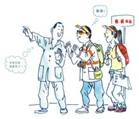
In English, just like in Chinese, we change the way we speak when talking with different people. The expressions you use might depend on whom you are speaking to or how well you know them. If you say to your teacher, “Where is my book?” this will sound rude. But if you say, “Excuse me, Mr West. Do you know where my book is?” your question will sound much more polite. On the other hand, it might be alright to say “Where is my book?” to the people you know well.
And you would not usually say, “Peter, lend me your pen.” A very direct order like this can sound rude in English. Usually in English polite questions are longer and include extra (附加的) language, such as “Could you please...?” or “Can I ask...?” It sounds more polite to say, “Peter, could you please lend me your pen?” If you stop a stranger in the street, we might first say, “Excuse me. I wonder if you can help me.” or “I’m sorry to trouble you but…” before asking him for help.
It might seem that speaking politely is more difficult than being direct, and in a way this may be true.
小题1:When we make requests, we need to speak in a ____ way.
| A.polite | B.careful | C.different | D.direct |
| A.Which is the way to the zoo? |
| B.How can I get to the zoo? |
| C.Do you know the way to the zoo? |
| D.Excuse me. Can you tell me the way to the zoo? |
| A.We should use long sentences when we ask for information and help. |
| B.When we ask for help from others, polite language must be used. |
| C.The way of speaking is important when we ask different people for help. |
| D.In English, polite questions are as neccessary as rude and direct ones. |
任务型阅读(共5小题;每小题1 分,满分5 分)
1.I often fail to finish the reading test because there is not enough time.
2.I have question with my lessons. But I don’t like to ask the teacher in front of my
classmates.
3.I can’t follow the tape when I am doing listening test, because there are always some
words I don’t know.
4.I always forget the new words. Ever though I learned them yesterday, I may forget them
today when I open the book.
5.I don’t dare to speak English with others, though I know I’m good at it.
A. Try to get the main idea of the tape and do not stop to think when you hear the words you don’t know. You don’t need to know every word in the passage.
B. Take short rests and plan your work reasonably.
C. Ask the teacher after class. You can also write the questions down on a piece of paper and give it to the teacher.
D. Review the words again and again until you remember them.
E. Do reading exercises in a given time. Try to read fast. You don’t need to know each word.
F. listen to other carefully and write down what they say. It’s a good way to practice your listening skill.
G. Don’t worry about that. Try to speak English more with your close friends first. Once you can do it well, talk with the others
查看习题详情和答案>>
小题1:I often fail to finish the reading test because there is not enough time.
小题2:I have question with my lessons. But I don’t like to ask the teacher in front of my
classmates.
小题3:I can’t follow the tape when I am doing listening test, because there are always some
words I don’t know.
小题4:I always forget the new words. Ever though I learned them yesterday, I may forget them
today when I open the book.
小题5:I don’t dare to speak English with others, though I know I’m good at it.
| A.Try to get the main idea of the tape and do not stop to think when you hear the words you don’t know. You don’t need to know every word in the passage. |
| B.Take short rests and plan your work reasonably. |
| C.Ask the teacher after class. You can also write the questions down on a piece of paper and give it to the teacher. |
| D.Review the words again and again until you remember them. |
F. listen to other carefully and write down what they say. It’s a good way to practice your listening skill.
G. Don’t worry about that. Try to speak English more with your close friends first. Once you can do it well, talk with the others
Hello, boys and girls!I __ ___David. My _ ____name is Hand. This is my pen. It’s black. That is _ ___English book. .It’s __ ___ .__ ___that? Oh, __ ___a computer game(游戏机). I_ ___ it very much. I have a __ ___ friend. _ ___name is Tony. His __ __ is 3985665.
1.A. is B. are C. am D. be
2.A. first B. last C. the D.\
3.A. an B. a C. the D. work
4.A. blue color B. a blue C. blue D. color blue
5.A. is B. What’s C. It’s D. Is it
6.A. this is B. that is C. I’m D. it’s
7.A. is B. like C. am D. not
8.A. first B. last C. good D. see
9.A. He B. Her C. His D. my
10.A. Telephone B. number C. phone number D. Phone number
查看习题详情和答案>>
听力部分
Ⅰ.情景反应,听句子,选择恰当的答语(每小题1分,共10分)
1.A.You're right.
B.All right.
C.Yes, please.
2.A.Sorry, I don't know.
B.I want to buy a shirt for my son.
C.I'm afraid I can't.
3.A.It doesn't matter.
B.I can't find my keys.
C.That's right.
4.A.Don't say so.
B.You are right.
C.That's all right.
5.A.I have just bought a library book.
B.I have just returned it.
C.I like it very much.
6.A.English, maybe.
B.I don't agree.
C.I think so.
7.A.It comes to ten yuan.
B.Each costs two yuan.
C.They're too expensive.
8.A.That's all right.
B.Thank you.
C.Yes, please.
9.A.It's Monday.
B.At 5∶00.
C.It's half past eight.
10.A.A factory worker.
B.She sells fruit in a shop.
C.In a hospital.
Ⅱ.对话理解,听录音,根据对话内容选择正确答案(每小题1分,共10分)
11.A.She's a worker.
B.She's a bookseller.
C.She is a teacher.
12.A.They grow rice.
B.They grow fruit.
C.They grow flowers.
13.A.He lives in a small village.
B.He lives in a small town.
C.He lives in a big city.
14.A.Yes, he does.
B.No, Jane lives there.
C.Yes, I think so.
15.A.On the 21st floor.
B.On the 25th floor.
C.On the 26th floor.
16.A.In a restaurant.
B.In a hotel.
C.In a shop.
17.A.Small.
B.Middle.
C.Large.
18.A.To go for a picnic.
B.To plant trees.
C.To play football.
19.A.Tea.
B.Coffee.
C.Orange juice.
20.A.Red.
B.Green.
C.Yellow.
Ⅲ.短文理解,听录音,根据短文内容及首字母提示补全单词(每小题2分,共10分)
21.E________ uses sign language.
22.Sign language is not d________, so we can learn it.
23.Most people who can s________ use sign language, too.
24.If someone smiles at you, it means he/she is friendly t________ you.
25.If you can a________ a question, you should put up your hand first.