网址:http://m.1010jiajiao.com/timu3_id_2589827[举报]
阅读下面短文,从短文后各题所给的四个选项(A、B、C和D)中,选出可以填入空白处的最佳选项,并在答题卡上将该项涂黑。
On the first day of your Senior High you must meet many new classmates. Do you want to make friends with them? Do you know how to make friends with them? The following article will tell you how to do it.
Making friends is a skill. Like most skills, it improves practice. If you want to meet people and make friends you must be to take action. You must first go to places where there are people. You won’t make friends at home alone. Join a club or group, for talking with those who the same experience as you is easier, and them in some activities.
Many people are when talking to strangers. After all, meeting strangers means facing , and it’s human nature to a bit uncomfortable about the unknown.
Most of our fears about dealing with strange people from doubts about ourselves. We other people are judging us, thinking us too tall or too short, too this or too that. , don’t forget that they must be feeling the same way. Try to accept yourself you are, and try to put the other person at ease. You’ll feel more comfortable.
Try to act self-confidently you don’t feel that way you enter a room full of strangers, such as a new classroom, walk straight, look at other people and smile. If you see someone you’d like to , say something. Don’t wait for the other people to a conversation.
Just meeting someone doesn’t mean that you will make friends with that person. Friendship is on mutual(相互的)liking and “give and take”. It takes time and effort to develop. And there are things that keep a new friendship from growing.
1.A. with B. on C. of D. to
2.A. able B. sure C. certain D. willing
3.A. lying B. going C. staying D. leaving
4.A. get B. have C. make D. like
5.A. join in B. take part in C. join D. enter
6.A. afraid B. happy C. nervous D. familiar
7.A. the newcomer B. the enemy C. the failure D. the unknown
8.A. feel B. fall C. cover D. suffer
9.A. bring B. come C. get D. move
10.A. find out B. believe in C. doubt D. imagine
11.A. Besides B. But C. However D. Therefore
12.A. what B. who C. that D. as
13.A. all B. both C. exactly D. never
14.A. even if B. because C. so long as D. as if
15.A. when B. while C. that D. in which
16.A. well B. immediately C. highly D. directly
17.A. refer to B. love C. speak to D. smile
18.A. start B. stop C. show D. hold
19.A. humorous B. new C. good D. old
20.A. depended B. based C. taken D. laid
查看习题详情和答案>>
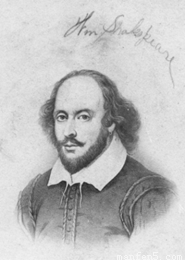
Today, we complete our story about the influential English writer William Shakespeare. He wrote plays and poems during the late fifteenth and early sixteenth centuries, which remain very popular today.
During earlier times, people would probably have learned several ancient Roman and Greek plays. It was not unusual for writers to produce more current versions of these works. For example, in Shakespeare’s play “The Comedy of Errors”, Shakespeare borrowed certain details from the ancient Roman writer Plautus. For his play “Macbeth”, Shakespeare most likely used a work on Scottish history by Raphael Holinshed for information. Shakespeare might have borrowed from other writers, but the intensity(强度)of his imagination and language made the plays his own. While many plays by other writers of his time have been forgotten, Shakespeare and his art live on.
Shakespeare was also influenced by the world around him. He described the sights and sounds of London in his plays. His works include observations about political struggles, the fear of diseases, and the popular language of the city’s tradesmen. Shakespeare’s knowledge of the English countryside is also clear. His works include descriptions of deep forests, local flowers, and the ancient popular traditions of rural people.
It would be impossible to list all of the ways in which Shakespeare’s works have influenced the world culture. But the first and greatest example would be his great influence on the English language. During his time, the English language was changing. Many new words from other languages were being added. Shakespeare used his sharp mind and poetic inventiveness to create hundreds of new words and rework old ones. For example, he created the noun forms of “critic”, “mountaineer” and “eyeball”. Many common expressions in English come from his plays, including “pomp and circumstance(装腔作势)” from “Othello”, “full circle(绕圈子地)” from “King Lear”, etc. The list of cultural creations influenced by Shakespeare is almost endless. From paintings to television to music and dance, Shakespeare was well represented. Shakespeare’s plays have been translated into every major language in the world.
Shakespeare became a wellknown writer during a golden age of theater. His years of hard work paid off.
1. From the passage, we can see that ________.
A. Shakespeare was hardworking when he was a student
B. many of Shakespeare’s works were influenced by earlier writings
C. the experience of living in London had no effect on Shakespeare’s works
D. Shakespeare became rich later because of the popularity of his works
2. Why could Shakespeare’s works survive his time?
A. Because there were so few people writing plays in his time.
B. Because he produced too many works that nobody else could do.
C. Because his works were rich in imagination and language.
D. Because he was a rich and influential person of his time.
3.Shakespeare’s greatest influence should be on .
A. paintings B. television
C. the English language D. music and dance
4.The passage is mainly about .
A. an introduction to Shakespeare’s life and his works
B. the main features and styles of Shakespeare’s plays
C. Shakespeare’s greatest influence on the world culture.
D. how culture influenced Shakespeare and he influenced culture.
查看习题详情和答案>>
Further education is officially described as the“post-secondary stage of education, comprising all vocational(职业的) and non-vocational provision made for young people who have left school, or for adults”. Further education thus embraces the vast range of university, technical, commercial, and art education and the wide field of adult education. It is this sector of education, which is concerned with education beyond the normal school-leaving ages of 16 or 18, that has experienced the most astonishing growth in the number of students.
In the 19th century the dominance(统治地位) of Oxford and Cambridge was challenged by the rise of the civic(城市的) universities, such as London, Manchester, and Birmingham. Following the lead of the 18th century German universities and responding to a public demand for increased opportunity for higher education, Britain’s new civic universities quickly acquired recognition—not only in technological fields but also in the fine and liberal arts.
Many new post-school technical colleges were founded in the early 20th century. The Fisher Act of 1918 empowered the local authorities to levy(征收) a rate (tax) to finance such colleges. The universities, on the other hand, received funds from the central government through the University Grants Committee, established in 1911 and recognized in 1920, after World War I.
A new type of technical college was established in the 1960s—the polytechnic, which provides mainly technological courses of university level as well as courses of a general kind in the arts and sciences. Polytechnics are chartered to award degrees validated(使有效) by a Council for National Academic Awards.
Thus, the third level in the United Kingdom is made up of colleges of further education, technical colleges, polytechnics, and universities. The colleges offer full-time and part-time courses beyond compulsory-school level. Polytechnics and universities are mainly responsible for degrees and research. The innovative Open University, with its flexible admission policy and study arrangements, opened in 1971. It uses various media to provide highly accessible and flexible higher education for working adults and other part-time students. It serves as an organizational model and provides course-materials for similar institutions in other countries.
Changes in British education in the second half of the 20th century have, without changing the basic values in the system, extended education by population, level, and content. New areas for expansion include immigrant cultural groups and multicultural content, the accommodation of special needs, and the development of tools and content in the expanding fields of microelectronics.
【小题1】The first paragraph is written to explain of further education.
| A.the development | B.the history |
| C.the definition | D.the prospects(前景) |
| A.replaced the dominance of Oxford and Cambridge |
| B.provided further education for all the people who need it |
| C.met the increased demand of the public for higher education |
| D.immediately followed the establishment of polytechnic colleges |
| A.were completely free of charge |
| B.were usually financed by local taxes |
| C.depended mainly on students’ tuition(学费) |
| D.received funds from the central government |
| A.only for adult students |
| B.part-time rather than full-time |
| C.non-vocational rather than vocational |
| D.created for both young people and adults |
| A.British Further Education |
| B.Changes in British Education |
| C.Polytechnics and Universities in Britain |
| D.Less Opportunity for Higher Education |
Human beings are the most intelligent of all animals because we are gifted with the ability to think and reason logically. Scientists and even common people with special intelligence have made a lot of inventions and contributions to modern lifestyle in the past. "Houses" have been the most popular area for discoveries and inventions in the past and even now.
Many household items have been the result of inventions of people who desired better functioning of the existent products. Every individual has intelligence and if it is used properly for the right purpose it leads to invention of a new tool or device. Many new household inventions are made almost every day and there are specific companies, which particularly keep a record of all these inventions.
A lot of inventions have been made recently in the household field. These products are patented(专利的)and have trade mark licenses(许可). The patented sliding cinch is a very simple but effective method to prevent shoulder stress and injury for those who work before computers all day long. Vanity PC is a type of computer furniture that specifically hides all the computer wires and keeps a clean and good look. All the outdoor dust, mud and snow can be kept out of the house by installing(安装)the dirt drain(排水管)at the entrance of the door. Another important invention is the automatic toilet night-light, in which a small light starts when the lid of the toilet seat is opened and closes as soon as the lid(盖子)is closed.
These are some of the new household inventions invented mostly by common people. Thus, a variety of new household items are invented every day, which helps in a better functioning of household chores(家务)and in a more useful manner.
1.The first paragraph is intended to _____________.
A. stress the importance of inventions
B. introduce the topic of the article
C. show the advantages of modern lifestyle
D. tell the differences between human beings and animals
2. According to the passage, people make house inventions to _____________.
A. earn more money and gain awards
B. accumulate their wealth
C. improve the present living conditions
D. meet the new demands of new science
3. It can be inferred that the sliding cinch is used to ___________.
A. prevent your shoulder from being over-pressured
B. keep your shoulder safe and sound when you are in an accident or an operation
C. help you practice your shoulder more often and reduce shoulder pains
D. cover your shoulder and make it stronger to resist the outside strike
4.Common people can also make good inventions because ___________.
A. wisdom and inspiration sometimes come from everyday life
B. some inventions are easy to be made and can be mastered by them
C. common people have a strong desire to do something for science research
D. success is often connected with hardship and bitter experience of common people
5.The passage mainly talks about _______________.
A. the correct use of household facilities
B. different ideas about household inventions
C. the history of household inventions
D. household inventions and their influence
查看习题详情和答案>>
下列句子中每句仅有一处错误,请按下列情况改正:
多一个词:把多余的词用斜线(\)划掉,在该行右边横线上写出该词,并也用斜线划掉。
缺一个词:在缺词处加一个漏字符号(∧),在该行右边横线上写出该加的词。
错一个词:在错的词下划一横线,在该行右边横线上写出改正后的词。
1. Students are encouraged to take active part in discussion.
2. The boy is such helpful that we all think highly of him.
3. Elizabeth has many postcards, all of them were bought in London.
4. Since the 1970s many new applications have found for the computer.
5. Liz was amazing when she found how much the dinner had cost.
查看习题详情和答案>>