网址:http://m.1010jiajiao.com/timu3_id_2560804[举报]
While watching the Olympics the other night, I came across an unbelievable sight.It was not a gold medal, or a world record broken, but a show of courage.
The event was swimming and started with only three men on the blocks.For one reason or another, two of them false started, so they were disqualified.That left only one to complete.It would have been difficult enough, not having anyone to race against, even though the time on the clock is important.
I watched the man dive off the block and knew right away that something was wrong.I'm not an expert swimmer, but I can tell a good dive from a poor one, and this was not exactly medal quality.When he resurfaced, it was evident that the man was not out for gold — his arms were waving in an attempt at freestyle.The crowd started to laugh.Clearly this man was not a medal competitor.
I listened to the crowd begin to laugh at this poor man who was clearly having a hard time.Finally he made his turn to start back.It was pitiful.He made a few desperate strokes and you could tell he was worn out.
But in those few awful strokes, the crowd had changed.
No longer were they laughing, but beginning to cheer.Some even began to stand and shout “Come on, you can do it!” and he did.
A clear minute past the average swimmer, this young man finally finished his race.The crowd went wild.You would have thought that he had won the gold, and he should have.Even though he was recorded one of the slowest times in Olympic history, this man gave more heart than any of the other competitors.
Just a short year ago, he had never even swum, let alone race.His country had been invited to Sydney.
In a competition where athletes remove their silver medals feeling they have somehow been cheated out of gold, or when they act so proudly in front of their competitors, it is nice to watch an underdog.
1.From the passage we can learn that the young man ________
A. made his turn to start back pitifully
B. was skillful in freestyle in the game
C. swam faster than the average swimmer
D. was not capable enough to win the medal
2.The crowd changed their attitudes because ________
A. they felt sorry for the young man
B. they were moved by the young man
C. they wanted to show their sympathy
D. they meant to please the young man
3.According to the passage, “it is nice to watch an underdog” probably means _______.
A. it’s amusing to watch a man with awful swimming skills
B. it’s amazing to watch an ordinary man challenging himself
C. it’s cheerful for athletes to act proudly before their competitors
D. it’s brave enough for some athletes to remove the silver medals
4. What’s the best title for the passage?
A. Compete for Gold!
B. Try again!
C. Break a Record!
D. Go for it!
查看习题详情和答案>>
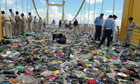
The Cambodian government says more than 378 people died and hundreds more were injured in a stampede (踩踏) during the celebrations of the annual Water Festival late Monday in Phnom Penh.
Less than 24 hours after the tragedy(悲剧), Cambodia's most serious loss of life in decades(十年), the government founded an organization to investigate(调查) how so many died on what was meant to be one of the nation's most joyous occasions.
Most of the victims(牺牲品) were young people in their teens and twenties. They were some of the estimated(估计) two million who had flooded to Phnom Penh for the Water Festival, which marks the end of the rainy season.
Most suffocated on the bridge, which thousands of people were using to leave Diamond Island, an entertainment(娱乐) area in the middle of the river. Others drowned(溺水) after jumping from the bridge into the water.
Buot Panha, 19, said shortly after 9:30 on Monday evening he ended up trapped(围困) with his friends in the middle of the bridge, fighting to breathe while terrified people struggled all around him.
Being tall saved his life, since he could stretch(伸出) his neck to take in oxygen(氧气). Shorter people were unable to do that, he says, which may be why two-thirds of the victims were women.
He tried to help a woman who was trapped with two children near him. She was screaming for people to help. Being tall, Buot Panha grabbed(抓住) one child and pushed him above the crowd to help him breathe.
But then some of the young men were told to jump off the bridge into the river to make room. So he handed back the child, squirmed his way to the edge, and jumped.
Some like Buot Panha were fortunate, jumping into the river below and swimming for the shore. But many simply could not move, and died where they lay.
Buot Panha says his first Water Festival will be his last. He vows(发誓) never to come back.
【小题1】The passage is mainly about ________.
| A.Water Festival celebrations | B.a stampede in Cambodia |
| C.a teenager, Buot Panha | D.a woman and her children |
| A.It is the biggest tragedy in decades in Cambodia. |
| B.It is the most serious loss of life in decades in Cambodia. |
| C.The government ordered an investigation. |
| D.Water Festival is Cambodia’s most joyous occasion. |
| A.breathed in | B.felt uncomfortable |
| C.died from too little oxygen | D.left in a hurry |
| A.being unable to breathe | B.being drowned |
| C.violence | D.the rainy season |
| A.His being tall saved him in the river. |
| B.He struggled through the crowd to save one child. |
| C.It was his first time to attend the Water Festival alone. |
| D.He will never come back to Phnom Penh for the Water Festival. |
It was my first year teaching in a special needs class, and I wasn’t sure what to expect at our yearly. Special Olympics sports meeting. My 1 had some challenges, from learning disabilities to cerebral palsy(大脑性麻痹).
Mark was one with the latter. Restricted to a 2 , he had to fight his spasms (抽筋) just to control his movements. 3 , he always had a positive attitude and greeted everyone with a huge smile.
His classmates 4 him and always took the time to make sure he was included in group activities, especially Mike, Andy and Lucas, three boys who were good at 5 . Obviously, Mark wanted to be like them, unrestricted by the limitation of his 6 and watching them moving on the playing field seemed to fill him with 7 .
When the day came, Mike, Andy and Lucas 8 well in their sports events, and gave the normally calm audience something to cheer about. Mark sat in his wheelchair on the sidelines, 9 them on.
The final event of the day was the 400 meter race. 10 was invited to either walk or run, according to their ability, around the 11 length of the track.
When Mike, Andy and Lucas reached the finish line, they 12 and turned to look behind them. At the 13 of the crowd, determined not to be left behind, was Mark. All his classmates had 14 him. He was alone on the track with over half the distance left to 15 .
Mike, Andy and Lucas looked at each other, and a silent 16 passed between them. Slowly, they jogged 17 towards their friend, cheering him on 18 he had done for them moments before.
The progress was 19 , but in the end the three star runners and Mark crossed the finish line together to the enthusiastic cries of their teachers and classmates. Seeing the look on Mark’s face as he crossed the finish line, hands upraised and laughing, I came to understand what 20 the Special Olympics, and the determined athletes who compete, so extraordinary.
Years later, I’m still cheering them on.
1. A.partners B.friends C.students D.classmates
2. A.bed B.machine C.wheelchair D.desk
3. A.So B.However C.Otherwise D.Therefore
4. A.protected B.satisfied C.respected D.loved
5. A.sports B.practice C.studies D.expression
6. A.interests B.body C.habits D.mind
7. A.wonder B.trust C.stress D.reset
8. A.trained B.played C.operated D.prepared
9. A.bringing B.holding C.cheering D.moving
10. A.Someone B.Nobody C.Anybody D.Everyone
11. A.entire B.different C.average D.equal
12. A.fell B.paused C.rushed D.rested
13. A.center B.front C.end D.top
14. A.left B.ignored C.passed D.helped
15. A.continue B.jog C.walk D.cover
16. A.demand B.thought C.action D.relief
17. A.back B.along C.again D.on
18. A.while B.although C.since D.as
19. A.boring B.great C.slow D.relaxing
20. A.leaves B.finds C.keeps D.makes
查看习题详情和答案>>
阅读下面短文,从短文后各题所给的四个选项(A、B、C和D)中,选出可以填入空白处的最佳选项,并在答题卡上将该项涂黑
 Born in America , I spoke English ,not Chinese , the
language of my ancestors . When I was three, my parents flashed cards with
Chinese 1at my face , but I pushed them 2.
My mom believed I would learn 3I was ready . But the 4never
came.
Born in America , I spoke English ,not Chinese , the
language of my ancestors . When I was three, my parents flashed cards with
Chinese 1at my face , but I pushed them 2.
My mom believed I would learn 3I was ready . But the 4never
came.
On a Chinese New Year’s Eve , my uncle spoke to me in Chinese , but all I could do was 5at him , confused , scratching my head . “ Still can’t speak Chinese?” He 6me , “You can’t even buy a fish in Chinatown .”
“Hey ,this is America , not China. I’ll get some 7with or without Chinese.” I replied and turned to my mom for 8.
“Remember to ask for fresh fish, Xin Xian Yu ,” she said ,handing over a $20 bill . I 9the words, running downstairs into the streets of Chinatown.
I found the fish 10surrounded in a sea of customers. “I’d like to buy some fresh fish,” I should to the fishman. But he 11my English words and turned to serve the next customer .The laugh of the people behind increased 12their impatience. With every 13, the breath of the dragons (龙) on my back grew stronger—my blood boiling— 14me to cry out . “ Xian Sheng Yu , please.” “Very Xian Sheng ,” I repeated .The crowd erupted into laughter . My face turned 15and I ran back home 16, except for the $20 bill I held tightly in my pocket.
Should I laugh or cry? They’re Chinese. I should feel right at 17. Instead , I was the joke , a disgrace (丢脸)to the language.
Sometimes, I laugh at my fish 18, but , in the end, the joke is on 19. Every laugh is a culture 20; every laugh is my heritage (传统) fading away.
1.A. custom B. games C .characters . D. language
2.A. ahead B. around C. along D. aside
3.A. when B. before C. unless D. until
4.A. success B. study C. time D. attempt
5.A. aim B. joke C. nod D. stare
6.A. cared about B. laughed at C. argued with D. asked after
7.A. right now B. from now C. at times D. in time
8.A. decision B. permission C. information D. preparation
9.A. repeated B. reviewed C. spelled D. kept
10.A. farm B. stand C. pond D. market
11.A. guessed B. forgot C. doubted D. ignored
12.A. by B. as C. with D. from
13.A. second B. effort C. desire D. movement
14.A. forcing B. allowing C. persuading D. leading
15.A. bright B. blank C. pale D. red
16.A. open-mouthed B. tongue-tied C. empty-handed D. broken-hearted
17.A. service B. home C. risk D. root
18.A. trade B. deed C. challenge D. incident
19.A. it B. us C. me D. them
20.A. thrown B. lost C. divided D. reflected
查看习题详情和答案>>
阅读下面短文,从短文后所给各题的四个选项(A、B、C和D)中,选出可以填入
空白处的最佳选项,并在答题卡上将该项涂黑。
A wealthy man and his son loved to collect rare works of art. They had a large , from Picasso to Van Gogh. They would often sit together and the paintings of great artists. When the Vietnam conflict , the son went to war. he died in battle while rescuing another soldier. The father was in deep .
A month later, a young man came with a large in his hands. He said, “Sir, I am the soldier for whom your son his life. He often talked about your love for . So please accept it as a gift.” The father opened the package and saw a of his son. The father was so drawn to the picture that his eyes welled up with tears.
A few months later, the wealthy man died. There was to be a great auction (拍卖) of his
. Many people gathered, over having an opportunity to one painting. The auctioneer said, “We will start the bidding (竞拍) with this picture of the son. Who will bid for it?” There was . Then a voice shouted, “We want to see the famous paintings. Just
it.” “The son! Who’ll take the son?” the auctioneer continued.
Finally, a came from the very back. It was the gardener of the old man. “I’m poor and can only $10 for that.” The auctioneer asked the crowd to bid more. , they still kept silent. So he pounded the gavel (小锤). “SOLD for $10!” A man shouted, “Go on with the collection!” The auctioneer said, “I’m sorry, the auction is . According to will, only the picture of the son would be auctioned. Whoever bought that picture would be with all of the possessions, including the paintings.”
1.A. library B. collection C. house D. garden
2.A. admire B. process C. sell D. arrange
3.A. broke away B. broke up C. broke out D. broke off
4.A. Unwillingly B. Surprisingly C. Generally D. Unfortunately
5.A. mood B. sorrow C. pressure D. nerve
6.A. package B. book C. box D. case
7.A. cost B. gave C. assessed D. concluded
8.A. music B. smoking C. clothes D. art
9.A. watch B. picture C. gift D. letter
10.A. house B. garden C. paintings D. son
11.A. disappointed B. excited C. puzzled D. stressed
12.A. buy B. search C. steal D. adopt
13.A. noise B. shout C. delight D. silence
14.A. ignore B. defeat C. divide D. tolerate
15.A. seller B. painter C. voice D. scream
16.A. spend B. sponsor C. contribute D. afford
17.A. Thus B. However C. Therefore D. Besides
18.A. over B. on C. apart D. alongside
19.A. the gardener’s B. the son’s C. the young man’s D. the old man’s
20.A. supplied B. appointed C. presented D. equipped
查看习题详情和答案>>