网址:http://m.1010jiajiao.com/timu3_id_2457164[举报]
In modern society there is a great deal of argument about competition. Some value it highly, believing that it is responsible for social progress and prosperity, others say that competition is bad; that it sets one person against another; that it leads to unfriendly relationship between people.
I have taught many children who held the belief that their self – worth relied on how well they performed at tennis and other skills. For them, playing well and winning are often life – and – death affairs. In their single – minded pursuit (追求) of success, the development of many other human qualities is sadly forgotten.
However, while some seem to be lost in the desire to succeed, others take an opposite attitude. In a culture which values only the winner and pays no attention to the ordinary players, they strongly blame competition. Among the most vocal are youngsters who have suffered under competitive pressures from their parents or society. Teaching these young people, I often observe in them a desire to fail. They seem to seek failure by not trying to win or achieve success. By not trying, they always have an excuse: “I may have lost, but it doesn’t matter because I really didn’t try.” What is not usually admitted by themselves is the belief that if they had really tried and lost, that would mean a lot. Such a loss would be a measure of their worth. Clearly, this belief is the same as that of the true competitors who try to prove themselves. Both are based on the mistaken belief that one’s self – respect relies on how well one performs in comparison with others. Both are afraid of not being valued. Only as this basic and often troublesome fear begins to dissolve (缓解) can we discover a new meaning in competition.
【小题1】What does this passage mainly talk about?
| A.Competition helps to set up self – respect. |
| B.Competition is harmful to personal quality development. |
| C.Opinions about competition are different among people. |
| D.Failures are necessary experiences in competition |
| A.It improves personal abilities. | B.It builds up a sense of duty. |
| C.It pushes society forward. | D.It encourages individual efforts. |
| A.those who try their best to win |
| B.those who value competition most highly |
| C.those who rely on others most for success |
| D.those who are against competition most strongly. |
| A.Fear of failure should be removed in competition. |
| B.Competition should be encouraged. |
| C.Winning should be a life – and – death matter. |
| D.Every effort should be paid back. |
Many of us assume that with such a last name, Peter Buffett, 52, must enjoy a life of endless privilege. But the son of billionaire investor (投资人) Warren Buffett definitely doesn’t think so.
“People who are born with a silver spoon in their mouth can fall victim (受害者) to what my father has called a silver dagger (匕首) in your back,” Buffett told Reuters in an interview. “It leads to a sense of entitlement (特权) and a lack of personal achievement.”
Entitlement, he believes, is the worst thing ever. “Anybody who acts like they deserve (应得) something ‘just because’ is a disaster,” he said.
In his new book, Life Is What You Make It: Finding Your Own Path to Fulfillment, Buffett says that the only real inheritance (遗产) handed down from his parents was a philosophy (价值观): Forge your own path in life. It is a belief that has allowed him to follow his own passions, establish his own identity, and reap (收获) his own successes.
Did his father ever want him to go into finance? “It was encouraged for a moment when I was open to the idea,” he told Reuters. But as he grew older, it became clear the financial world “was not speaking to my heart.”
His father accepted his choice to become a musician. He began his musical career by writing music for TV commercials (广告). He then released his own albums.
“I am my own person and I know what I have accomplished in my life,” he told Reuters. “This isn’t about wealth or fame or money or any of that stuff, it is actually about values and what you enjoy and finding something you love doing.”
Along with the book, Buffett has begun a “Concert & Conversation” tour in which he plays the piano, talks about his life and warns against consumerist (消费主义) culture and damaging the environment.
“Economic prosperity (繁荣) may come and go; that’s just how it is,” he writes in the book. “But values are the steady currency (硬通货) that earn us the all-important rewards.”
What does “It” in the second paragraph refer to?
A. A life of a top investor. B. A silver spoon in the mouth.
C. Being born to a wealthy family. D. The victim of a silver dagger in the back.
What does the article tell us?
A. Peter Buffett is a born musician.
B. Peter Buffett enjoys a hugely privileged life.
C. A wealthy family can benefit a child but also spoil him or her.
D. Peter Buffett was forced by his parents to take over their business.
The article claims that Peter Buffett owes his achievements largely to ______.
A. his passion for music B. the good education he received
C. his great determination D. the values he learned from his parents
Which of the following statements would Peter Buffett probably agree to?
A. Wealth is there to enjoy to the fullest.
B. A person’s value lies within.
C. Many people are fooled by economic prosperity.
D. Young people should choose their own philosophy, whatever their parents believe in.
查看习题详情和答案>>
BEIJING, Sep. 10 (Xinhuanet) -- The extra-large model baby in the Spain Pavilion(馆) was “conceived”(构思)by a Spanish filmmaker, Shi Yingying reports.
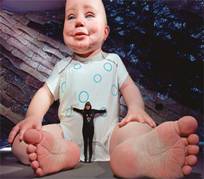
Visitors admiring the 6.5-meter-high giant baby, Miguelin, in the Spain Pavilion may be surprised to realize that it was not the concept of a famous designer or a group of groundbreaking engineers. It came from one filmmaker’s interpretation of the meaning of “Better City, Better Life”.
Spanish director Isabel Coixet developed the idea after being asked to contribute to Expo 2010 Shanghai.
“They asked me to do something to tell the Chinese audience about Spain in the future and the first thing jumping to my mind was a baby,” said Coixet. “If we really fight to have better cars, better cities and better lives, it’s for them - for our children.”
Despite her Spanish heritage, Coixet doesn’t focus on making Spanish films or using Spain as the setting. Fans of her various award-winning films, including My Life Without Me, The Secret Life of Words and Elegy, may not even be aware of Coixet’s Spanish background.
“The borders between countries are just illusion(假象),” said Coixet. “Some directors feel really comfortable telling stories that belong to their territory.”
But Coixt feels the opposite: “I'm more comfortable outside my country. It gives me a strange freedom.”
One of her favorite things about being a director is the freedom. “The thing is that the world is wide and this freedom lets you make films everywhere,” she said.
Coixet’s curiosity took her latest exploration and movie work to Japan. In the movie Map of the Sound of Tokyo, the Catalan actor Sergi Lopez is the owner of a wine shop in Tokyo, and Japanese actress Rinko Kikuchi is a young woman who works both as a fishmonger and as a hired killer.
The conflict of the two people's very different worlds and the tango-like relationship they develop is just one representation of what Coixet is able to produce by mixing cultures.
While she doesn’t know if she will shoot a film in Shanghai, two things have caught her attention: Shanghainese women and crickets(蟋蟀).
After just arriving in the city, she was surprised by the mix of old Chinese culture in a booming chief city “Behind the skyscrapers, there is a flower and bird market with heaps of crickets and birdcages in,” she said. “I'm totally amazed with the city.”
The huge baby represents the idea that ______________.
A. our children are the new generation full of imagination.
B. our children will develop the friendship between China and Spain.
C. our children are our future.
D. our children will understand the meaning of “better city, better life”.
We learn from the passage that Coixet’s award-winning films were set ____________.
A. only in Spain. B. only in Japan.
C. mainly in the countries outside Spain. D. mainly in the countries within Europe.
According to Isabel Coixet, a flower and bird market behind the high rises_______________.
A. shows people in Shanghai are living a rich life spiritually and materially.
B. reflects prosperity of the market.
C. indicates the Chinese people are leading a rich life.
D. represents the traditional culture of China.
From the passage we can learn that ____________.
A. Isabel Coixet is dissatisfied with the design of the extra-large model baby.
B. A mix of different cultures is reflected in Isabel Coixet’s films.
C. Isabel Coixet feels less comfortable while making films all over the world.
D. Isabel Coixet designed the huge baby according to the requirement of a group of engineers.
查看习题详情和答案>>Traffic jam and cities, it seems, go hand in hand. Everyone complains about being stuck in traffic; but, like the weather, no one seems to do anything about it. In particular, traffic engineers, transportation planners, and public officials responsible for transportation systems in large cities are frequently criticized for failing to solve traffic jam. But is traffic jam a sign of failure? Long queues at restaurants or theater box offices are seen as signs of success. Should transportation systems be viewed any differently? I think we should recognize that traffic jam is an unpreventable by-product of successful cities, and view the “traffic problem” in a different light.
Cities exist because they promote social interactions and economic transactions.Traffic jam occurs where there are lots of people but limited spaces. Culturally and economically successful cities have the worst traffic problems, while decaying cities don’t have much traffic. New York and Los Angeles are America’s most crowded cities. But if you want access to major brokerage houses (经纪行), you will find them easier to reach in crowded New York than in any other large cities. And if your firm needs access to post-production film editors or satellite-guidance engineers, you will reach them more quickly through the crowded freeways of LA than through less crowded roads elsewhere.
Despite traffic jam, a larger number and wider variety of social interactions and economic transactions can be made perfect in large, crowded cities than elsewhere. Seen in this sight, traffic jam is an unfortunate consequence of prosperity, not a cause of economic decline and urban decay.
So while we can consider traffic jam as increasing costs on the areas of big cities, the costs of inaccessibility (交通不便) in uncrowded places are almost certainly greater.
There is no doubt that traffic jam brings the terrible economic and environmental damage in places like Bangkok, Jakarta, and Lagos. But mobility is far higher and traffic jam levels are far lower here in the US, even in our most crowded cities. That’s why, for now, we don’t see people and capital streaming out of San Francisco and Chicago, heading for cities like California, and Illinois.
【小题1】We can conclude from the first paragraph that_______.
| A.traffic jam and weather are the two factors preventing the development of the big city |
| B.traffic jam seems to be very difficult to deal with |
| C.if traffic engineers try their best, traffic jam can be solved |
| D.public officials are always criticized for misusing their power |
| A.Traffic jam is unavoidable in any cities. |
| B.Traffic jam is both a sign of failure and a sign of success. |
| C.Traffic jam is one of the consequences of successful cities. |
| D.Traffic jam is a cause of economic decline. |
| A.declining | B.developing | C.rich and successful | D.strong and healthy |
| A.The traffic jam in the two cities has been worsened. |
| B.New York and Los Angeles are the least successful cities in the US. |
| C.It is easier to reach major brokerage houses in the two cities than in other cities. |
| D.Despite the traffic jam in LA, you’ll find a satellite-guidance engineer more quickly there. |
The city of Angkor was the capital of the Khmer Empire from the 9th to the 15th centuries. The Khmer Empire was one of the most prosperous kingdoms in the history of Southeast Asia, and its prosperity was expressed through a wide range of architecture.
The city of Angkor was founded on political and religious ideas adapted from India, and the temples of Angkor were intended as a place of worship for the king and a way for him to ensure his immortality through identification with the Hindu gods.
Angkor Wat was first built by King Suryavarman Ⅱ in the 12th century as a vast funerary temple that would hold his remains, symbolically(象征性地) confirming his permanent identity with Vishnu.
During its six centuries as imperial capital, Angkor went through many changes in architectural styles and in religion. The city of Angkor transferred itself from the Hindu god Shiva to the Hindu god Vishnu, and finally to the Mahayana Buddhist goddess Avalokitesvara.
By the late 13th century, the once frenzied(发狂的) pace of Angkor's architectural pursuits had begun to die down, and a more restrained type of religion was on the rise under the growing influence of Theravada Buddhism.
At the same time, Angkor and the Khmer Empire were increasingly threatened and attacked by invading armies. By the 16th century, the golden age of Angkor was over and many of the great temples began to move back into the jungle.
From the 15th to 19th centuries, Theravada Buddhist monks cared for Angkor Wat, and it is thanks to them that the temple remains mostly intact(完整的). Angkor Wat became one of the most important pilgrimage(朝拜) sites in Southeast Asia. Angkor Wat is the best preserved example of Khmer architecture in Cambodia and is so grand in design that some rank it among the seven wonders of the world. It appears on the Cambodian national flag, a very rare instance of a flag with an image of a building.
1. Angkor Wat was first built to________.
A. hold the remains of a king B. serve as the royal palace
C. worship the gods D. be the tomb for the king
2. Angkor Wat probably began to face real threat from________.
A. the 12th century B. the late 13th century
C. the 16th century D. the 15th century
3. Vishnu was the name of________.
A. a king in ancient Cambodia
B. a temple in Cambodia
C. an Indian god
D. a monk in ancient Cambodia
4. We can infer from the last paragraph that________.
A. Angkor Wat is widely accepted as one of the seven wonders of the world
B. Theravada Buddhist monks had fought against the outside invaders
C. Angkor Wat is not so important as it used to be
D. Angkor Wat has become a symbol of Cambodia
5. The passage mainly tells us________.
A. the history of Angkor Wat
B. the protection of Angkor Wat
C. the importance of Angkor Wat
D. the position of Angkor in Cambodian history
查看习题详情和答案>>