网址:http://m.1010jiajiao.com/timu3_id_2435242[举报]
As we know, there are differences between western culture and Chinese culture. We can see differences when we pay attention to the way words are used. Let’s look at the words about animals and plants. Most expressions in Chinese about the dog, for example, “a homeless dog”, “a mad dog”, “a running dog” and “a dog catching mouse”, have negative meanings. But in western countries, dogs are thought to be honest and good friends of humans. In English, people use the dog to describe positive actions. For example, “You are a lucky dog.” means you are a lucky person. And “every dog has its day.” means each person has good luck sometimes. To describe a person’s serious illness, they say “sick as a dog”. The word “dog-tired” means very tired. However, Chinese love cats very much. But in western culture, “cat” is often used to describe a woman who is cruel.
The rose is regarded as symbol of love in both China and some western countries. People think the rose means love, peace, courage and friendship. And the rose is the national flower of England, America and many other countries.
The words about plants and animals are used in positive or negative ways in different cultures. We can learn about many differences in cultures by comparing how some words are used.
1. “Every dog has its day.” means “________”.
A. Everybody in the world is lucky.
B. Each person lives his own way of life.
C. If one works hard, he’s sure to succeed.
D. Everybody has a time in life to be lucky.
2.What can we know from the passage?
A. Words show differences in culture.
B. Chinese people prefer dogs to cats.
C. Western people think cats to be good friends.
D. Rose is the national flower of all western countries.
3.Which statement is right according to passage?
A. People think the rose means love, peace, luck and friendship.
B. The words about plants and animals are used both in positive and negative ways in different cultures.
C. In China, people use the dog to describe negative actions.
D. In eastern culture, “cat” is often used to describe a woman who is cruel.
4.What’s the best title for the passage?
A. Negative or Positive
B. Different Countries Have Different Culture
C. Rose Means the Same in Chinese and English
D. What Dog and Cat Mean in English and Chinese
查看习题详情和答案>>
Information is received into our brain by attention, and its quality determines (决定) how well it will be processed, saved and used afterwards.
All information we receive is chosen by our attention. Factors (因素) affecting (影响) our attention are personal interest, experience, ability, feelings, knowledge, environment, timing, and so on. The same information may attract different forms and levels of attention from different people. Some people can get and save the information easily; some may have great difficulty; while others may just turn a blind eye to it. To the same information, one may even pay different levels of attention at different times. But if the facts work together, the quality of attention may be better. Therefore, it is not surprising to see that somebody with average intelligence (智力) can have excellent performances in some fields.
The good news is that a person's attention can be shaped, trained and made stronger by effective exercise. With this in mind, we should keep improving the quality of our attention.
1."it" in Paragraph 1 means _______.
A. information B. brain C. attention D. quality
2.All information we receive depends on _______.
A. information itself B. our attention
C. our intelligence D. the environment
3.Which is not the factor that affects our attention according to the passage?
A. Interest and experience.
B. Experience and knowledge.
C. Ability and feelings.
D. Food and drinks.
4.About attention, which of the following statements is right?
A. People always have the same level of attention.
B. People pay the same attention to the same information.
C. A person may pay different levels of attention to the same information at different times.
D. All factors affecting attention never work together.
5.According to the passage, _______ can help people to make their attention better.
A. speaking more B. effective exercise
C. hard work D. high intelligence
查看习题详情和答案>>

Once there was a parrot on sale in a pet store. It was a beautiful red and blue bird. It sat on a perch in the middle of the store, so that everyone could see it when they came in. The owner was very proud of it and asked a high price for it.
One day a man went into the store. "That's a beautiful bird,"he said to the pet store owner, "But why is it so expensive? Is it unsual bird?"
"No, it's not very unusual. It's expensive because it can talk," the pet store owner said.
"I see. How can I make it talk?" the man asked.
The pet store owner asked him, "Do you see those string tied to each of the bird's legs?"
"Yes," the man answered.
"Well, you pull those strings," the pet store owner told him."That will make the parrot talk."
The man asked,"Do you mind if I try?"
"Not at all," the pet store owner said.
The man walked up to the parrot and pulled the string on its left leg. The parrot said, "Good morning."
The man pulled the string on the parrot's right leg. This time the parrot said, "How are you today?"
"That's not very interesting, " said the man. "Any parrot could do that." Then he laughed, "But what wold happen if I pulled both strings at the same time?"
"I'll fall off my perch, you fool!" the parrot said.
1.The parrot was expensive because________.
A.it was pretty beautiful
B.it could talk with the people
C.it was a very unusual bird
D.it was in the middle of the store
2.The parrot would talk when _________.
A.people came into the pet store
B.it was the pet store owner
C.people said it was beautiful
D.people pulled the strings on its legs
3.Which is the first sentences that the parrot said to the man?
A.Good morning.
B.How are you?
C.That's wasn't interesting.
D.I'll fall off my perch, you fool.
4.From the story we know the parrot was_______.
A.kind B.silly C.clever D.crazy
5.The best title for the passage should be _________.
A.Unusual Parrot B.Parrot Talk C.Silly man D.Clever Owner
查看习题详情和答案>>
“Visitors to the 2010 World Expo in Shanghai will be able to go sightseeing in super cool cars with no drivers,” Shanghai city government speaker said recently.
When the six-seat car was shown to the public, it interested many people. “The car will help visitors feel what high technology(技术)is and help them enjoy the tour of the World Expo site,” said a teacher from Tongji University. The car, 4.5 meters long, 1.7 meters wide(宽), and 1.6 meters tall, runs along a white line. The car costs around 300,000 yuan to build and can reach a top speed of 50 kilometers per hour.
According to the researchers, visitors will be able to driver the car anywhere in the World Expo site by pressing a button(按按钮). If they want to get off or stop the car, all they need to do is just to press the button again.
“People can rent one of these cars for a whole day or just take a ride in it from one place to another,” the teacher said. About 400 to 500 of these cars will be made for the Expo in 2010. the cars will have radar(雷达)to help them get around. They will mainly use solar(太阳能)batteries. And they have no need of drivers and oil(汽油), these cars will help save energy and human work, and cause no pollution to the environment.
1.The new type of car has _____ seats.
A. seven B. six C. five
2.According to this passage, which of the following is TRUE?
A. The car can reach a top speed of 50 kph.
B. The car costs about 30,000 yuan to build.
C. The car is 4.5 meters long and 1.7 meters tall.
3.Which of the following is not mentioned in this passage?
A. People can buy this type of car and drive it in the World Expo site.
B. This type of car can save energy and human work, and cause no pollution.
C. People can press the button themselves when they want to get off or stop the car.
4.The title(标题)of the passage is probably “_____”.
A. Radar First Used in Cars
B. Cool Cars with No Driver
C. Tour the 2010 World Expo
查看习题详情和答案>>
If you ask your parents: “Did you buy salt recently?” They might either say: “Yes, we bought more salt than usual”, or “No, we couldn’t find any in the market.”
This is because of the recent craze(狂热) of salt buying in China. In big cities like Beijing, Shanghai and Shenzhen, salt almost sold out in only one night.
After the big earthquake in Japan on March 11, there was a nuclear leak(核泄漏). And rumors(传言) about whether it will affect our daily life appeared: first, iodized(含碘的) salt can keep us from the dangers of radiation(辐射);second, there will be less sea-salt in the ocean because of the nuclear pollution.
Both the government and experts said the rumors were not true, but people still bought as much salt as possible. Why? Many salt-buyers didn’t really care or know what experts or the government were saying. That was the real reason behind the craze of salt buying.
On March 20, the government said the salt market is back to normal. And most of China’s salt is from lakes, not the ocean.
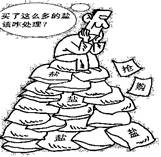
Now, many people want to return the salt they bought. “There is no reason why those people should get their money back,” an article in Xinhua Daily Telegraph said. “They made the craze in the first place.”
Perhaps people should learn a lesson from the salt: don’t believe everything you hear.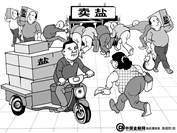
【小题1】The recent craze of salt buying in China happened because of ________.
A. the earthquake
B. the rumors
C. the shortage(缺乏) of salt
【小题2】When did the rumors start?
A. On March 11.
B. After March 11.
C. On March 20.
【小题3】According to the passage most of China’s salt is from ________.
A. lakes B. the ocean C. rivers
【小题4】Which of the following statements is true according to the passage?
A. People believed what the government and experts said first.
B. People could return the salt and got back their money later.
C. Salt almost sold out in only one night because of the rumors.
【小题5】The passage tells us that ________.
A. we can’t believe everything we hear
B. there must be a nuclear leak after an earthquake
C. only iodized salt can keep us from the dangers of radiation