题目内容

What we today call American folk art was, indeed, art of, by and for ordinary, everyday“folks”who, with increasing prosperity and leisure(闲暇),created a market for art of all kinds, and especially for portraits. Citizens of prosperous, essentially middleclass republics—whether ancient Romans, 17th century Dutch people, or 19th century Americans—have always shown a marked taste for portraiture. Starting in the late eighteenth century, the United States contained increasing numbers of such people, and of the artists who could meet their demands.
The earliest American folk art portraits come, not surprisingly, from New England—especially Connecticut and Massachusetts—for this was a wealthy and populous region and the center of a strong craft tradition. Within a few decades after the signing of the Declaration of Independence in 1776, the population was pushing westward, and portrait painters could be found at work in western New York, Ohio, Kentucky, Illinois, and Missouri.Midway through its first century as a nation, the United States' population had increased roughly five times, and eleven new states had been added to the original thirteen. During these years the demand for portraits grew and grew, eventually to be satisfied by the camera. In 1839 the photograph taken by an early photographic process was introduced to America, announcing the age of photography, and within a generation the new invention put an end to the popularity of painted portraits. Once again an original portrait became a luxury(奢侈品),commissioned by the wealthy and executed(执行)by the professional.
But in the time of greatest prosperity of portrait painting—from the late 18th century until the 1850's—anyone with small amount of artistic ability could become a limner,as such a portraitist was called. Local craftspeople—sign, coach, and house painters—began to paint portraits as a profitable sideline(副业);sometimes as talented man or woman who began by sketching family members gained a local reputation and was besieged(包围)with requests for portraits; artists found it worth their whole to pack their paints, canvases, and brushes and to travel the countryside, often combining house decorating with portrait painting.
36.In Paragraph 1 the author mentions 17th century Dutch people as an example of a group that________.
A.consisted mainly of selftaught artists
B.appreciated portraits
C.influenced American folk art
D.had little time for the arts
37.According to the passage, where were many of the first American folk art portraits painted?
A.In western New York.
B.In Illinois and Missouri.
C.In Connecticut and Massachusetts.
D.In Ohio.
38.How much did the population of the United States increase in the first fifty years following independence?
A.It became three times larger.
B.It became five times larger.
C.It became eleven times larger.
D.It became thirteen times larger.
39.According to the passage, which of the following contributed to a decline in the demand for painted portraits?
A.The lack of a strong craft tradition.
B.The westward immigration of many painters.
C.The growing preference for landscape paintings.
D.The invention of the camera.
40.The author implies that most limners________.
A.received instruction from travelling teachers
B.were women
C.were from wealthy families
D.had no formal art training
B
C
B
D
D

I was nineteen years old the first time I saw my own true character.
My trip to and from work each day included a ten-minute walk through the heart of downtown, where the 36 often gathered. Like most busy citizens, I learned to 37 those nameless faces. When it came to homeless beggars, my 38 life experience had led me to one 39 that they are on the street because they choose to be, probably due to alcohol or drugs.
It was an extremely cold day. When I passed the groups of beggars as usual, I heard a shaky voice target me.
“Spare some change?” he asked.
I didn’t even 40 looking up at his nameless face. I briefly 41 him walking into a liquor store and buying whiskey with the money we spared him. Like most teenagers, it took me only moments to 42 him.
“I have no money on me,” I said quickly.
Looking back now, I feel as if God had set out that day to teach me a lesson. And God 43 . Just a few feet past him, I managed to find the only ice patch on the sidewalk. I 44 and landed heavily on my right knee. The 45 was almost killing me as I tried to get up. Then I heard a shaky voice only inches above me.
“Are you all right?” he asked.
I knew immediately this was the man I had just rushed past. Even in pain, I 46 took a quick moment to sniff for the smell of alcohol on his breath. There was none. He wasn’t 47 . I saw the 48 in his eyes.
I 49 to get to my feet. He held my arm as I walked difficultly to the nearby bus stop.
“My name is Mike,” he said. “That’s quite a fall you took, and you really need to get it checked by a doctor,” he said with deep 50 .
“This bus goes past the hospital,” I said.
Mike paused, and a look of sudden 51 crossed his face. He reached into his pocket and pulled out a small cup. He took out all the change and held it out toward me.
“I think there’s just enough here for you to take the bus,” he said.
I was highly embarrassed as I remembered my 52 . I reached for my purse and took out my change. At least ten dollars. I offered Mike all my change.
“Thank you and take care of yourself,” I said. Both of us knew that few minutes earlier I couldn’t have 53 what happened to him.
Mike held his cup tightly, 54 it as if it were the first gift he had ever received.
A half cup of change seemed too small a gift for the man who gave a 55 to every nameless face I’ve ever seen.
| 【小题1】 |
|
| 【小题2】 |
|
| 【小题3】 |
|
| 【小题4】 |
|
| 【小题5】 |
|
| 【小题6】 |
|
| 【小题7】 |
|
| 【小题8】 |
|
| 【小题9】 |
|
| 【小题10】 |
|
| 【小题11】 |
|
| 【小题12】 |
|
| 【小题13】 |
|
| 【小题14】 |
|
| 【小题15】 |
|
| 【小题16】 |
|
| 【小题17】 |
|
| 【小题18】 |
|
| 【小题19】 |
|
| 【小题20】 |
|
Timetable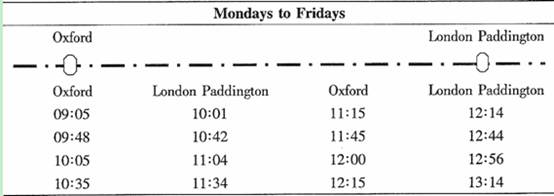

【小题1】What is most likely to be discussed in the paragraph that follows?
| A.What we shall do if the system goes wrong. |
| B.What we shall do if there are no asphalt roads. |
| C.How the system cools the building in summer. |
| D.How the system collects heat in spring and autumn. |
| A.Its number is l0865 305305. |
| B.It belongs to Mr. E. M. Driscoll. |
| C.It is valid through the year of 2010. |
| D.It gets the owner a discount when used. |
| A.11:45 | B.11:15 | C.10:35 | D.10:05 |
| A.French Slam® | B.Chicken-Fried Steak® |
| C.The Super Bird® | D.Sandwich with Salad or Soup® |
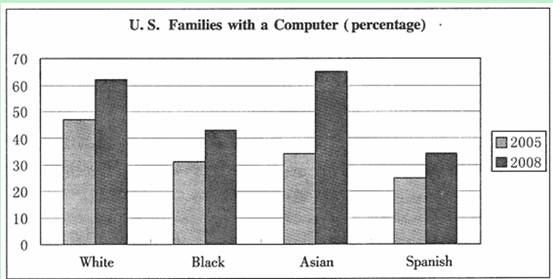
| A.the percentage of the Spanish families with a computer rose 35 points |
| B.the percentage of the White families with a computer remained unchanged |
| C.the number of the Black families with a computer was on the decrease |
| D.the number of the Asian families with a computer showed the sharpest increase |
 hide them and you can pretend they don’t exist, but they’ll still be around. And at last you’ll have to deal with them, just like those bananas.
 When a dirty and untidy orange cat showed up in the prison yard,I was one of the first to go out there and pet it.I hadn’t touched a cat or a dog in over 20 years.I spent at least 20 minutes,knelt down behind the kitchen as the cat rolled around,relaxed.What he was expressing outwardly, I was feeling inwardly.It was an amazing bit of grace to feel him under my hand and note that I was reaching a life or another creature with something as simple as my care.
Over the next few days,there were other prisoners responding to the cat.Every yard period,a group of prisoners gathered there.They stood around talking and taking turns petting the cat.These were guys you wouldn’t usually find talking to each other.Several times I saw an officer in the group,not chasing people away, but just watching and seeming to enjoy along with the prisoners.Bowls of milk and water appeared along with bread, wisely placed under the edge of the dustbin to keep the birds from getting it.
The cat was obviously homeless and in pretty bad shape.People said that the cat came to the right place.He's getting treated like a king.This was true.but as 1 watched 1 was also thinking about what the cat was doing for us.There was a lot of talk about what's wrong with prisons in America.We need more programs.We need more psychologists or treatment of various kinds.Some may even talk about making prisons more kind.But I think what we really need is a chance to practise our own kindness.Not receive it,but give it.After more than two decades here,I know kindness is not a value that's encouraged.It's often seen as a weakness.
Instead,the culture encourages keeping your head down,minding your own business,and never letting yourself be weak.
The cat did my heart good to see the effect he had on me and the men here.By simply saying,”I need some help here”,he did something important for us.He needed us.And we needed to be needed.I believe we all do.
【小题1】From the passage,we can learn that the author was .
| A.an animal protector | B.the cat owner |
| C.a prison officer | D.a prisoner |
| A.The cat was dirty because it was kept in prison. |
| B.The officer in the prison enjoyed petting the cat. |
| C.The prisoners prepared food for both the cat and birds. |
| D.The author realized the importance of practising kindness. |
| A.showing love to others can make prisoners strong |
| B.the American prison culture will be improved |
| C.the author is not content with the prison culture |
| D.caring for others is encouraged in American prisons |
| A.Caring Makes Us Human. | B.Prison Culture is Important. |
| C.Animals Need Care. | D.Everyone Needs to be Cared for. |
[1] Look at the center circles of Diagram A and Diagram B. Which of the centre circles looks larger? 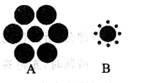
[2] Take a first look and you probably think that the centre circle in Diagram A is smaller than that in Diagram B. In fact, they are exactly the same size.
[3]Then look at the picture on the right. What do you see? A vase? Or two faces? Does the picture change quickly from one to the other again and again? Maybe or maybe not, but you can see them at the same time. 
[4]“What’s happening? Is something wrong with my eyes?” You may wonder at what you see. Don’t worry. Here is how it goes:
[5]When we look at things, our eyes send messages to our brains and then our brains interpret the information. However, sometimes our brains interpret the received information in a wrong way. It seems that our eyes are playing a joke on us. This often happens and we call it “Visual illusion(幻觉)”. 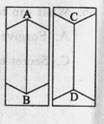
[6] Movie makers often make use of illusions. They make the objects around actors much smaller or bigger than usual. This makes us believe that the actors are much larger or smaller than they usually are. The movies Jurassic Park and Honey J shrunk the kids just make use of illusions.
【小题1】In which column of a magazine can you read the above text?
| A.Culture. | B.Science. | C.Humour. | D.Education. |
| A.something is wrong with our eyes |
| B.the two circles are not of the same size |
| C.our brains interpret the information wrongly |
| D.pictures change quickly from one to the other |
A. The second one. B. The third one. C. The sixth one.. D. The fifth one
【小题4】What’s the right order according to the text?
a. We look at things with our eyes. b. Our brains interpret the messages.
c. Our brains tell us what we have seen. d. Our eyes send messages to our brains.
A. a-d-b-c B c-a-b-d C a-c-d-b D. b-e-a-d