题目内容
At a primary school in a small town in the east of South Carolina, second-grade teachers Garneau and Lynne are convinced that separating elementary-age boys and girls produces immediate academic improvement in both genders(性别).
David Chadwell, South Carolina’s expert of single gender education says, “Boys and girls learn, hear and respond to their surroundings differently.We can teach boys and girls based on what we now know.”
Male and female eyes are not organized in the same way, he explains.The organization of the male eye makes it sensitive to motion and direction.“Boys understand the world as objects moving through space,” he says.
The male eye is also drawn to cooler colors like silver and black.It’s no accident that boys tend to create pictures of moving objects instead of drawing the happy colorful family, like girls do in their class.
The female eye, on the other hand, is drawn to warmer colors like red, yellow and orange.To attract girls, Chadwell says, the teacher doesn’t need to move as much as in boy’s class.Using descriptive phrases and lots of colors in presentations or on the blackboard gets their attention.
Boys and girls also hear differently.“When someone speaks in a loud tone, girls understand it as yelling,” Chadwell says.“They think you’re mad and can shut down.” Girls are more sensitive to sounds.He advises girls’ teachers to watch the tone of their voices.Boys’ teachers should sound more forceful, even excited.
A boy’s nervous system causes him to be more cautious when he is standing, moving, and the room temperature is around 69 degrees Fahrenheit.Stress in boys, he says, tends to increase blood flow to their brains, a process that helps them stay focused.Girls are more focused when seated in a warmer room around 75 degrees Fahrenheit.Girls also respond to stress differently.When exposed to threat and conflict, blood goes to their guts(肠道), leaving them feeling nervous or anxious.
These differences can be applied in the classroom, Chadwell adds.“Single gender programs are about making the best use of the learning.”
1.What is David Chadwell’s attitude toward separating elementary-age boys and girls while learning?
A.Supportive B.Worried
C.Concerned D.Uninterested
2.To engage boy in a class, the teacher ______.
A.must have a moving object in this hand
B.needs to wear clothes in warm color
C.has to speak politely
D.had better move constantly while teaching
3.Which of the following shows the organization of the passage?
( ?= Paragraph 1 ?= Paragraph 2 ?= Paragraph 3 …... ?= Paragraph 8 )
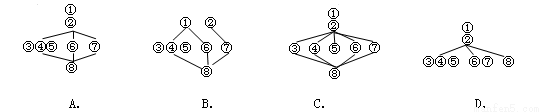
4.Which of the following students is most likely to be focused?
A.A boy sitting in a warm room
B.A standing boy who is faced with stress
C.A girl standing in a cold room
D.A girl who is facing a lot of pressure
1.A
2.D
3.A
4.B
【解析】
试题分析:南加州东部一所小镇小学支持实行男女生分开学习的方式,因为性别的差异在学习,倾听和回应方面都存在差异。他们认为单一性别教育势在必行。
1.1】推理判断题。根据前两段得知南加州东部一所小镇小学支持实行男女生分开学习的方式。南加州单一性别的教育专家大卫认为:男孩和女孩在学习、听讲和反应方面都不同。因此专家大卫是支持的态度。选A。
2.2】细节理解题。根据Boys understand the world as objects moving through space,” he says 和The male eye is also drawn to cooler colors like silver and black.It’s no accident that boys tend to create pictures of moving objects instead of drawing the happy colorful family, like girls do in their class.在班里,男孩更能理解移动中的物体,更容易创造出移动的物体。选D。
3.3】语篇结构题。第一段总述南加州东部一所小镇小学支持男女生分开学习的方式,第二段讲述南加州单一性别的教育专家大卫也是支持的态度。第三、四、五段在讲男女生在学习上的差异。第六段讲述男女生在听课上的差异。第七段在讲男女生对压力的反应上的差异。最后一段总结单一性别教育就是要充分利用这些差异。因此选A。
4.4】细节理解题。根据第七段A boy’s nervous system causes him to be more cautious when he is standing, moving, and the room temperature is around 69 degrees Fahrenheit.Stress in boys, he says, tends to increase blood flow to their brains, a process that helps them stay focused。得知男孩在站立移动时,他的紧张系统使他更谨慎。有压力的男孩更容易注意力集中。选B。
考点:教育类文章

One night, when I was eight, my mother gently asked me a question I would never forget. “Sweetie, my company wants to me but needs me to work in Brazil. This is like your teacher telling that you’ve done and allowing you to skip a grade(跳级), but you’ll have to your friends. Would you say yes to your teacher?” She gave me a hug and asked me to think about it. I was puzzled. The question kept me for the rest of the night. I had said “yes” but for the first time, I realized the decisions adults had to make.
For almost four years, my mother would call us from Brazil every day. Every evening I’d wait for the phone to ring and then tell her every detail of my day. A phone call, however, could never replace her and it was difficult not to feel lonely at times.
During my fourth-grade Christmas break, we flew to Rio to visit her. Looking at her large apartment, I became how lonely my mother must have been in Brazil herself. It was then I started to appreciate the tough choices she had to make on family and work. difficult decisions, she used to tell me, you wouldn’t know whether you make the right choice, but you could always make the best out of the situation, with passion and a attitude.
Back home, I myself that what my mother could do, I could, too. If she to live in Rio all by herself, I, too, could learn to be . I learn how to take care of myself and set high but achievable .
My mother is now back with us. But I will never forget what the has really taught me. Sacrifices in the end. The separation between us has proved to be for me.
1.A. attract B. praise C. surprise D. promote
2.A. little B. much C. well D. wrong
3.A. refuse B. leave C. contact D. forgive
4.A. wondering B. sleeping C. explaining D. regretting
5.A. poor B. timely C. final D. tough
6.A. nervously B. politely C. eagerly D. curiously
7.A. patience B. presence C. intelligence D. Influence
8.A. empty B. expensive C. comfortable D. modern
9.A. interested in B. doubtful about C. aware of D. satisfied with
10.A. when B. where C. which D. that
11.A. abandoning B. balancing C. comparing D. mixing
12.A. Faced with B. Supplied with C. Depending on D. Insisting on
13.A. different B. friendly C. positive D. general
14.A. criticized B. informed C. warned D. reminded
15.A. offered B. managed C. attempted D. expected
16.A. grateful B. independent C. energetic D. practical
17.A. examples B. limits C. rules D. goals
18.A. question B. experience C. history D. occasion
19.A. run out B. come back C. pay off D. turn up
20.A. blessing B. gathering C. failure D. pleasure