题目内容
B
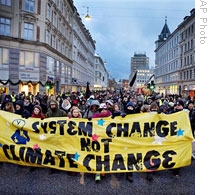
Almost 200 countries met for two weeks in Copenhagen, Denmark at a United Nations conference on climate change. It was due to conclude a deal designed to set a carbon cutting framework to cover 2012-2050. In the end, only five of them reached an agreement: the United States, China, India, Brazil and South Africa.
President Obama praised the agreement last Friday. He said, “Many people are disappointed in the agreement, but the compromise is better than nothing.”
The voluntary agreement, known as the Copenhagen Accord, urges major polluters to make deeper cuts in the emission(排放) of greenhouse gases. Greenhouse gas emissions, such as carbon dioxide, are partly created by burning oil and coal for transportation and electricity.
The agreement sets targets to prevent the Earth’s average temperature from rising more than two degrees Celsius above pre-industrial levels. And the plan calls for 100 billion dollars a year in aid to poor nations to deal with climate change. This would start in 2020.
But the agreement is not legally binding(约束). It fails to set detailed targets for cuts in carbon emissions. And it failed to earn the support of all the nations at the talks.
India’s environment minister praised the united position taken by India, China, Brazil and South Africa. He said it permitted them to avoid the legally binding targets and international supervision proposed by developed countries.
India has promised to cut emissions by at least twenty percent but they say rich nations created the problem, so they should take most of the responsibility for reducing greenhouse gases.
China rejected accusations that it was responsible for the results at Copenhagen. A Foreign Ministry spokeswoman said developed countries didn’t perform well at the talks. She said China has taken its own measures to fight climate change and supports pressing ahead with international cooperation.
China and other large developing countries have accused rich nations of failing to offer big enough cuts in their own emissions. They also say wealthy nations did not offer enough money and technology to help poor countries deal with climate change.
In Europe, politicians and environmentalists expressed deep disappointment that world leaders failed to reach a stronger agreement. United Nations Secretary General Ban Ki-moon says the Copenhagen Accord is only a beginning, and that he will work with world leaders to reach a legally binding treaty(条约) in the coming months.
46. What’s the main purpose of the Copenhagen conference?
A. To sign the Copenhagen Accord.
B. To reach a legally binding agreement on cutting carbon emissions.
C. To discuss measures of controlling the world climate change.
D. To prevent the Earth’s average temperature from rising.
47. Which is true about the agreement, the Copenhagen Accord?
A. It will collect $ 100 billion to help poor countries to deal with climate change.
B. It has earned the support of all the nations at the conference.
C. It has set detailed targets for big enough cuts in carbon emissions.
D. It is far from a satisfactory agreement, which should be legally binding.
48. We can infer from the passage that ______.
A. the Copenhagen conference has achieved most of its designed goals
B. a stronger agreement with legal effect will soon be reached
C. big differences still remain between developing and developed countries.
D. developed countries won’t make cuts in the emission of greenhouse gases
49. Which of the following is NOT China’s attitude towards the issue of climate change?
A. China should be responsible for the result of the world climate change.
B. Rich countries should offer more money to help poor ones deal with climate change.
C. China supports pressing ahead with international cooperation to fight climate change.
D. Major polluters should make deeper cuts in the emission of greenhouse gases.
50. By saying “the Copenhagen Accord is only a beginning”, Ban Ki-moon implies that ______.
A. there is still a long way to go
B. there is little hope to realize the goal
C. too little is achieved at this conference
D. he is disappointed with the world leaders
46---50 BDCAA
解析

 名校课堂系列答案
Online Voting —The Most Beautiful Places in China
What are the most beautiful places in China in your eyes? Please take part in our activity and vote online. We are looking forward to your choice and voice!
Everyone is welcome!
Rules:
1) Voting period: October 1 to November 30.
2) The results and the winners list will be released in December.
3) 10 votes are allowed.
4) Please leave your contact information when sending your votes. CRIENGLISH takes no responsibility if a winner fails to receive the award because of incorrect contact information.
5) Your comments will be important in choosing the winners.
6) CRIENGLISH reserves the right to decide the final winners.
7) CRIENGLISH reserves the right for final explanation of the rules.
Awards:
The three top winners will each receive an award worth 300 Yuan (about 48 US dollars);
The five second place winners will each receive an award worth 200 Yuan (about 32 US dollars);
The ten third place winners will each receive an award worth 100 Yuan (about 16 US dollars).
【小题1】You need to leave your contact information when sending your votes so that ______.
| A.CRIENGLISH can post it online |
| B.everybody online can contact you |
| C.CRIENGLISH can reach you if you win a prize |
| D.CRIENGLISH can use it for some other purposes |
| A.8. | B.10. | C.15. | D.18. |
| A.The activity lasts three months. |
| B.Everyone must provide 10 votes at least. |
| C.Only the one giving his information can join the activity. |
| D.You’d better give a comment in order to win. |
| A.travel around the ten most beautiful places in China |
| B.choose the ten most beautiful places in China |
| C.write an article about the ten most beautiful places in China |
| D.send some photos about the ten most beautiful places in China |
| A.A Travel Research Agency | B.A Medical Center |
| C.An Animal Reservation | D.A Souvenir shopping mall |
Somali pirates(海盗) robbed three Thai fishing ships with 77 sailors on board nearly l, 200 Miles off the Somali coast, the farthest-off-shore attack to date, an officer said Tuesday.
Pirates have gone farther south and east in answer to increased patrols(巡逻)by warships off the Somali shore. The robbing of the three ships Sunday was about 600 miles outside the normal operation area for the international force, said a spokesman.
The spokesman said the attack so far out at sea was a clear sign that the international patrols against pirates were having a “marked effect on pirate activity in the area”.
“Once they start attacking that far out, you’re not even really talking about the Somali basin or areas of water that have any connection with Somalia,” said an officer, Roger Middleton. “Once you’re that far out, it's just the Indian Ocean, and it means you’re looking at trade going from the Gulf to Asia, from Asia to South Africa. ”
“This is the farthest robbing to date. They are now operating near the Maldives and India,” said another officer.
The three ships--the MV Prantalay 11, 12, and l 4—had 77 members on board in total. All of them are Thai, the spokesman said. Before the Sunday robbing, pirates held l l ships and 228 sailors.
Pirates have increased attacks over the past year in hopes. of catching more dollar payments. Because of increased patrols and defenses on board ships, the success rate(率)has gone down, though the number of successful attacks has stayed the same year over year.
【小题1】The pirate attack reported in the text happened __________.
| A.far out in the Indian Ocean |
| B.in the normal patrol area |
| C.near the Somali, coast |
| D.in the south of Africa |
| A.More goods on board are lost. |
| B.Pirate attacks happen in a larger area now. |
| C.The number of attacks has stayed the same these years. |
| D.Pirate attacks are as serious as before along the Somali coast. |
| A.The patrols are of little effect. |
| B.The patrols are more difficult. |
| C.More patrols are quite necessary even in Asia. |
| D.The patrols only drive the pirates to other areas. |
| A.228. | B.77. | C.383. | D.305. |