题目内容

完形填空

阅读下面短文,从短文后各题所给的四个选项(A, B, C和D)中,选出可以填入空白处的最佳选项,并在答题卡上将该项涂黑。

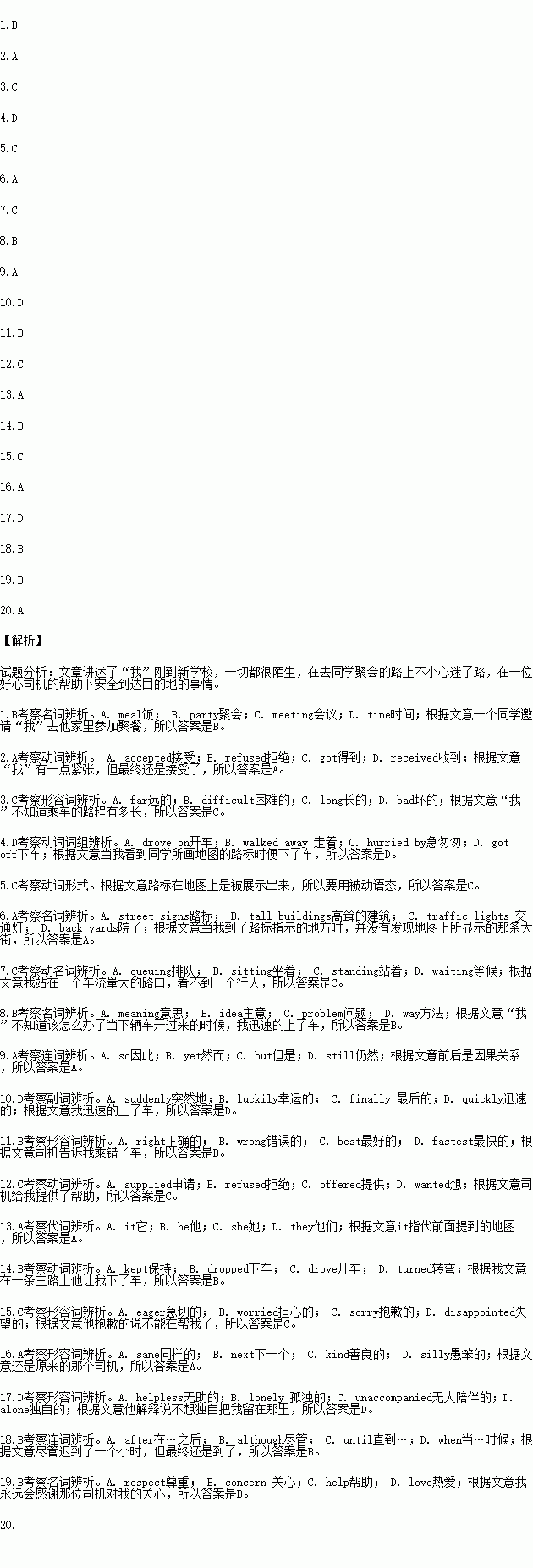
When I came to my new school three years ago, I was surprised at how lonely I felt. Then one of my classmates invited me to her house for a dinner ________ . I was a little anxious, but finally I gladly________.

Not really knowing how ________ the bus ride should be, I ________ when I saw the landmarks ________on my friend’s hand-drawn map. But when I got close enough to the________ , I found none of the streets were shown on the map. I was ________ on a busy road with cars driving past without a person in sight. I had no________ when the next bus would come, ________when a bus did come by, I ________ got on. I told the bus driver where I wanted to go and he said that I had caught the________ bus, but he let me stay on. After he had finished his scheduled bus route, he ________ to help me out. I gratefully showed him my little hand-drawn map but ________ did not help much.

He finally ________ me off at a main road to catch a different bus and was ________that he could not help me more. After a few minutes of walking, I noticed a bus pull up beside me. It was the ________bus driver. He explained that he didn’t want to leave me there ________ . He sent out a call and someone radioed back, saying that the bus I needed to catch was about ten minutes away. At last I made it to the dinner party ________ I was over an hour late.

I am forever thankful for the________that this bus driver had for me. His act of kindness left a________ on my heart.

1.A. meal B. party C. meeting D. time

2.A. accepted B. refused C. got D. received

3.A. far B. difficult C. long D. bad

4.A. drove on B. walked awayC. hurried byD. got off

5.A. show B. showingC. shown D. to show

6.A. street signsB. tall buildings C. traffic lights D. back yards

7.A. queuing B. sitting C. standing D. waiting

8.A. meaning B. idea C. problem D. way

9.A. so B. yet C. but D. still

10.A. suddenlyB. luckily C. finally D. quickly

11.A. right B. wrong C. best D. fastest

12.A. supplied B. refused C. offered D. wanted

13.A. it B. heC. she D. they

14.A. kept B. dropped C. drove D. turned

15.A. eager B. worried C. sorry D. disappointed

16.A. sameB. next C. kind D. silly

17.A. helpless B. lonely C. unaccompanied D. alone

18.A. after B. although C. until D. when

19.A. respect B. concern C. help D. love

20.A. mark B. sign C. symbolD. Line
练习册系列答案
相关题目

For thousands of years, people thought of glass as something beautiful to look at. Only recently have they come to think of it as something to look through. Stores display their goods in large glass windows. Glass bottles and jars that hold food and drink allow us to see the contents. Glass is used to make eyeglasses, microscopes, telescopes, and many other extremely useful and necessary objects.

Until the Second World War, most of the glass used for optical instruments was imported from Europe. However, during the war Americans could not get European glass, and they were forced to make their own. As a result, new kinds of glasses were developed that had been previously unknown. These new effects were achieved by mixing other chemical elements with the sand. Some of these new glasses are very strong and can resist many kinds of shocks. Legend has it that a very hard glass was invented by a Roman who showed his discovery to the Emperor. When the Emperor saw the glass he feared that it would become more valuable than gold and sliver, making his treasure worthless. Therefore, he had the glassmaker killed, and the secret was not discovered again for hundreds of years.

In the present century, safety glass was invented for use in modern cars and planes. Safety glass is made by placing a layer of plastic between two layers of plate glass. When the outside layer of glass is broken, the pieces do not scatter and injure people. Some glass of the type is strong enough to resist bullets.

Although in recent years plastics have replaced glass under conditions where glass might be easily broken, there are new uses being developed , for the greatest advantage of glass is that its component parts are inexpensive and can be found all over the world.

1.With the passage of time, glass _________.

A. is regarded as transparent

B. is no longer seen as decoration

C. is used to make things look pleasant

D. is widely used to replace steel in making containers

2.Why did Americans make their own glass during the Second World War?

A. The war blocked the way of glass import.

B. They refused to use the European glass.

C. The glass made in Europe was out of date.

D. They were able to make a new kind of glass.

3. By telling the legend, the author wants to _________.

A. prove that the Roman was the first inventor of hard glass

B. support that the Americans were as clever as the Romans

C. give some interesting information about hard glass

D. provide a historical event concerned with hard glass

4.New uses of glass are being developed on the ground that _________.

A. glass is not as safe as plastics

B. glass is not as strong and durable as plastics

C. glass is easily obtainable and inexpensive

D. glass is more and more widely used

Sports are all about change. A team gets better. A kid practices more and swims a personal best or learns a new move on the basketball court. In 2006, two things happened that got me thinking about change—in sports and in life.

One of them is tennis champion Andre Agassi, who retired in 2006. Agassi was a terrific player who won 60 titles, including eight major championships(冠军称号). But his greatest accomplishment(成就)might have been how much he changed during his career.

When he was young, Agassi was a show off who seemed to care only about himself. He didn't train very hard, but he won matches because of his tremendous(极大的)talent.Eventually, though, injuries and his bad attitude caught up with him. He fell from No.1 in the world ranking to No.141.

So Agassi changed. He trained harder and became a world-class player again. More importantly, he changed as a person. He was nicer to fans and opponents(对手). He stopped thinking just about himself and started thinking about others. Through his Andre Agassi Charitable Foundation, he raised more than $60 million to help disadvantaged kids around his hometown of Las Vegas, Nevada. He even started a school, the Andre Agassi College Preparatory Academy, for at-risk kids.

At the start of a new year, lots of people promise themselves they will change. They might vow to get in good physical shape, do better in school or be nicer to others. Changes such as those can be difficult. But they do happen. Just remember Andre Agassi: It wasn't easy, but he changed, and changed for the better.

1.According to the writer, which of the following may be the greatest achievement for Agassi?

A. He once ranked No.1 in the world rankings.

B. He won 60 titles.

C. He changed much during his career.

D. He won 8 major championships.

2.What does the underlined work “vow” in the 6th paragraph probably mean?

A. promise. B. agree. C. wish. D. prove.

3.What do you know about Andre Agassi Charitable Foundation?

A. It is intended to help at-risk kids.

B. It is a charity school set up by Agassi.

C. Some disadvantaged kids can get help from it.

D. Agassi runs it with his prize money.

4.What might be talked about in the paragraphs following this passage?

A. What achievements Agassi has made after he changed for the better.

B. How we can change for the better.

C. Another thing happened in life that got the writer thinking about change.

D. Some assessments(评价) about Agassi from different people.

Once upon a time, there was a wonderful old man who loved everything on the land —— animals and plants.

One day while walking through the woods, the old man found a cocoon of a butterfly. He took it home. A few days later, a small opening appeared; he sat and watched the butterfly for several hours as it struggled to force its body through that little hole. Then it seemed to stop making any progress. It appeared as if it had gotten as far as it could and it could go no farther. Then the man decided to help the butterfly, so he took a pair of scissors and cut the remaining bit of the cocoon. The butterfly then came out easily.

But it had a swollen body and small, shriveled wings. The man continued to watch the butterfly because he expected that, at any moment, the wings would enlarge and expand to be able to support the body, or they would be smaller. Neither happened! In fact, the butterfly spent the rest of its life crawling around with a swollen body and shriveled (枯萎)wings. It never was able to fly.

What the man in his kindness and hurry did not understand was that the struggle required for the butterfly to get through the tiny opening was nature’s way of forcing fluid from the body of the butterfly into its wings so that it would be ready for flight once it achieved its freedom from the cocoon.

Sometimes struggles are exactly what we need in our life. If we were allowed to go through our life without any difficulties, it would cripple (无能) us. We would not be as strong as what we could have been. And we could never fly.

1.The old man cut the cocoon in order to ____.

A. kill the butterfly

B. play with the butterfly

C. make the butterfly come out easily

D. have the butterfly

2.The reason why the butterfly could not fly is that _____.

A. the old man broke its wings

B. it was too small

C. newly born butterflies can’t fly

D. it came out of its cocoon without enough struggle

3.What can we know from the passage?

A. That old man was fond of everything except the butterfly.

B. It was the old man that stopped the butterfly flying.

C. The old man realized his mistake.

D. It’s not hard for the butterfly to come out of the cocoon.

4.What does the author want to tell us by writing the passage?

A .We should help others.

B. Without others' help we can still succeed.

C. Struggles in our life can make us stronger.

D. Butterflies can fly without people’s help.

违法和不良信息举报电话:027-86699610 举报邮箱:58377363@163.com

精英家教网