题目内容
that protect the environment such as solar energy are becoming possible alternatives.
Increasing demand for clean, renewable energy is driving a growing market for solar energy products..
Two of the main types of products that take advantage of solar energy are passive and active solar products.
These two types of systems differ in how they are constructed and can also differ greatly in cost. Passive solar
technology can be used to heat air or water directly using the sun's energy. Unlike an active solar application,
passive solar set-ups accomplish their task without the use of additional electrical components, such as fans
that need an external electricity supply. Some solar space heating or water heating systems are active solar
heating systems that have various components that call for external power sources. Because of their simplicity
compared with active systems, passive solar heating systems generally are cheaper than active ones.
In addition to these solar heating systems, there are also solar power system available. Rather than using the
sun's energy for heating applications, these systems change solar energy into electricity. An important part of
these products is called photovoltaic cells, which generate electricity from light. As sunlight falls on a
photovoltaic cell, the light's energy is changed into electricity that can then be used to power many kinds of
electronic devices. Because of the complicated technology involved, these kinds of solar power systems can
be very expensive.
When considering what kind of solar heating or power system to install (安装) in your home or business,
be sure to purchase your equipment from a reputable manufacturer who will be able to help you with any
necessary repair.
Solar energy application 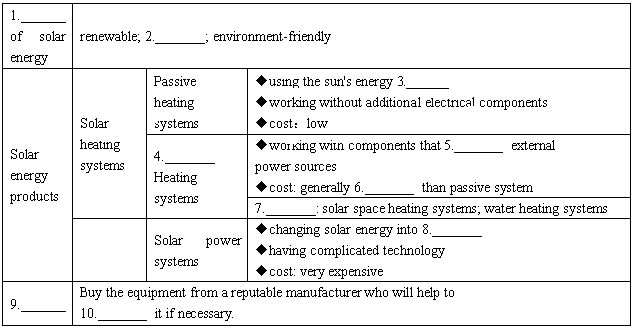
6.higher 7.Examples 8.electricity 9.Advice 10.repair

 计算高手系列答案
任务型阅读 (共10小题; 每小题1分,满分10分)
请认真阅读下列短文,并根据短文的内容要点完成文章后的表格列单。
注意:补全填空应符合语法和搭配要求,每格只填一个单词。
Even British People Can’t Speak English Properly
There are different regional accents across the UK, and a number of regions have several different dialects, that is, they have their own unique vocabulary and grammatical phrases. There were at least six different accents born to London the last time I counted.
Worse than that, it is not just where a person is born in the UK that decides their accent. For example, a language and its accents often vary across class or level of education. Another example is how language can differ among age groups in the UK. The words and pronunciations used by young people in the UK can be radically different compared with those used by adults.
Yoof culture
The word ‘yoof’ is a slang spelling of ‘youth’. Some people consider ‘yoof’ to be a negative term, since its pronunciation is easier and lazier than ‘youth’. Other people see the term as positive, because it describes how young people are creating their own language, concepts and identity. When people find it difficult to understand their children, the children can say more things than without censorship(审查,检查) of their parents. In this way, young people are starting to find freedom, independence and self-expression. They are creating a ‘yoof culture’.
It is not possible to come up with a complete list of words used by yoof. By the time the list was completed, it would be out of date. New words come and go like fashions. However, a few features of the yoof style of language are as follows:
◆instead of saying something like ‘That’s good!’ or ‘I understand’, yoof will use a single adjective like ‘Safe!’, ‘Sorted!’, ‘Sound!’, ‘Cool!’ or ‘Wicked!’.
◆instead of ‘He then said no!’, yoof will say ‘She was like: no!’
◆Instead of ‘She’s attractive!’, yoof will say ‘She’s fine!’ or ‘She’s fit!’
◆Instead of ‘I don’t care!’, a yoof will say ‘Whatever!’.
New social and political language
Certain groups of society feel threatened by ‘yoof culture’ or by the British working classes having more social freedom. As a result, a negative term now commonly used in the UK is ‘chav’. It is insult and is meant to describe someone who is uneducated and anti-social (e.g. ‘He’s a chav!’). A young person who wears a jacket with a hood(风帽,头巾) (after all, it rains a lot in the UK) is sometimes called a ‘hoodie’. It is a negative term and suggests that the young person is interested in committing crime.
Where does that leave us?
Learners of English often feel that the best test of their English is how well they can talk to a native speaker. Yet learners should not worry about communicating with native speakers so much. Research conducted by the British Council shows that 94 per cent of the English spoken in the world today is spoken between non-native speakers of the language. In fact, when we think about ‘international English’, there is no such thing as native or non-native speakers. The UK no longer owns the English language.
 |
