题目内容

_______, in the queue for half an hour, Tom suddenly realized that he had left his wallet at home.

ATo wait 

BHave waited

CHaving waited

DTo have waited


答案:C
提示:

过去分词做伴随状语,wait在realize之前,所以用完成时


练习册系列答案
相关题目

听力(共两节,满分35分)

第一节:(共15小题,每小题2分,满分30分)

听下面5段对话或独白,每段对话或独白后有几个小题。从题中所给出的A、B、C三个选项中选出最佳选项,并标在试卷原相应位置。听每段对话或独白前,你将有时间阅读各小题,每小题5秒钟;听完后,各小题目将给出5秒钟的作答时间。每段对话或独白读两遍。

听第一段材料,回答第1~3题。

1.How many women will take part in the Athens Olympics?

A.About 50%

B.44% of all participants.

C.38.2% of all participants

2.For the Athens Olympics, how many delegations will be all men?

A.26

B.21

C.4 or 5 or even less

3.When were women first allowed in the Olympic Games?

A.1896.

B.1912.

C.1956.

听第二段对话,回答第4~6题。

4.What is the man doing?

A.He is walking on the street.

B.He is looking for a bar.

C.He is driving in his car.

5.Where is the man at the moment?

A.He is on Queen’s Street.

B.He is on St.James Street.

C.He is in the Q-Bar.

6.What is the woman telling the man about?

A.How to find the nearest hotel.

B.How to get to her house.

C.Where to get an up-to-date map.

听第三段对话,回答第7~9题。

7.Where does the conversation take place?

A.At a duty-free store.

B.At a teahouse.

C.On a plane.

8.What do we know about the woman?

A.She feels bad because of the lower pressure and jet lag.

B.Her husband is a Chinese who knows Chinese tea well.

C.She may have been to China several times.

9.What can we learn from the conversation?

A.The speakers have been to China several times.

B.They are old friends who haven’t seen each other for a long time.

C.The man is likely to know more about China than the woman.

听第四段独白,回答第10~12题。

10.What does the man think of the new webpage?

A.Better than the old page.

B.Worse than the old page.

C.As good as the old page.

11.What do we know about the old page?

A.The visitors are encouraged to give their contact information.

B.There are clear links to descriptions of our products and services.

C.There was little influence to the sale volume.

12.How is the feedback of the new page?

A.Positive.

B.Inefficient.

C.Discouraging.

听第五段对话,回答第13~15题。

13.With on-campus housing, students should remember that _________.

A.they may have to follow certain housing rules.

B.a deposit may be required to rent an apartment

C.on-campus apartments are very limited.

14.What is one advantage of off-campus living NOT mentioned in the report?

A.Tenants(房客)are generally responsible for building upkeep.

B.Students can prepare their own meals.

C.Occupants(居住者)have freedom to select their roommates.

15.What should renters living off-campus be prepared to do?

A.Pay a refundable deposit(可偿还的押金).

B.Provide their own furnishings.

C.Sign a housing contract.

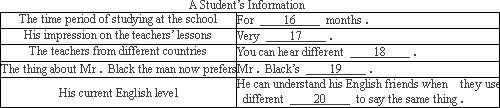
第二节:听取信息(共5小题;每小题1分,满分5分)

听下面一段对话,请根据题目要求,从所给的内容中获取必要的信息,填入答题卡标号为16-20的空格中。听录音前,你将有10秒钟的阅读时间,录音读两遍。你将有80秒钟的作答时间。

The latest research suggests that the key factor separating geniuses from the merely accomplished is not I.Q., a generally bad predictor of success. Instead, it’s purposeful practice. Top performers spend more hours practising their craft. It you wanted to picture how a typical genius might develop, you’d take a girl who possessed a slightly above average language ability. It wouldn’t have to be a big talent, just enough so that she might gain some sense of distinction. Then you would want her to meet, say, a novelist, who coincidentally shared some similar qualities. Maybe the writer was from the same town, had the same family background, or shared the same birthday.

 This contact would give the girl a vision of her future self. It would hive her some idea of a fascinating circle who might someday join. It would also help if one of her parents died when she was 12, giving her a strong sense of insecurity and fuelling a desperate need for success. Armed with this ambition, she would read novels and life stories of writers without end. This would give her a primary knowledge of her field. She’s be able to see new writing in deeper ways and quickly understand its inner workings.

 Then she would practise writing. Her practice would be slow, painstaking and error-focused. By practising in this way, he delays the automatizing process. Her mind wants to turn conscious, newly learned skills into unconscious. Automatically performed skills. By practising slowly, by breaking skills down into tiny parts and repeating, she forces the brain to internalize a better pattern of performance. Then she would find an adviser who would provide a constant stream of feedback, viewing her performance form the outside, correcting the smallest errors, pushing her to take on tougher challenges. By now she is redoing problems—how do I get characters into a room—dozens and dozens of times. She is establishing habits of thought she can call upon in order to understand or solve future problems.

 The primary quality our young writer possesses is not some mysterious genius. It’s the ability to develop a purposeful, laborious and boring practice routine; the latest research takes some of the magic out of great achievement. But it underlines a fact that is often neglected. Public discussion is affected by genetics and what we’re “hard-wired” to do. And it’s true that genes play a role in our capabilities. But the brain is also very plastic. We construct ourselves through behaviour.

The passage mainly deals with________.

A. the function of I.Q. in cultivating a writer

B. the relationship between genius and success

C. the decisive factor in making a genius

D. the way of gaining some sense of distinction

By reading novels and writers’ stories, the girl could________.

A. come to understand the inner structure of writing

B. join a fascinating circle of writers someday

C. share with a novelist her likes and dislikes

D. learn from the living examples to establish a sense of security

In the girl’s long painstaking training process, ________.

 A. her adviser forms a primary challenging force to her success.

 B. her writing turns into an automatic pattern of performance

 C. she acquires the magic of some great achievement

 D. she comes to realize she is “hard-wired” to write

What can be concluded from the passage?

 A. A fuelling ambition plays a leading role in one’s success

 B. A responsible adviser is more important than the knowledge of writing.

 C. As to the growth of a genius, I.Q. Doesn’t matter, but just his|her effort.

 D. What really matters is what you do rather then who you are.

违法和不良信息举报电话:027-86699610 举报邮箱:58377363@163.com

精英家教网