题目内容
Fish is easy to _________{消化} when you are ill.
digest
听力(共两节,满分20分)
第一节(共5小题;每小题1分,满分5分)
听下面5段对话。每段对话后有一个小题,从题中所给的A、B、C三个选项中选出最佳选项。听完每段对话后,你都有10秒钟的时间来回答有关小题和阅读下一小题。每段对话仅读一遍。
1.When should the man arrive?
A.At 8∶45
B.At 8∶15
C.At 8∶30
2.Why does the man want to go to Paris?
A.For his further study
B.For the study of French
C.For a visit to Paris
3.What is the relationship between the two speakers?
A.Sister and brother
B.Mother and son
C.Wife and husband
4.Why did the woman miss her class?
A.Because she was ill.
B.Because she was upset.
C.Because she was late.
5.What can we learn from the conversation?
A.The man will be paid for another week.
B.The woman cannot get the painting now.
C.The woman has about 200 dollars.
第二节(共15小题;每题1分,满分15分)
听下面5段对话或独白。每段对话或独白后有几个小题,从题中所给的A,B,C三个选项中选出最佳选项。听每段对话或独白前,你将有时间阅读各个小题,每小题5秒钟;听完后,每小题将给出5秒钟的作答时间。每段对话或独白读两遍。
听第6段材料,回答第6、7题。
6.Which flight will the man change to?
A.EA983.
B.EA 6645
C.CA983
7.Where might the man be now?
A.In Shanghai
B.In New York
C.In America
听第7段材料,回答第8、9题。
8.What can you know from the conversation?
A.The woman has ever kept fish.
B.The woman has never kept fish.
C.The woman thinks it easy to keep fish.
9.How much should the woman pay?
A.40 yuan
B.14 yuan
C.28 yuan
听第8段材料,回答第10至12题。
10.What might the woman do after she finishes her Chinese course?
A.Take a more challenging class.
B.Take a more advanced class
C.Take a more beneficial class
11.Why does the man want to take a part-time job?
A.To practice Chinese
B.To make Chinese friends
C.To benefit from Chinese
12.What can we know about the speakers?
A.The man is from China
B.The woman is from England
C.They are studying Chinese
听第9段材料,回答第13至16题。
13.What does the woman need to do?
A.Prepare a list of tips on using computer disks.
B.prepare a list of tips on using paper clips.
C.Prepare a list of tips on using a soft pen.
14.What does the man do?
A.A computer teacher.
B.A librarian.
C.A lab assistant.
15.What should never be done to the disks?
A.Write on the back of the of them with a pencil.
B.Write on them with a ballpoint pen.
C.Write on them with a soft pen.
16.How does the man advise holding the disks?
A.Holding the center of the disks.
B.Holding the edges of the disks.
C.Holding the disks with clean hands.
听第10段材料,回答第17至20题。
17.What do the “latchkey children” have in common?
A.They spend part of each day alone.
B.They watch TV after school each day.
C.They hang out outside each day
18.What is the biggest problem faced by children at home alone?
A.loneliness
B.Fear
C.Safety
19.What is a school rule against?
A.Hiding keys.
B.Wearing keys.
C.Wearing jewelry
20.Which of the following is TRUE according to the talk?
A.Latchkey children have no parents to look after all the time.
B.Latchkey children have no house to live in every day.
C.Latchkey children look after themselves while their parents work.
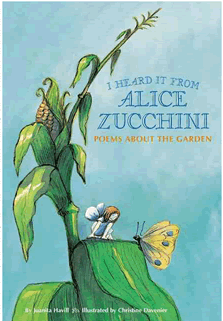
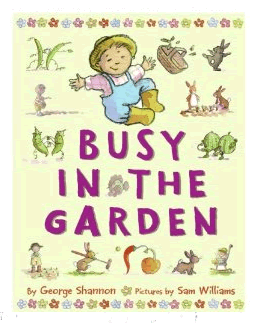
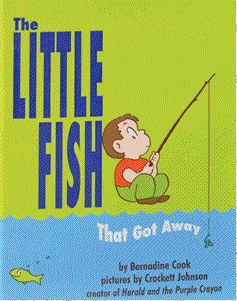
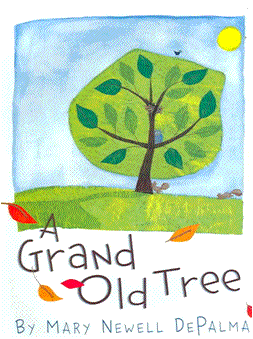
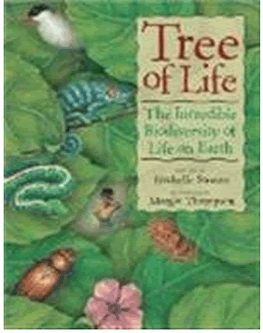
AI Heard It from Alice Zucchini: Poems About the Garden Juanita Havill Illustrated by Chirstine Davenier 2006,Chronicle Books, $ 15.95. Ages 4 to 8. Reviewer: Jean Boreen, Ph. D. B Busy in the Garden George Shannon Pictures by Sam Williams 2006,Creenwillow/HarperCollins, $ 15.99 and $ 16. 89. Ages 3 ~ 5. Reviewer: Sheilah Egan. CThe Biggest Fish in the Lake Margaret Carney Illustrated by Janet Wilson 2001,Kids Can Press, $ 15. 95. Ages 4 to 8. Reviewer: Sue Reichard. DThe Little Fish that Got Away Bemadine Cook Illustrated by Crockett Johnson 2005 ( orig. 1956), HarperCollins, $ 14. 99. Ages 3 to 7. Reviewer:Barbara L. Talcrofe EA Grand Old Tree Mary Newell DePalma 2006,Arthur A. Levine Books/Scholastic, $ 16. 99. Ages 2 to 5. FTree of Life: the incredible biodiversity of life on earth Rochelle Strauss Illustrated by Margot Thompson 2004,Toronto: Kids Can Press, $ 16. 95. Grades 3 to 6.

 期末冲刺100分创新金卷完全试卷系列答案期末冲刺100分创新金卷完全试卷系列答案