题目内容
| 任务型读写。 In a memorybased competition between you and a chimp (猩猩);who do you think would win?If you put yourself on top, you might want to guess again. In a test that challenged participants to remember numbers, a young chimp performed better than Japanese college students. Here's how the test worked.At Kyoto University in Japan, human students and chimpanzee participants sat in front of a computer.Five numbers, ranging from 1 to 9, were combined with one another and then, they appeared at random places on the screen. The numbers stayed on the screen for less than a second.In the first test, for example, participants saw the numbers for 650 milliseconds (about twothirds of a second). Then, each number disappeared and they saw a white square instead.Participants had to touch the squares in numerical order, based on the numbers that had been there a moment before. In this test, the students touched the boxes in the correct order about 80% of the time.A young chimp named Ayumu performed equally well. During a harder test, participants were only able to see the numbers for 210 milliseconds. This time, students only succeeded in putting the boxes in the correct order about 40% of the time. But Ayumu still could select the boxes in the right order nearly 80% of the time. "Some people have what's called a 'photographic memory, ' which allows them to remember a surprising number of details after just a quick glimpse of something.Ayumu's memory might work in a similar way, " says lead researcher Tetsuro Matsusawa. The chimp's young age might have something to do with his impressive performance, too.In previous tests, the Japanese researchers found that young chimps performed better than their mothers. The scientists are interested to see whether Ayumu loses his strong memory as he grows older.They already know that young children sometimes have sharp memories when offered something photographical, but they lose this ability over time.
|
6.twice/double 7.allowing/enabling 8.glance/glimpse 9. ability 10.age/grow

 导学与测试系列答案
 新非凡教辅冲刺100分系列答案
 s with a positive educational experience, some students are better suited for certain teaching styles and classroom types than others.If there's a mismatch (不协调) between student and teacher, a child can form lasting negative feelings about school or his own abilities.
  llies since I was a kid.The good news is that
 son is that bullies can be anonymous (匿名的) and enlist other bullies to make their targets miserable.Another reason is that they don't have to face their targets. So it's easier to get rid of any empathy that they may otherwise feel.There are ways to fight against "cyber-bullying", but many parents aren't aware of them - and many bullied kids feel too overwhelmed to deal with the situation.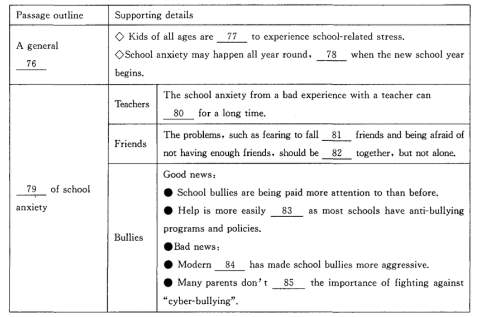
任务型读写(共10小题; 每小题1分,满分10分)
阅读下列短文,根据所读内容在文章后的表格中填入恰当得单词。 注意:表格中每个空格中只填入一个单词。
Some people believe that greed and selfishness has become the basis of modern society, and we should return to the old traditions of family and community then we will have a better life. To what extend do you agree or disagree with the above opinion?
In this fast-paced world, many values are undergoing major changes. While people traditionally prioritize caring, sharing and generosity in life and work, modern people seem to be
more self-absorbed or self-concerned.
Modern people act selfishly to survive the harsh competition of life. They say that it is a jungle out there. To survive, you have to fight with whatever means that come handy. Obviously greedy and selfishness go perfectly well with such ideas. In a company, employees do everything they can to get better pay and higher position, even at the cost of colleagues. We are in any way advocating any selfish conduct. It is just that people are pressured to act in a certain way due to outside influences
. In spite of common practice, it is hard to conclude that modern society is built on greed and selfishness, both of which are not newly invented vocabulary. In ancient times people also did greedy and selfish things though such behaviors were more condemned then. But we can not ignore the fact that people in the past lived a relatively more isolated life and faced less pressure compared with their modern counterparts.
Are we happier to share with others and be generous to them? There is no fixed answer, either. Some people take great pleasure helping and giving to others while others feel happy doing the opposite. But I personally think that people should not be too selfish. Caring for others can actually encourage the development of a mutually beneficial relationship.
In conclusion, modern people appear to be more self-centered than those in the past due to strong outside pressure. However, we should encourage people to know the importance of being caring and generous and to build a mutually beneficially relationship with others.
Are Modern People Becoming More Selfish
| Main comparisons | Contexts |
| __1__ are changing | In the past people put caring, sharing and generosity in the first ____2____. |
| Nowadays, people seem to be more ____3____about themselves. | |
| ___4___are changing too. | People in the past appeared to be modest and self-effacing(谦让的). |
| People may strive to achieve their own _5___ at the price of their coworkers. | |
| The author’s understanding | |
| ___6____ for the changes in author’s eyes | Fierce __7___ and great __8___on modern people may be responsible for the changes. |
| The author’s ___9____towards topic | A relationship which can ___10___ two sides should be established. |
任务型读写(共10小题;每小题1分,满分10分)
阅读下列短文,根据所读内容在文章后的表格中填入恰当的单词。注意:表格中的每个空只填一个单词。
Researchers from the University of Michigan reported that empathy(感情移入),the ability to understand other people, among college students had dropped sharply over the past 10 years. That could be because so many people have replaced face time with screen time. Today, people spend more time alone and are less likely to join groups and clubs.
But there is another explanation. Turn on the TV, and you’re showered with news and reality shows full of people fighting, competing, and generally treating one another with no respect. Humans learn by example---and most of the examples on it are anything but empathetic.
There are good reasons not to follow those bad examples. Humans are socially related by nature. Having relationships with other people is an important part of being human—and having empathy is decisive to those relationships. Researchers have also found that empathetic teenagers are more likely to have high self-respect. Besides, empathy can be a cure for loneliness, sadness, anxiety, and fear.
Empathy is also an indication of a good leader. In fact, many top companies report that empathy is one of the most important things they look for in new managers. Good social skills---including empathy—are a kind of “emotional(情感的) intelligence” that will help you succeed in many areas of life.
What’s the best way to develop empathy? For starters, let down your guard and really listen to others. One doesn’t develop empathy by having a lot of opinions and doing a lot of talking. In addition, you’d better volunteer at a nursing home or a hospital, be a member of a club or a team, have a “sharing circle” with your family, or spend time caring for pets at an animal shelter.
|
Title |
Empathy |
|
Situation |
A1._____drop of empathy among college students in the past decade. |
|
2.______of empathy dropping |
◆Having less face-to-face3.__________ ◆Showing no 4.__________among people in TV programs |
|
Importance of empathy |
◆Being vital for social5._________ ◆Making6. _______ more likely to have high self-respect ◆7._________one’s loneliness, sadness, anxiety, and fear ◆Indicating you can be a good leader |
|
8.______to develop empathy |
◆To be a good 9.________ ◆To work as a volunteer ◆To 10._________a club, share feelings with your family or care for a pet |
第Ⅱ卷(非选择题,共35分)
第四部分:写作(共两节,满分35分)
第一节 任务型读写(共10小题;每小题1分,满分10分)
阅读下面短文,根据所读内容在表格中的空白处填入恰当的单词。注意:每个空格只填一个单词。
In a memory – based competition between you and a chimp (猩猩); who do you think would win? If you put yourself on top, you might want to guess again.
In a test that challenged participants to remember numbers, a young chimp performed better than Japanese college students.
Here's how the test worked. At Kyoto University in Japan, human students and chimpanzee participants sat in front of a computer. Five numbers, ranging from 1 to 9, were combined with one another and then, they appeared at random places on the screen.
The numbers stayed on the screen for less than a second. In the first test, for example, participants saw the numbers for 650 milliseconds (about two- thirds of a second).
Then, each number disappeared and they saw a white square instead. Participants had to touch the squares in numerical order, based on the numbers that had been there a moment before.
In this test, the students touched the boxes in the correct order about 80 percent of the time. A young chimp named Ayumu performed equally well.
During a harder test, participants were only able to see the numbers for 210 milliseconds.
This time, students only succeeded in putting the boxes in the correct order about 40 percent of the time. But Ayumustill could select the boxes in the right order nearly 80 percent of the time.
Some people have what's called a "photographic memory", which allows them to remember a surprising number of details after just a quick glimpse of something. Ayumu's memory might work in a similar way, says lead researcher Tetsuro Matsuzawa.
The chimp's young age might have something to do with his impressive performance, too. In previous tests, the Japanese researchers found that young chimps performed better than their mothers.
The scientists are interested to see whether Ayumu loses his strong memory as he arrows older. They already know that young children sometimes have sharp memories when offered something photographical, but they lose this ability over time.
|
Topic |
A (76) competition between human beings and chimps |
|
Purpose |
To judge whose memory is better |
|
The (77) of the first test |
◆A chimp and some Japanese students participated in the competition and sat before a computer. ◆Different (78) of five numbers appeared on the screen. ◆Each of the number was (79) by a white square. |
|
The results of the second test |
◆Students (80) to put the boxes in the right order about 40% of the time. ◆Ayumu got the right order (81) the time of the students |
|
Conclusion |
◆Some people have “photographic memory”, (82) some people to remember numbers after they (83) at something. ◆The chimps have the similar (84) to human beings’. ◆Young children, just like chimps, have strong memory but they’ll lose it when they (85) . |