题目内容
请阅读下面短文,并根据所读内容在文章后表格中的空格里填入一个最恰当的单词。
注意: 请将答案写在答题卡上相应题号的横线上。 每个空格只填一个单词。
The expression, “everybody’s doing it,” is very much at the center of the concept of peer pressure. It is a strong influence of a group, especially of children, on members of that group to behave as everybody else does. It can be positive or negative. Most people experience it in some way during their lives.
People are social creatures by nature, and so it is hardly surprising that part of their self-respect comes from the approval of others. This instinct (天性) is why the approval of peers, or the fear of disapproval, is such a powerful force in many people’s lives. It is the same instinct that drives people to dress one way at home and another way at work, or to answer “fine” when a stranger asks “how are you?” even if it is not necessarily true. There is a practical aspect to this: it helps society to function efficiently, and encourages a general level of self-discipline that simplifies day-to-day interaction.
For certain individuals, seeking social acceptance is so important that it becomes like an addiction; in order to satisfy the desire, they may go so far as to abandon their sense of right and wrong. Teens and young adults may feel forced to use drugs, or join gangs that encourage criminal behavior. Mature adults may sometimes feel pressured to cover up illegal activity at the company where they work, or end up in debt because they are unable to hold back the desire to buy a house or car that they can’t afford in an effort to “keep up with the Joneses.”
However, peer pressure is not always negative. A student whose friends are good at academics may be urged to study harder and get good grades. Players on a sports team may feel driven to play harder in order to help the team win. This type of influence can also get a friend off drugs, or to help an adult take up a good habit or drop a bad one. Study groups and class projects are examples of positive peer groups that encourage people to better themselves.
Schools try to teach kids about the dangers of negative peer pressure. They teach kids to stand up and be themselves, and encourage them to politely decline to do things that they believe are wrong. Similarly, it can be helpful to encourage children to greet the beneficial influence of positive peer groups.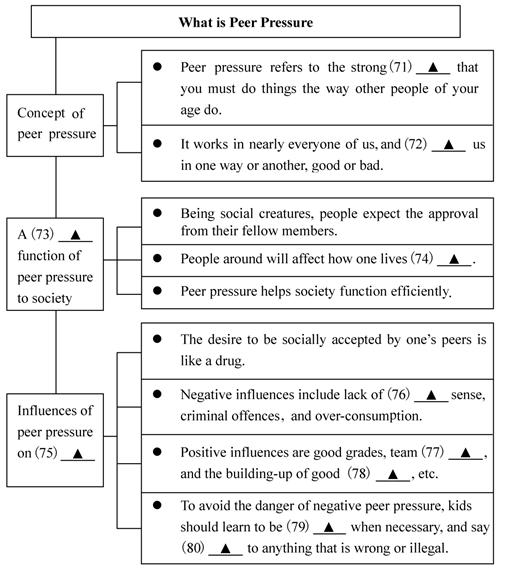
【小题1】feeling
【小题2】influences
【小题3】practical
【小题4】unconsciously
【小题5】individuals
【小题6】moral
【小题7】spirit
【小题8】habits
【小题9】independent
【小题10】no
解析试题分析:文章大意:文章说明了我们在生活中都受到同辈压力的影响。然而同辈压力的影响有积极的,也有消极的。
【小题1】feeling。词义归纳。根据文章第一段对“同辈压力”这一概念的解释可以归纳出the strong feeling强力的感觉。此题概括有难度。
【小题2】influences。原词再现。根据第一段中的It is a strong influence of a group, especially of children, on members of that group to behave as everybody else does.,注意用第三人称单数。
【小题3】practical。原词再现。根据第二段中的There is a practical aspect to this: it helps society to function efficiently, and encourages a general level of self-discipline that simplifies day-to-day interaction.可以归纳出答案。
【小题4】unconsciously。词义归纳。根据第二段中讲述人生来是具有社会性动物,周围的人将无意识的影响一个人的生活。
【小题5】individuals。原词再现。根据文中第三段中For certain individuals, seeking social acceptance is so important that it becomes like an addiction可以归纳出答案。
【小题6】moral。词义归纳。根据第三段Teens and young adults may feel forced to use drugs, or join gangs that encourage criminal behavior. Mature adults may sometimes feel pressured to cover up illegal activity at the company where they work, or end up in debt because they are unable to hold back the desire to buy a house or car that they can’t afford in an effort to “keep up with the Joneses可以得出消极影响包括缺乏道德感、刑事犯罪和过度消费。此题归纳较难。
【小题7】spirit。词义归纳。根据第四段中的Players on a sports team may feel driven to play harder in order to help the team win.可以归纳出“团队精神”。
【小题8】habits。原词再现。根据第四段中的This type of influence can also get a friend off drugs, or to help an adult take up a good habit or drop a bad one.可以得出答案,注意用复数形式。
【小题9】independent。词义归纳。根据最后一段中的They teach kids to stand up and be themselves, and encourage them to politely decline to do things that they believe are wrong.可以归纳出“孩子应当学会独立”。
【小题10】no。词义归纳。根据最后一段They teach kids to stand up and be themselves, and encourage them to politely decline to do things that they believe are wrong.中短语的“decline to”转换为短语“say no to”。
考点:考查学生对信息的归纳。

 名校课堂系列答案
There are a number of advantages when it comes to living alone. However, it also comes with a few safety concerns. You still never know who will be around the corner. Don’t become another victim; be sure to follow our tips.
1. All doors should be kept locked.
Always keep your doors locked when you are in your apartment or dorm. Make sure the doors are closed behind you when you come into the building and never leave your room unlocked, even when you are in it. There’s always a chance that someone might sneak in while you are unaware. Always try to remember to close doors behind you to ensure your safety.
2. Don’t lose your keys.
Even if you do everything you can to keep the doors locked, criminals might still be able to come into your house with a key. Always know where your keys are to prevent this. Never put them down in a public place or give them to friends. Also, before you bring your car into the repair shop, take off the house keys.
3. When it comes to safety, standing up for yourself is important.
If you aren’t getting all the security features you want, don’t be afraid to ask. If your lighting situation is less than ideal, discuss this with your supervisor or landlord. Talk to the campus security organization if you think a security phone near your dorm is a good idea. Request that the building employ someone to monitor those entering and leaving the building. You should feel safe where you reside (居住于), so stand up for your rights.
4. Be careful.
You still might find yourself in a potentially dangerous situation. Check your peephole (窥视孔) before letting anyone in. Whenever you witness something around your building that makes you uncomfortable or suspicious just dial 911. It is a good idea to always walk with a friend instead of alone. Become familiar with people who live in the building, so you can keep track of anyone that is a stranger.
| 【小题1】 to follow when living alone | Leave your doors【小题2】 as soon as you come into the building so that someone is not able to sneak in. |
| Never lose your 【小题3】 or give them to others. | |
| 【小题4】 up for your rights: Discuss this with your supervisor or landlord if you are not 【小题5】 with your lighting situation. Request the building to have someone 【小题6】 to monitor those entering and leaving the building. Ask the campus security organization to fix a security【小题7】 near your dorm. | |
| Be careful Dial 911 when you find something uncomfortable or 【小题8】 . When walking, keep your friends in【小题9】 instead of alone. Be familiar with people in the neighborhood so that you will pay attention to 【小题10】 . |
Educators have spent ages arguing about whether the traditional classroom structure, with students all working on the same lesson, is really suited to different learning styles.
Twelve-year-old Yuval Kagan looks like he’s ready to work at a call center. He’s among 10 students sitting at a long table covered with laptop computers, talking into their headphones. ”Yes,” he says, looking at his computer screen. Yural is talking to a math teacher. If he has a question, he hits a button called “raise your hand” and the teacher speaks to him.
Yuval says he enjoys this form of teaching. “In a lesson with a class, the teacher always has to tell other students to stop talking, but here you can have one-on-one teaching.”
That personalized approach is what makes School of One different. It’s an after-school math program taking place here at I.S. 228 and two other middle schools. Kids spend part of their time working with online teachers. But teachers can also set instruction in small groups, where a teacher explains a special math problem. And sometimes they work together, as demonstrated by two boys using colorful blocks to figure out a geometry problem.
School of One was first piloted last summer with middle scholars in Chinatown. Assessment tests showed so much progress that the Department of Education expanded the program. Dominick D’Angelo, the principal of I.S. 228, says he wanted his sixth graders to take part because the traditional classroom doesn’t serve every child. But School of One is what its name suggests.
“A student is working at his or her own pace,” says D’Angelo. “Not with a group of 30 other students. If they don’t get it today, they have to work on it again tomorrow. They’re not left behind because they can’t catch up with the class. It’s at their own pace.”
Chancellor Joel Klein says “This kind of approach---students centered, not classroom centered---is going to be a part of the future of Education.”
But Daniel Willingham, a professor of Psychology says “Studies have been done trying to prove that some people learn best visually, however, other people learn best aurally (听觉上). They have shown that there’s no benefit in meeting the needs of those learning styles.” He adds, “It’s not clear whether considering different styles of learning makes a real difference.”
The city has raised money from private donors to keep the program going next fall. And though officials say they didn’t deliberately launch it this spring in time for the state exams, they’ll be very curious to see the performance of those 240 sixth graders at the three schools now using the School of One.
Title: Arguments about classroom structures and learning styles
| A comparison of two 【小题1】 approaches | 【小题2】 classroom | ●Classroom centered: all the students work on the 【小题3】 lesson. ●Teachers have to tell students to keep 【小题4】 in class. |
| School of One | ●【小题5】 centered: students spend part of their time working with online teachers and talking to them separately. ●Teachers can also organize the kids in small groups to explain special problems. Sometimes they can 【小题6】 . | |
| Experts’ opinions | ●The new approach will be part of the future of Education. ●Some people learn best visually, while other people learn best by 【小题7】 . ●It is not 【小题8】 to meet the needs of those learning styles. ●We are not 【小题9】 about whether considering different styles of learning makes a real difference. | |
| Officials’ expectations | ● How the three schools’ sixth graders 【小题10】 in the coming state exams. | |