阅读理解。

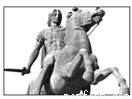
There is a very instructive incident involving the life of Alexander the Great, King of Greek. Alexander, after conquering many kingdoms, was returning home.

On the way, he fell ill and it took him to his death bed. With death staring him in his face, Alexander realized his conquests, his great army, his sharp sword and all his wealth were of no consequence. So, he lay helplessly waiting to breathe his last. He called his generals and said, “I will depart from this world soon, and I have three wishes. Please carry them out without fail.”

“My first desire is that,” said Alexander, “my physicians alone must carry my coffin.” After a pause, he continued, “Secondly, I desire that when my coffin is being carried to the grave, the path leading to the graveyard be strewn (撒满) with gold, silver and precious stones which I have collected.” The King continued, “My third and last wish is that both my hands should be kept hanging out of my coffin.” Alexander's favorite general kissed his hand and pressed them to his heart. “Oh King, we assure you that your wishes will all be fulfilled. But tell us why do you make such strange wishes?”

Alexander took a deep breath and said, “I would like the world to know of the three lessons I have just learnt. I want my physicians to carry my coffin because people should realize that no doctor can really cure any bodies. They are powerless and cannot save a person from the clutches of death. So let people not take life for granted.

“The second wish of strewing gold, silver and other riches on the way to the graveyard is to tell people that not even a bit of gold will come with me. I spent all my life earning riches but cannot take anything with me. Let people realize that it is just a waste of time to chase wealth.

“And about my third wish of having my hands hanging out of the coffin, I wish people to know that I came empty?handed into this world and empty?handed out of this world.” With these words, the King closed his eyes. Soon he let death conquer him and breathed his last.

1.The first paragraph suggests that Alexander ________.

A.was conquering many kingdoms

B.realized that what he got in his life was nothing to him at all

C.wanted to leave as he came empty?handed

D.regarded his conquests, his great army, his sharp sword and all his wealth as the most important things

2.The underlined word “clutches” in Paragraph 3 means “________”.

A.sentence B.attention

C.control D.shadow

3.The author intends to ________.

A.tell us the story of Alexander

B.introduce readers to the instructive lessons of Alexander

C.stress the power of Alexander the Great

D.persuade people to realize what Alexander said

4.What would be the best title for the passage?

A.The Death of Alexander

B.The Greed of Alexander

C.Three Wishes of Alexander

D.The Life of Alexander

Memory, they say, is a matter of practice and exercise. If you have the wish and really made a conscious(自觉的)effort, then you can quite easily improve your ability to remember things. But even if you are successful, there are times when your memory seems to play tricks on you.

Sometimes you remember things that really did not happen. One morning last week, for example, I got up and found that I had left the front door unlocked all night, yet I clearly remember locking it carefully the night before.

Memory “trick” work the other way as well. Once in a while you remember not doing something, and then find out that you did. One day last month, for example, I was sitting in a barber(理发师)shop waiting for my turn to get a haircut, and suddenly I realized that I had got a haircut two days before at the barber shop across the street from my office.

We always seem to find something funny and amusing(有趣的)in incidents caused by people’s forgetfulness or absent-mindedness. Stories about absent-minded professors have been told for years, and we never got tired of hearing new ones. Unfortunately, however, absent-mindedness is not always funny. There are times when “trick” of our memory can cause us great trouble.

1.If you want to have a good memory, .

A. you should force yourself to remember things

B. you should make a conscious effort of practice and exercise

C. you should never stop learning

D. you should try hard to remember tings

2.Which of the following statements is true according to the passage?

A. One night the writer forgot to lock the front door.

B. One night the writer forgot having locked the front door.

C. The writer remembered to lock the door.

D. the writer remembered unlocking the front door.

3.From the sentence “We never get tired of hearing new ones”, we can infer that .

A. we enjoy hearing new stories about absent-mindedness of professors

B. we don’t want to know anything more about absent-mindedness of professors

C. we will never get tired of listening to new stories about absent-mindedness

D. absent-mindedness happens not only to professors but to many other people

4.In the passage, the writer seems to tell you .

A. forgetting things is serious and dangerous

B. always forgetting things is understandable

C. forgetting things at times is natural

D. the way to protect yourself from memory “tricks”

5.The best title for this passage is .

A. How to Get a Good Memory

B.“Tricks”of Memory

C. Forgetfulness and absent-mindedness is Dangerous

D. Get rid of Absent-mindedness

违法和不良信息举报电话:027-86699610 举报邮箱:58377363@163.com

精英家教网