Wild animals seem to have escaped the Indian Ocean tsunami(海啸), adding weight to the idea that they possess a “sixth sense” for disasters, experts said on Thursday.Sri Lanka wildlife officials have said the giant waves that killed over 24,000 people along the Indian Ocean Island's coast seemingly missed wild beasts, with no dead animals found.
“No elephants are dead, not even a dead hare or rabbit.I think animals can sense disaster.They have a sixth sense.They know when things are happening,” H.D.Ratnayake, deputy director of Sri Lanka's Wildlife Department said on Wednesday.
The waves washed floodwaters up to 3 km(2 miles)inland at Yala National Park in the southeast, Sri Lanka's biggest wildlife reserve(自然保护区)and home to hundreds of wild elephants.“There has been a lot of evidence about dogs barking or birds migrating before volcanic eruptions or earthquakes.But it has not been proved,” said Matthew van Lierop, an animal behaviour specialist at Johannesburg Zoo.“There have been no specific studies because you can'treally test it in a lab or field setting,” he said.Other authorities agreed with this conclusion.“Wildlife seems to be able to pick up certain phenomenon, especially birds.There are many reports of birds detecting coming disasters,” said Clive Walker, who has written several books on African wildlife.
Animals certainly rely on the known senses such as smell or hearing to avoid danger such as predators(食肉动物).The idea of an animal's “sixth sense” is a lasting one that the evidence on Sri Lanka's damaged coast is likely to add to.
(1)
This passage is mainly about ________.
[ ]
A.
the damage that was caused in the Indian Ocean tsunami.
B.
why animals can save themselves from natural disasters.
C.
how to protect the wildlife when disaster happens.
D.
the different opinions about animals' natural power.
(2)
Which of the following is true according to the passage?
[ ]
A.
It has been proved that animals have a sixth sense.
B.
Research has been made on the special movements of animals before disasters.
C.
It's generally considered that animals can sense the coming of disasters.
D.
It can be tested that animals have the known sense to escape from the disasters.
(3)
What does the term “sixth sense” in the passage mean?
[ ]
A.
It is the natural ability of animals that can'tsave them from danger.
B.
It is the animal's imagination in the brain.
C.
It is some hidden power to say in advance that something will happen.
D.
It is a kind of sense that is the same as smell or hearing.
(4)
Which section does the passage most probably appear in a newspaper?
The days of the hunter are almost over in India.This is partly because there is practically nothing left to kill, and partly because some steps have been taken, mainly by banning tiger-shooting, to protect those animals which still survive.
Some people say that Man is naturally a hunter.I disagree with this view.Surely out earliest fordfathers, who at forst possessed no weapons, spent their time digging for roots, and were no doubt themselves often hunted by meat-eating animals.
I believe the main reason why the modern hunter kills is that he thinkds people will adminre his courage in overpowering dangerous animals.Of course, there are some who truly believe that the killing is not really the important thing, and that the chief pleasure lies in the joy of the hunt and the beauties of the wild countrysidel.There are also those for whom hunting in fact offers a chance to prove themselves and risk death by design;these men go out after dangerous animals like tigers, even if they say they only do it to rid the countryside of a threat.I can respect reasons like these, but they are clearly different from the need to strengthen your high opinion of yourself.
The greatest big-game hunters expressed in their writings something of these finer motives(动机).One of them wrote.
“You must properly respect what you are after and shoot it cleanly and on the animal’s own territory(领地).You must fix forever in your mind all the wonders of that particular day.This is better than letting him grow a few years older to be attacked and wounded by his own son and eventually eaten, half alive, by other animals, Hunting is not a cruel and senseless killing – not if you respect the thing you kill, not if you kill to enrich your memories, not if you kill to feed your people.”
I can understand such beliefs, and can compare these hunters with those who hunted lions with spears(矛)and bravely caught them by the tail.But this is very different from many tiger-shoots I have seen, in which modern weapons were used.The so-called hunters fired from tall trees or from the backs of trained elephants.Such methods made tigers seem no more dangerous than rabbits.
(1)
Theere is no more hunting in India now partly because ________.
[ ]
A.
it is dangerous to hunt there
B.
hunting is already out of date
C.
hunters want to protect animals
D.
there are few animals left to hunt
(2)
The author thinks modern hunters kill mainly ________.
[ ]
A.
to make the countryside safe
B.
to earn people’s admiration
C.
to gain power and influence
D.
to improve their health
(3)
What do we learn about the big-game hunters?
[ ]
A.
They hunt old animals
B.
They mistreat animals
C.
They hunt for food
D.
They hunt for money
(4)
What is the author’s view on the tiger-shoots he has seen?
[ ]
A.
Modern hunters lack the courage to hunt face-to-face
B.
Modern hunters should use more advanced weapons
C.
Modern hunters like to hunt rabbits instead of tigers
D.
Modern hunters should put their safety first
阅读理解
Wilderness
“In wilderness(荒野)is the preservation of the world.” This is a famous saying from a writer regarded as one of the fathers of environmentalism.The frequency with which it is borrowed mirrors a heated debate on environmental protection:whether to place wilderness at the heart of what is to be preserved.
As John Sauven of Greenpeace UK points out, there is a strong appeal in images of the wild, the untouched; more than anything else, they speak of the nature that many people value most dearly.The urge to leave the subject of such images untouched is strong, and the danger exploitation(开发)brings to such landscapes(景观)is real.Some of these wildernesses also perform functions that humans need-the rainforests, for example, store carbon in vast quantities.To Mr.Sauven, these ”ecosystem services” far outweigh the gains from exploitation.
Lee Lane, a visiting fellow at the Hudson Institute, takes the opposing view.He acknowledges that wildernesses do provide useful services, such as water conservation.But that is not, he argues, a reason to avoid all human presence, or indeed commercial and industrial exploitation.There are ever more people on the Earth, and they reasonably and rightfully want to have better lives, rather than merely struggle for survival.While the ways of using resources have improved, there is still a growing need for raw materials, and some wildernesses contain them in abundance.If they can be tapped without reducing the services those wildernesses provide, the argument goes, there is no further reason not to do so.Being untouched is not, in itself, a characteristic worth valuing above all others.
I look forwards to seeing these views taken further, and to their being challenged by the other participants.One challenge that suggests itself to me is that both cases need to take on the question of spiritual value a little more directly.And there is a practical question as to whether wildernesses can be exploited without harm.
This is a topic that calls for not only free expression of feelings, but also the guidance of reason.What position wilderness should enjoy in the preservation of the world obviously deserves much more serious thinking.
(1)
John Sauven holds that ________.
[ ]
A.
many people value nature too much
B.
exploitation of wildernesses is harmful
C.
wildernesses provide humans with necessities
D.
the urge to develop the ecosystem services is strong
(2)
What is the main idea of Para.3?
[ ]
A.
The exploitation is necessary for the poor people.
B.
Wildernesses cannot guarantee better use of raw materials.
C.
Useful services of wildernesses are not the reason for no exploitation.
D.
All the characteristics concerning the exploitation should be treated equally.
(3)
What is the author's attitude towards this debate?
[ ]
A.
Objective.
B.
Disapproving.
C.
Sceptical.
D.
Optimistic.
(4)
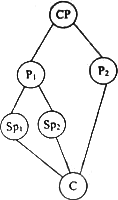
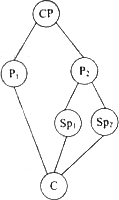
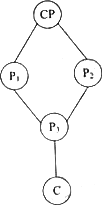
Which of the following shows the structure of the passage?
(CP:Central Point P:Point Sp:Sub-point(次要点) C:Conclusion>