题目内容

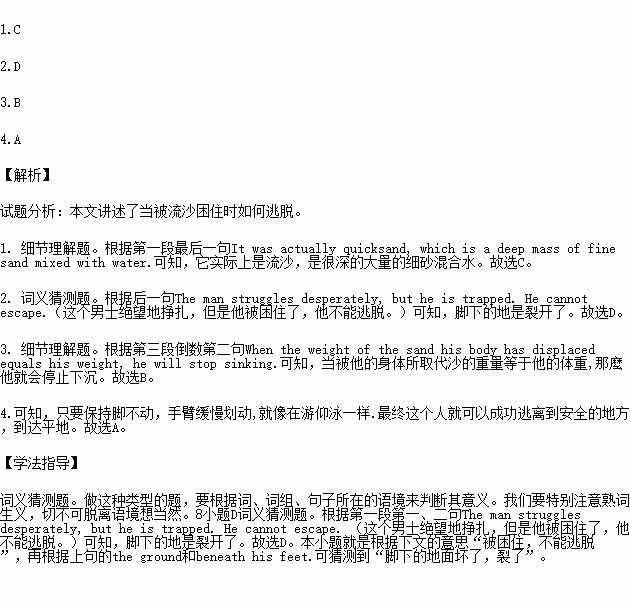
A man steps on what seems like solid ground but discovers with horror that the ground is giving way beneath his feet. The man struggles desperately, but he is trapped. He cannot escape. Slowly he sinks deeper and deeper until at last he is gone, buried in the treacherous earth. The solid ground was solid only in appearance. It was actually quicksand, which is a deep mass of fine sand mixed with water.

How is quicksand formed? Water pushes up from below the surface and is held by the sand. The grains of sand are forced apart by the water. They cannot hold any weight. The subsurface water may have come from a spring, a river or a stream. Sometimes pools of water near beaches become filled with sand. When the soil under these pools does not allow for good drainage(排水), the sand can become stretches of quicksand.

Is it true that a man who steps into quicksand is doomed to(注定) die? No, for men have fought their way from quicksand to firm land again. It is panic(恐慌) that creates the condition that can result in death, for the more a person struggles, the worse matters become. Quick movements will make the sand give way temporarily(临时地), but then it rushes and settles solidly around the body. A man trapped in quicksand should either lie back, or not move at all, except to stretch out his arms. When the weight of the sand his body has displaced equals his weight, he will stop sinking. With feet held still, and with slow movements of the arms, as in the backstroke in swimming men can manage to roll to safety and reach firm ground.

1.What is quicksand?

A. A piece of solid ground mixed with water.

B. A pool near the beach filled with water.

C. A deep mass of fine sand mixed with water.

D. A piece of sinking land in the water.

2.The underlined part “giving way” in the first paragraph probably means ________.

A. shaking and moving

B. allowing others to be first

C. rising to the top

D. breaking or breaking into pieces

3.A person stops sinking when the weight of his body is ________ that of the sand his body has displaced.

A. greater thanB. the same as

C. half ofD. close to

4.Men can manage to reach firm ground by ________.

A. holding feet still and moving arms slowly

B. lying back calmly and moving arms frequently

C. stretching out arms and swimming quickly

D. swimming quickly and moving arms slowly
练习册系列答案
相关题目

阅读下面短文,掌握其大意,然后从各题所给的A、B、C、D四个选项中,选出最佳选项。

In our modern world, when something wears out, we throw it away and buy a new one. The is that countries around the world have growing mountains of because people are throwing out more rubbish than ever before.

How did we _ a throwaway society? First of all, it is now easier to _ an object than to spend time and money to repair it. _ _ modern manufacturing (制造业) and technology, companies are able to produce products quickly and inexpensively. Products are plentiful and _ _.

Another cause is our of disposable (一次性的) products. As people, we are always looking for _ to save time and make our lives easier. Companies thousands of different kinds of disposable products: paper plates, plastic cups, and cameras, to name a few.

Our appetite for new products also to the problem. We are _ buying new things. Advertisements persuade us that _ is better and that we will be happier with the latest products. The result is that we _ _ useful possessions to make room for new ones.

All around the world, we can see the _ _ of this throwaway lifestyle. Mountains of rubbish just keep getting bigger. To the amount of rubbish and to protect the _ __, more governments are requiring people to recycle materials. _ , this is not enough to solve our problem.

Maybe there is another way out. We need to repair our possessions throwing them away. We also need to rethink our attitudes about _ . Repairing our possessions and changing our spending habits may be the best way to reduce the amount of rubbish and take care of our environment.

1.A. key B. reason C. project D. problem

2.A. gifts B. rubbish C. debt D. products

3.A. face B. become C. observe D. change

4.A. hide B. control C. replace D. withdraw

5.A. Thanks to B. As to C. Except for D. Regardless of

6.A. safe B. funny C. cheap D. powerful

7.A. love B. lack C. prevention D. division

8.A. sensitive B. kind C. brave D. busy

9.A. ways B. places C. jobs D. friends

10.A. donate B. receive C. produce D. preserve

11.A. adapts B. returns C. responds D. contributes

12. A. tired of B. addicted to C. worried about D. ashamed for .

13.A. newer B. stronger C. higher D. larger

14.A. pick up B. pay for C. hold onto D. throw away

15.A. advantages B. purposes C. functions D. consequences

16.A. show B. record C. decrease D. measure

17.A. technology B. environment C. consumers D. brands

18. A. However B. Otherwise C. Therefore D. Meanwhile

19.A. by B. in favour of C. after D. instead of

20.A. spending B. collecting C. repairing D. advertising

课文填空

A MASTER OF NONVERBAL HUMOUR

Not that Charlie’s own life was easy! He was born in a poor family in 1889. His parents were both poor music hall 1. . You may find it astonishing that Charlie was taught to sing as soon as he could speak and dance as soon as he could walk. Such training was common in acting families at this time, especially when the family income was often uncertain. Unfortunately his father died, leaving the family even 2. off, so Charlie spent his childhood looking after his sick mother and his brother. By his teens, Charlie had, through his humour, become one of the most popular child actors in England. He could 3. and act the fool doing ordinary everyday tasks. No one was ever bored watching him — his subtle acting made everything entertaining.

COMMUNICATION: NO PROBLEM?

The first person to arrive was Tony Garcia from Colombia, 4. followed by Julia Smith from Britain. After I met them and then introduced them to each other. I was very surprised. Tony approached Julia, 5. her shoulder and kissed her on the cheek! She stepped back appearing surprised and put up her hands, as if in defence. I guessed that there was probably a major misunderstanding. Then Akira Nagata from Japan came in smiling, together with George Cook from Canada. As they were introduced, George reached his hand 6. to the Japanese student. Just at that moment, however, Akira bowed so his nose touched George’s moving hand. They both apologized — another cultural mistake!

THEME PARKS — FUN AND MORE THAN FUN

The theme park you are probably most familiar with is Disneyland. It’ll be found in several parts of the world. It will bring you 7. a magical world and makes your dreams come true, whether you are travelling through space, visiting a pirate ship or meeting your favorite fairy tales or Disney cartoon character. As you wander around the fantasy 8. park, you may see Snow White or Mickey Mouse in a parade or on the street. Of course Disneyland also has many exciting rides, from giant swinging ships to terrifying free-fall drops. 9. all these attractions, no 10. tourism is increasing wherever there is a Disneyland. If you want to have fun, come to Disneyland.

September is an exciting month in every college freshman’s life. For many, it’s the first time that they’ve left home to live in a new environment. But after the hustle and bustle (喧嚣) of a few weeks, excitement gives way to a less enjoyable emotion—homesickness.

Homesickness manifests (显露) itself in many ways. You may miss mum’s cooking, your pets, or even your old bed. All this becomes a fond memory of the past. Homesickness can be a bitter feeling for many students, especially when faced with the challenges of settling into an unfamiliar environment.

But remember, you’re not alone. According to a recent BBC article, 70 percent of British college students experience homesickness. In this increasingly globalized world in which people migrate to faraway places for a relationship, education or work, homesickness is a feeling shared by many adults.

Homesickness can have similar symptoms to depression and in extreme cases it can develop into a panic attack. As for the term, homesickness or nostalgia wasn’t invented until the 17th century. It was considered a disorder by a Swiss physician, who attributed soldiers’ mental and physical discomfort to their longing to return home, “nostos” from Greek, and the accompanying pain, “algos”.

Studies in recent years, however, have shown that nostalgia may have some benefits to our mental health. After a decade of surveys and researches, Constantine Sedikides, a US social psychologist, found that nostalgia is what makes us human. He explains that nostalgia can resist loneliness, boredom and anxiety. Therefore, it’s necessary for college students to learn some ways to overcome the uncomfortable feeling.

1.From the first two paragraphs, we can infer that ________.

A. homesickness means a fond memory of the past

B. only a few students will experience homesickness

C. homesickness is an enjoyable emotion among freshmen

D. college freshmen usually suffer from homesickness after weeks

2.According to the passage, we can know that ________.

A. homesickness may cause mental diseases

B. homesickness is a feeling only shared by adults

C. homesickness won’t do any good to our health

D. homesickness is also called nostalgia in Switzerland

3.The attitude of Sedikides towards homesickness is ________.

A. negativeB. supportiveC. doubtfulD. critical

4.What is the best title for the passage?

A. Let’s accept homesickness

B. How to fit in with the college life

C. A harmful emotion—homesickness

D. The disadvantages of homesickness

阅读下面短文,掌握其大意,然后从各题所给的A、B、C、D四个选项中,选出最佳选项。

Last March my dad told us that there was a chance he would be deployed (部署,派遣)overseas. My brother and I didn't think anything of it and forgot his ________. Two weeks later, Dad didn't come home on time. We didn't think it was serious ________ it wasn't the first time. We waited, and ________ at midnight Dad came in. We asked where he'd been. He just ________, “I am leaving tomorrow for Afghanistan(阿富汗).”

Hearing that, we were in ________, thinking that this could not be happening to us. But when he started ________ his desert uniforms we knew it was for real.

He sat us all down and my brothers and I had a discussion about ________ we were going to do while he was away. And then we ________ and helped him get ready. We ________ his uniforms and talked more about what we needed to do. We didn't get to sleep ________ 4 a.m. Therefore, my dad called school to ________ we were not going to be there that day.

We took off for Madison ________ he would check in and get ready to leave. When we got there the official told us that he ________ leave until 5 p.m. We had our last ________ together and then headed to the airport. We were told it was time to leave. We hugged him and said ________.

“________ is going to happen to me, and I love you,” he said. Then he was ________. We left the airport not saying anything to each other.

My dad is ________ gone, and he won't be home for a while. He talks to us ________ on the phone. I hope that my story makes you think about your own family now and what ________ to you.

1.A. promiseB. wordsC. birthdayD. appointment

2.A. whenB. thoughC. thatD. since

3.A. finallyB. graduallyC. constantlyD. actually

4.A. whisperedB. weptC. repliedD. screamed

5.A. excitementB. shockC. reliefD. peace

6.A. packingB. wearingC. searchingD. mending

7.A. howB. whenC. whetherD. what

8.A. woke upB. cheered upC. stayed upD. turned up

9.A. removedB. ironedC. sewedD. chose

10.A. untilB. overC. inD. after

11.A. confirmB. announceC. denyD. explain

12.A. whenB. thatC. whereD. why

13.A. couldn’tB. wouldn’tC. needn’tD. mustn’t

14.A. mealB. weekendC. talkD. lesson

15.A. apologyB. helloC. thanksD. good-bye

16.A. AnythingB. EverythingC. NothingD. Something

17.A. missingB. goneC. lostD. puzzled

18.A. stillB. evenC. everD. yet

19.A. seriouslyB. frequentlyC. loudlyD. occasionally

20.A. belongsB. appealsC. countsD. happens

违法和不良信息举报电话:027-86699610 举报邮箱:58377363@163.com

精英家教网