题目内容

请根据表格的内容提示,写一篇题为SAVE EARTH, SAVE US的公益广告解说词。
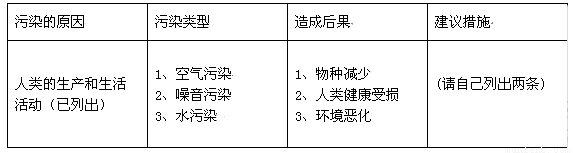
注意:1. 词数:120词左右;

2.内容要涵盖上面所列的几条;

3.不能逐词翻译。

With the development of modern society, pollution caused by human activities is becoming a mere and more serious problem.


SAVE EARTH, SAVE US

With the development of modern society, pollution caused by human activities is becoming a more and more serious problem.

Smoke from factories and gases from vehicles are the main reasons for air pollution. Rivers are polluted when people throw waste into them, or when factories pour waste water into them. Modern lifestyle and modern ways of production also cause noise pollution. As a result, many species are dying out. More and more people are suffering from health problems.

Enough attention should be paid to this problem and measures should be taken. Firstly, we should make laws to prevent factories from pouring waste water into rivers and sending smoke into the air without being dealt with. Secondly, we should raise people’s awareness of the serious problem and call on more people to protect the environment. Only by working together can we help the environment!

【解析】

试题分析:根据表格内容用英语表述公益广告解说词,具体信息是以表格的形式给出,考点只需要适当串联即可,在写作的时候一定要使用合适的连接词来连接全文,让文章成为一个整体,同时要注意使用英语句型,也要使用倒装句,定语从句等特殊的句式来提高文章的多样性。如:Only by working together can we help the environment!还要用适当的关联词把句与句连起来,如:Firstly, Secondly等。关键是要点要全面覆盖,不能有遗漏和省略。写作的时候运用多种表达方式,让句子有变化。

【亮点说明】文中使用了非常好的短语和句子为文章增色不少,比如With the development of modern society, Enough attention should be paid to this problem, More and more people ,还运用了Only by working together can we help the environment!倒装句等等。并注意了句子的衔接如:As a result;Firstly,…Secondly,…等等。

考点:提纲作文。


练习册系列答案
相关题目

Today, we are talking about money. I can share a bit about my history with money and my new view when it comes to using green paper.

I made a web page with links to posts about our financial journey where you can look for more details of where we’ve been and how we got where we are now. It was a big part of my story in the past and was a huge part of our downsizing journey. We got out of debt and stayed out of debt.

So I feel eager to share the benefits of being on this side. It takes planning and more careful thought whenever a dollar is spent now than it did when I had a wallet full of credit cards. I now like to think all of my dollars having a job. So many of us work for money and don’t consider that money should work for us, too. Make your dollars do the job of helping you live the life you want.

Each time money is spent or saved, it should be going toward something that you purposefully want for your life. Last week I was out and I spent $20 on food in 3 days. It made me angry because afterward I thought about eating is not at all what for my life.

On the other hand, there are times I spend $20 while out with my family and it doesn’t bother me one bit. An afternoon out with my kids during which we stop for ice cream, and do something fun together has a completely different feel to it.

In the end, I want the dollars I spend to have purpose like I can enjoy life while still planning and saving for the future.

1.What do the underlined words “green paper” in Paragraph I refer to ______.

A. money B. work C. newspaper D. book

2.You can learn about the writer’s history with money ______.

A. by making a web page

B. by reading posts about their financial journey

C. by going on a financial journey

D. by writing to him

3.In the writer’s opinion, ________.

A. more credit cards should be used in our daily life

B. we should work hard to make more money

C. money should help us live better

D. saving money is very easy

4.Why did the writer feel happy with the money spent with his family?

A. Because the money is spent on food.

B. Because the money is spent in doing something fun.

C. Because eating is what he wanted for his life.

D. Because the money went toward something that he wanted for his life.


The deserts of the world are not all covered with sand. Many of them have surfaces of rock or clay or small stones. They are not flat, either. They often have high hills and deep valleys. There is some plants’ life in many parts of the desert. There is little rain in the desert, but it does fall often enough for most plants.

The deserts of the world are not uninhabited(not lived by people). People also live outside oases(绿洲), but these people are not farmers. They have camels, goats, donkeys, sheep, etc. These animals can live on the desert plants and do not need much water.

The people of the desert have to move constantly from place to place, they must always look for grass or desert plants for their animals. They usually live in tents. When there is no more food for their animals, they fold up their tents, pat them on their camels and donkeys, and move to another place. In good years, when there is enough food for their animals, they trade their skins and their goats and camel hairs with the people of oases for wheat and fruit. But in bad years, when there is not enough food for their animals, the people of the desert would attack the oases people. But they are also hospitable, no man in the desert would ever refuse to give a stranger food and water.

1. According to the passage, deserts are mostly made up of _______.

A. clay B. rock

C. stones D. sand

2.The underlined word “hospitable” has the meaning of being _______.

A. brave B. cruel

C. strange D. kind

3.In the desert _______.

A. it rains in spring only

B. there is some rain, but far from enough

C. it rains for a short time every month

D. the rainfall is just enough for the plants

4.People live _______.

A. only inside the oases

B. only outside the oases

C. both inside and outside the oases

D. in places with regular rainfalls

5.From the passage we know that life _______.

A. is hard in deserts B. is happy in deserts

C. is impossible in deserts D. in deserts is much better now


It was a sunny day. A city man was driving along a country road with a new wagon(马车)and a beautiful pair of horses. He didn’t pay a lot of   to where he was going. Pretty soon he  that he was lost, but he   to drive, expecting to re-find his way or to someone who could tell him how to get back to the .

    It was a long   road. For many hours he kept on driving. When it was almost ,he saw in a a tall farmer ploughing(犁地) the land. He stopped his   team of horses near the fence and called out,“Hello,farmer.”

    “Hello,yourself,”the farmer replied,   ploughing.

    “Where does the horse ?”he asked without knowing his language mistakes.

    “I haven’t seen it go anywhere. It  stays right where it is,”said the farmer, stopping his work.

    “How far is it to the next town?” said the city man,speaking a little .

    “Don’t know. I never it,” replied the farmer. By this time the city man was getting .“What do you know?You’re the biggest fool I  saw.”

      stopping, the farmer turned and looked for a long time   at the city man. Then he said,“Maybe I don’t know much.   I am a fool. But at least I’m not lost!”

1.A. signs         B. orders         C. attention       D. direction

2.A. realized      B. recognized     C. accepted        D. received

3.A. stopped       B. used           C. wanted          D. continued

4.A. miss          B. meet           C. look            D. lose

5.A. town          B. country        C. capital         D. village

6.A. lonely        B. busy           C. dirty           D. crowded

7.A. at noon       B. at night       C. raining         D. dark

8.A. truck         B. pile           C. field           D. store

9.A. strong        B. tired          C. weak            D. tiring

10.A. but           B. went on        C. stopped         D. still

11.A. go            B. lead up        C. get             D. show

12.A. always        B. often          C. sometimes       D. seldom

13.A. began         B. still          C. without         D. already

14.A. clearly       B. lower         C. more loudly     D. more politely

15.A. judged        B. measured        C. saw             D. studied

16.A. sad           B. lovely         C. friendly        D. angry

17.A. ever          B. often          C. even            D. never

18.A. Still         B. Not            C. With            D. Finally

19.A. gladly        B. immediately    C. in silence      D. excitedly

20.A. Really        B. Perhaps        C. Certainly       D. Fortunately


违法和不良信息举报电话:027-86699610 举报邮箱:58377363@163.com

精英家教网