题目内容

Security guard, truck driver, salesperson—year after year, these jobs appear on lists of the unhappiest careers. Although many factors can make a job unhappy, unusual hours, low pay, no chance for advancement — these three gigs stand out for another reason: a lack of small talk.

Psychologists have long said that connecting with others is central to well-being, but just how much conversation we require is under investigation. In one study, researchers eavesdropped(窃听) on undergraduates for four days, then cataloged each overheard conversation as either small talk (What do you have there? Popcorn?(Yummy!) or serious (So did they get divorced soon after?). They found that the second type related with happiness—the happiest students had roughly twice as many serious talks as the unhappiest ones. Small talk, meanwhile, made up only 10 percent of their conversation, versus almost 30 percent of conversation among the least content students.

However, don't just consider chat worthless yet. Scientists believe that small talk could promote linking. Chatting with strangers could brighten your morning. In a series of experiments, psychologists gave Chicago travelers varying directions about whether to talk with fellow train passengers something they typically avoided. Those told to chat with others reported a more pleasant journey than those told to enjoy your being alone or to do whatever they normally would. None of the chatters reported being rejected. And the results held for introverts(内向者) and extroverts(外向者) alike which makes sense, since acting extroverted has a positive effect on introverts.

Small talk can also help us feel connected to our surroundings. People who smiled at, made eye contact with, and briefly spoke with their Starbucks reported a greater sense of belonging than those who rushed through the business. Similarly, one not yet published paper found that when volunteers broke the silence of the Tate Modern to chat with gallery goers, the visitors felt happier and more connected to the exhibit than those who were not approached.

So go ahead, pry. Chitchat needn’t be idle. And nosiness isn’t all bad.

1.The author attributes the unhappiness felt by security guards, truck drivers and sales people to ________.

A. unusual hours and low pay

B. a lack of small talk

C. no chance for advancement

D. an absence of serious conversation

2.What was the conclusion of the study mentioned in the second paragraph?

A.Connecting with others is central to our well-being.

B.We require 30 minutes of conversation every day to be happy.

C.Serious conversation is linked to happiness.

D.Small talk cannot help make us feel happy.

3.The author used the Tate Modern example to demonstrate that ________.

A. connecting with others is key to our happiness

B. unserious conversation could promote bonding

C. small talk can help us feel connected to our surroundings

D. smiling can help people gain a great sense of belonging

4.Which of the following shows the development of ideas in this passage?
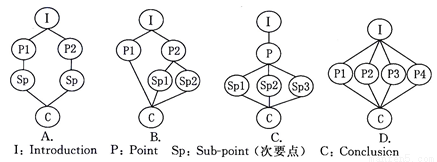
练习册系列答案
相关题目

请认真阅读下列短文,并根据所读内容在文章后表格中的空格里填入一个最恰当的单词。请将答案写在答题卡上相应题号的横线上。每个空格只填1个单词。

Some students get so nervous before a test, they do poorly even if they know the material. Sian Beilock has studied these highly anxious test-takers.

Sian Beilock: “They start worrying about the consequences. They might even start worrying about whether this exam is going to prevent them from getting into the college they want. And when we worry, it actually uses up attention and memory resources. I talk about it as your cognitive horsepower that you could otherwise be using to focus on the exam.”

Professor Beilock and another researcher, Gerardo Ramirez, have developed a possible solution. Just before an exam, highly anxious test-takers spend ten minutes writing about their worries about the test.

Sain Beilock: “What we think happens is when students put it down on paper, they think about the worst that could happen and they reappraise the situation. They might realize it’s not as bad as they might think it was before and, in truth, it prevents these thoughts from appearing suddenly when they’re actually taking a test.”

The researchers tested the idea on a group of twenty anxious college students. They gave them two short math tests. After the first one, they asked the students to either sit quietly or write about their feelings about the upcoming second test.

The researchers added to the pressure. They told the students that those who did well on the second test would get money. They also told them that their performance would affect other students as part of a team effort.

Professor Beilock says those who sat quietly scored an average of twelve percent worse on the second test. But the students who had written about their fears improved their performance by an average of five percent.

Next, the researchers used younger students in a biology class. They told them before final exams either to write about their feelings or to think about things unrelated to the test.

Professor Beilock says highly anxious students who did the writing got an average grade of B+, compared to a B- for those who did not.

Sain Beilock: “What we showed is that for students who are highly test-anxious, who’d done our writing intervention, all of a sudden there was no relationship between test anxiety and performance. Those students most prone to worry were performing just as well as their classmates who don’t normally get nervous in these testing situations.”

But what if students do not have a chance to write about their fears immediately before an exam or presentation? Professor Beilock says students can try it themselves at home or in the library and still improve their performance.

Title: Overcoming test 1.______________

Problem

Some students get nervous before a test, so they can’t do 2. __________ even if they know the material.

Reason

3.__________ about the consequences 4._________ them their attention and memory resources.

Solution

Write down their worries to 5.________ the negative thoughts appearing suddenly.

Results of the researches

College students: 6._______ with those sitting quietly, students writing about their fears improved their performance.

Younger students: highly anxious students who did the writing instead of 7._______ things unrelated to the test got 8. _______ grades.

9.___________ ways to solve the problem

If students have no 10.________ to write about their fears immediately, they can try it themselves at home or in the library.

阅读下面短文,从短文后各题所给的四个选项(A、B、C和D)中,选出可以填入空白处的最佳选项。

Long, long ago, there was a small village. This village had a(an) tradition. At the beginning of every year, any boy who had reached the age of majority (成年) was given land and money to build a home. The boy had to his home before winter. If his home failed to endure(忍耐) the cold weather in winter, the villagers could not him in any way.

One , Paul and Marc reached their majority. They their land and money and decided to search nearby villages for ideas on building their homes. In each village, they found the nicest and talked to the owners. Each owner gladly offered .

After Marc saw several homes, he the best ideas and went back to his own land. Paul, , continued collecting more ideas. Soon he had so many great ideas that he began to some of them. But he always believed he could find even better ideas in the next village.

Marc began building his home. He had several false starts, his home gradually rose from his land. By fall, Marc had finished his home. It wasn't perfect, but it was strong and he could it later. Paul enjoyed all the beautiful homes and with home owners. The first snow came and Paul, realizing he was running out of time, back to his land. He built the best home he could in the time he had, but it was . The first winter storm destroyed his home and he froze to .The villagers mourned for him.

Marc the winter. Each year, Marc searched for other good ideas he could use to make his own home look better. He became a leader in the village, a family, and lived a happy, content life.

We all build and improve our own mental homes. It's and fun for us to search for ideas from other mental home owners, but we only improve our own mental home if we actually the best ideas.

1.A. strange B. hopeful C. good D. reasonable

2.A. find B. run C. complete D. buy

3.A. help B. encourage C. scold D. persuade

4.A. winter B. summer C. autumn D. spring

5.A .exchanged B. received C. recognizedD. won

6.A. girls B. jobs C. houses D. presents

7.A. rooms B. drinks C. attention D. advice

8.A .expected B. gathered C. created D. understood

9.A. similarly B. finally C. however D. therefore

10.A. forget B. believe C. replace D. doubt

11.A. because B. although C. but D. so

12.A. repair B. rebuild C. sell D. improve

13.A. conversations B. achievements C. struggles D. arguments

14.A. drove B. rushed C. flew D. moved

15.A. weak B. funny C. small D. amazing

16.A. blindness B. death C. sadness D. disease

17.A. experienced B. hated C. survived D. spent

18.A. brought B. earned C. contacted D. raised

19.A. slow B. easy C. dangerous D. special

20.A. realize B. bring C. collect D. apply

根据短文内容,从短文后的选项中选出能填入空白处的最佳选项。选项中有两项为多余选项.

Everyone knows that good time management skills are important to students if they want to do well in school. _1.__ The skills listed below are quite important.

You should have the ability to say “no”. A party this weekend? A cool club to join? An overnight trip on Saturday? A quick pizza with your classmates that turns into three hours of just hanging out? Learning to say “no” can save you a lot of time. But it’s not easy to say “no”. You should develop some good skills in saying “no”. ___2.___

You shouldn’t spare time for all the fun activities. High schools are amazing because there is always something fun for you to take part in. Unfortunately, you cannot spend time on all of the fun activities. __3.___ You can go there when you finish your homework. In this way, you needn’t feel guilty about enjoying yourself.

_4.__ Some students like putting off things. This is a bad habit. You may end up with too many tasks one day. If you have a task, don’t wait to get started until the last week, because you may not know what to do at all if you have too many tasks and you may end up in crisis.

_5.__ Staying up a little too late? Maybe not eating a healthy dinner every night of the week? In order to keep in good health, you have to check on time so as to be energetic. Practicing a little self-care can really go a long way towards making sure you can have enough passion for your work with your limited time while in school.

A. Choose the one that you like most.

B. You should keep your health in check.

C. You should avoid putting off your tasks.

D. Try your best to get rid of your bad habits.

E. It is very good for your time management.

F. Here are some tips to help you learn to say “no”.

G. But what skills are needed for good time management?

阅读下面短文,从短文后各题所给的四个选项(A, B, C, D)中,选出可以填入空白处的最佳选项,并在答题卡上将该项涂黑。

Rolling, dark clouds covered much of the sky. The warm wind suddenly became cold and picked up wildly, sending some dead leaves flying ________ across the sky. A few drops of rain mixed with ice began to fall, then into heavy ________.

Doug, my older brother, and I first rode the bus to a bus stop. Then we ________ off and began our long walk home. The wind was ________ the snow around us like a huge blanket, making it ________ to see clearly. The only sounds we heard were the ________ of the wind as well as the crunch of our footsteps on the snow. Slowly but ________, my brother and I were ________ to death. Looking to my left, I saw a pine tree and squatted down.

“What are you doing here, Bud? Come on!” said Doug, “There’s no ________ behind this little tree. If we rest here, we will die from the freeze.”

“You go on, and I’ll ________ soon.” I replied.

Doug was ________ for a moment. Then he spoke, “Bud, do you remember the four pine trees at the side of the road? ________ we get there, we can rest a while and get warm. You just stick your hand down the back of my ________, keep your head down and hold on.”

As we struggled through the snow, my hand ________ from my brother’s belt and I fell to my knees.

“Where are the trees?” I said, as the snow ________ up around me like a feather bed. Once again, Doug pulled me to my feet.

“Just a few more ________ and we’ll be home and warm,” he said.

As the darkness closed around us, we approached home, ________. I only heard a worried shouting not in the distance. Then someone took my hand and ________ me into a warm, bright light. And then I survived.

Now, I still think about the lesson learned from our winter ________ story: Never ________, no matter what will happen.

1.A. slowlyB. gentlyC. peacefullyD. fiercely

2.A. snowB. stormC. smogD. fog

3.A. cameB. brokeC. showedD. got

4.A. meltingB. rollingC. pollutingD. clearing

5.A. difficultB. simpleC. availableD. likely

6.A. callB. shoutC. toneD. whistle

7.A. surelyB. carefullyC. secretlyD. hardly

8.A. scaringB. freezingC. fightingD. starving

9.A. attractionB. recreationC. protectionD. radiation

10.A. catch upB. fall behindC. look onD. hang around

11.A. braveB. silentC. proudD. confident

12.A. BeforeB. UnlessC. AlthoughD. When

13.A. dressB. bootC. beltD. coat

14.A. slippedB. brokeC. separatedD. shook

15.A. wentB. clearedC. mixedD. folded

16.A. stopsB. stepsC. milesD. blocks

17.A. discouragedB. dynamicC. unconsciousD. enthusiastic

18.A. persuadedB. followedC. forcedD. pulled

19.A. survivalB. travelC. explorationD. research

20.A. hold onB. took offC. give upD. set aside

违法和不良信息举报电话:027-86699610 举报邮箱:58377363@163.com

精英家教网