题目内容

For an artist who has no lack of passion and great courage to overcome any difficulty, inspirations of his art will never _______.

A. make out B. run out C. work out D. turn out


B

【解析】

试题分析:考查动词短语辨析。句意:对于一个不乏热情和克服困难的勇气的艺术家来说,艺术的灵感将是无穷无尽的。A辨认出,弄清楚;B用完,耗尽;C制定,计算出,锻炼;D结果是。故选B。

考点:考查动词短语辨析


练习册系列答案
相关题目

完形填空(共20小题;每小题1.5分,满分30分)

In a village near Nuremberg lived a family with eighteen children. Merely to keep food on the table, the goldsmith(金匠)father worked eighteen hours a day. Despite their condition, two of Durer's children had a dream to seek their talent for , but they knew 1well their father would never be able to send of them to Nuremberg to study at the Academy.

The two boys finally worked out an agreement. They would toss(扔) a coin. The _ would work in the nearby mines to support his brother. Albrecht Durer the toss and went off to Nuremberg. Albert went into the dangerous mines and, for the next four years, financed his brother, work at the academy was almost an success. Albrecht's woodcuts(木刻) and oils were better than those of his professors and he soon was earning considerable fees his works.

When the young returned home, the Durer family held a festive dinner. Albrecht rose to toast to his beloved brother, "Now, Albert, it is your to seek your dream. I will support you."

All heads turned to the far end of the table, where Albert sat, tears streaming down his pale face, while he and repeated, "No ...no." Finally, Albert rose and the tears from his cheeks. He said softly, "I go to Nuremberg, brother. It is too late for me. Look what four years in the mines have done to my hands! The bones in every finger have been smashed(猛击) at least once, and I cannot even hold a glass to your toast."

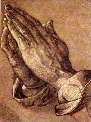
Today, Albrecht Durer's masterful works in every great museum in the world, but chances are great you, like most people, are familiar with only one of them. Albrecht Durer drew his brother's abused hands with palms together and thin stretched(伸展) skyward. He it "The Praying Hands."

Next time you see that touching creation, take a second look. Let it be your reminder, if you still need one, that no one ever makes it !


1.A. hopeful B. hopeless C. disappointed D. lucky

2.A. music B. art C. mining D. farming

3.A. all B. each C. both D. either

4.A. painter B. loser C. winner D. failure

5.A. lost B. got C. won D. beat

6.A. whose B. his C. whom D. who

7.A. casual B. immediate C. attractive D. ordinary

8.A. far B. quite C. very D. more

9.A. for B. to C. in D. at

10.A. miner B. artist C. worker D. professor

11.A. luck B. turn C. move D. moment

12.A. sobbed B. nodded C. smiled D. laughed

13.A. recovered B. wept C. wiped D. handed

14.A. can’t B. mustn’t C. can D. have to

15.A. hold B. return C. move D. turn

16.A. visit B. represent C. present D. hang

17.A. when B. that C. which D. as

18.A. figures B. hands C. fingers D. arms

19.A. said B. loved C. told D. called

20.A. alone B. out C. yet D. before


Wealth starts with a goal saving a dollar at a time. Call it the piggy bank strategy(策略). There are lessons in that time-honored coin-saving container.

Any huge task seems easier when reduced to baby steps. I f you wished to climb a 12,000-foot mountain, and could do it a day at a time, you would only have to climb 33 feet daily to reach the top in a year. If you want to take a really nice trip in 10 years for a special occasion, to collect the $15,000 cost, you have to save $3.93 a day. If you drop that into a piggy bank and then once a year put $1,434 in a savings account at 1% interest rate after-tax, you will have your trip money.

When I was a child, my parents gave me a piggy bank to teach me that, if I wanted something, I should save money to buy it. We associate piggy banks with children, but in many countries, the little containers are also popular with adults. Europeans see a piggy bank as a sign of good fortune and wealth. Around the world, many believe a gift of a piggy bank on New Year’s Day brings good luck and financial success. Ah, but you have to put something in it.

Why is a pig used as a symbol of saving? Why not an elephant bank, which is bigger and holds more coins? In the Middle Ages, before modern banking and credit instruments, people saved money at home, a few coins at a time dropped into a jar or dish. Potters(制陶工) made these inexpensive containers from an orange-colored clay(黏土) called “pygg,” and folks saved coins in pygg jars.The Middle English word

for pig was “pigge”. While the Saxons pronounced pygg, referring to the clay, as “pug”, eventually the two words changed into the same pronunciation, sounding the “i” as in pig or piggy. As the word became less associated with the orange clay and more with the animal, a clever potter fashioned a pygg jar in the shape of a pig, delighting children and adults. The piggy bank was born.

Originally you had to break the bank to get to the money, bringing in a sense of seriousness into savings. While piggy banks teach children the wisdom of saving, adults often need to relearn childhood lessons. Think about the things in life that require large amounts of money--- college education, weddings, cars, medical care, starting a business, buying a home, and fun stuff like great trips. So when you have money, take off the top 10%, put it aside, save and invest wisely.

1.What is the piggy bank strategy?

A. Paying 1% income tax at a time.

B. Setting a goal before making a travel plan.

C. Aiming high even when doing small things.

D. Putting aside a little money regularly for future use.

2.Why did the writer’s parents give him a piggy bank as a gift?

A. To delight him with the latest fashion.

B. To encourage him to climb mountains.

C. To help him form the habit of saving.

D. To teach him English pronunciation.

3.What does then underlined word “something”(Paragraph 3) most probably refer to?

A. Money B. Gifts

C. Financial success D. Good luck

4.The piggy ban originally was _________.

A. a potter’s instrument B. a cheap clay container

C. an animal-shaped dish D. a pig-like toy for children

5.The last paragraph talks about ________.

A. the seriousness of educating children

B. the enjoyment of taking a great trip

C. the importance of managing money

D. the difficulty of starting a business


违法和不良信息举报电话:027-86699610 举报邮箱:58377363@163.com

精英家教网